

From seminary to Oxford to Parliament: Mtumbuka tells Malawian students to embrace failure
Rumphi Central MP (UTM Party) Dr Matthews Mtumbuka has urged Malawi university students to treat failure not as something to fear but as an integral part of the path to success, drawing on his own winding journey from a rural upbringing to Oxford and eventually Parliament.
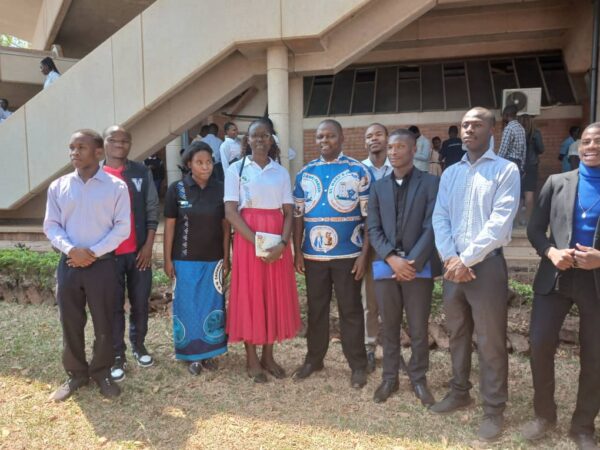
Speaking on Sunday at a gathering of the National Movement of Catholic Students in Malawi (NMCS Pax Romana Malawi), held at the University of Malawi (UNIMA) to mark the movement’s 70th anniversary in Africa, Mtumbuka, a UTM presidential running mate, told students to believe in themselves and make the most of whatever opportunities came their way, regardless of background.
He structured his address around three themes: that students are chosen to serve, that success is a choice, and that faith guides everything, before turning to his own life story as evidence that determination and faith can outweigh circumstance.
“I wanted you as young men and women to be inspired and to believe that no story of success is impossible,” he told the gathering.
Mtumbuka recounted growing up the son of two rural primary school teachers in Rumphi, and enrolling at St Patrick’s Seminary with ambitions of becoming a priest before changing course to study engineering at what was then the Polytechnic, now the Malawi University of Business and Applied Sciences (MUBAS).
There, he served as president of the engineering students’ body in his second year and as Students Union President in his fourth, before founding a renewable energy NGO in his final year and going on to win a Rhodes Scholarship to Oxford, where he completed a PhD at 27, making him the youngest Malawian to hold a doctorate at the time.
He went on to work for Shell Oil in Scotland before returning to Malawi in 2009 to join Malswitch, now NITEL, a decision he said was driven by a wish to serve his country.
He later spent eight years at Airtel, with postings in Rwanda and Kenya, before leading two international engineering and IT companies in Malawi and retiring early in 2023 to found his own firm, which now employs more than 80 people.
Mtumbuka entered politics in 2024 following the death of former vice-president Saulos Chilima, and told students that setbacks along the way are inevitable, citing his own defeat in the 2025 presidential election as running mate to Dalitso Kabambe before winning the Rumphi Central parliamentary seat in a by-election in March 2026.
“Failure is a stepping stone for success. Those who fear failure, fear success,” he said, adding: “Those who are afraid of failure do not have enough desire for success.”
He urged students to commit fully to even the most modest starting points.
“You may start as an intern. Work as the most hardworking person your boss has ever seen. You may start to work as a volunteer, let everyone be ashamed to let you go without giving you the full time job.
“You may start with the smallest of tiny businesses, but work like a donkey and with passion more than the passion Ronaldo has for football and slowly the world will smile at you,” he said.
Turning to the issue of graduate unemployment, Mtumbuka appealed to government to expand job creation through mining, manufacturing and export industries, and to explore labour export partnerships with countries facing skilled labour shortages.
“With the excess graduates that we have, government should also partner with countries in need of skilled labour to send our young people there for white collar jobs,” he said.
He encouraged students to begin small, through internships, volunteering or modest businesses, citing two Malawian science students who began as volunteer researchers at the Wellcome Trust in the early 2000s and have since become professors.
He also urged students to maintain good health, stay positive, remain organised, surround themselves with supportive people, and continuously develop their skills.
Success, he told the gathering, should be measured not only by personal achievement but by the capacity to serve others, a message organisers said was intended to inspire the next generation of Catholic students to carry the movement’s values forward as it marks seven decades since its founding in 1956.
Follow and Subscribe Nyasa TV :