

Chakwera leads in rememberance of Kamuzu: Malawi founding president
Malawi Congress Party (MCP) president Lazarus Chakwera and his party alliance partners are leading commemorations to remember Ngwazi Hastings Kamuzu Banda, the founding president of Malawi who died in November 1997amid heightened tension ahead of the Constitutional Court sanctioned presidential election.


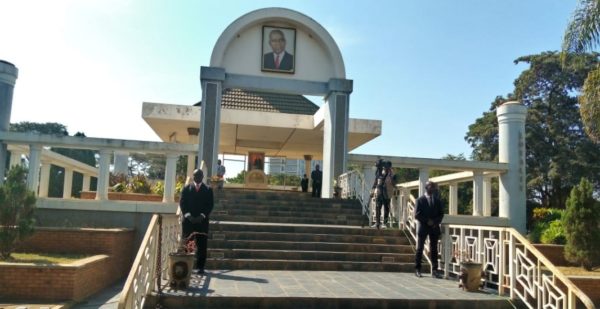
MCP’s major partner in the Tonse alliance Saulos Chilima, the country estranged vice-president also attended the commemorations at mausoleum in Lilongwe where Kamuzu—the country’s ruler from independence in 1964 to 1994—now rests.
Family members of the country’s founding president honoured him by laying wreaths at his mausoleum in the capital city while government officials and other political parties stayed away from the function.
Nephew to Kamuzu, Ken Kandodo remembered the founding president as selfless, who faced jail term just to give Malawi independence.
“Kamuzu loved his country, this is why he developed the country to this level,” said Kandodo.
Political commentator Wiseman Chijere Chirwa said Kamuzu Day holiday is vital because Kamuzu Banda remains relevant to Malawi.
“Kamuzu did not only bring us the independence but appointed people in public positions on merit. He gave people responsibilities on merit,” said Chirwa.
Minister of Information Mark Botomani said the government recognises the great job Kamuzu Banda did to Malawi as the first Head of State, saying this is why the government set aside May 14 as Kamuzu Day holiday.
However critics of Kamuzu say his legacy was tainted with his brutal regime, his iron fist rule, the killings of his political opponents, detention of his critics and forced gifts from poor people.
History of Kamuzu Day
Kamuzu Banda was born near Kasungu in Malawi (then British Central Africa). His date of birth is unknown, as it took place when there was no birth registration. Even though it was assumed he was born in March or April 1898, his official birthday was observed on May 14th.
After receiving much of his education overseas, Banda returned home (then British Nyasaland) to speak against colonialism and advocate independence.
Banda was formally appointed as prime minister of Nyasaland in 1963 and led the country to independence on July 6th 1964. He chose the name Malawi for the fledgeling nation, after the Maravi, an old name of the Nyanja people that inhabit the area.
Two years later he proclaimed Malawi a republic with himself as president. Under a new constitution, he consolidated power, making Malawi a one-party state under the Malawi Congress Party (MCP). In 1971, he became President for Life of Malawi.
Banda’s control over Malawi started to wane after the collapse of the Soviet Union. His vehement anti-communist stance had led to support from western countries. Those countries would only continue to give aid to Malawi if he implemented a series of reforms.
In 1993, mounting pressure from within and from the international community forced Banda to hold a referendum on whether to maintain the one-party state. The referendum resulted in 64% in favour of multiparty democracy. Banda ran in the first democratic presidential election in 1994 and was defeated by Bakil Muluzi.
Former president Bingu wa Mutharika’s administration reinstituted the Kamuzu Day on May 14 and scrapped off Freedom Day—the day the Bakili Muluzi administration set to reflect on the June 14 1993 National Referendum that ushered in multiparty democracy.
Banda died in South Africa on 25 November 1997, aged 98.
The prayers have been organised by the Nkhoma Synod of the CCAP.
Follow and Subscribe Nyasa TV :