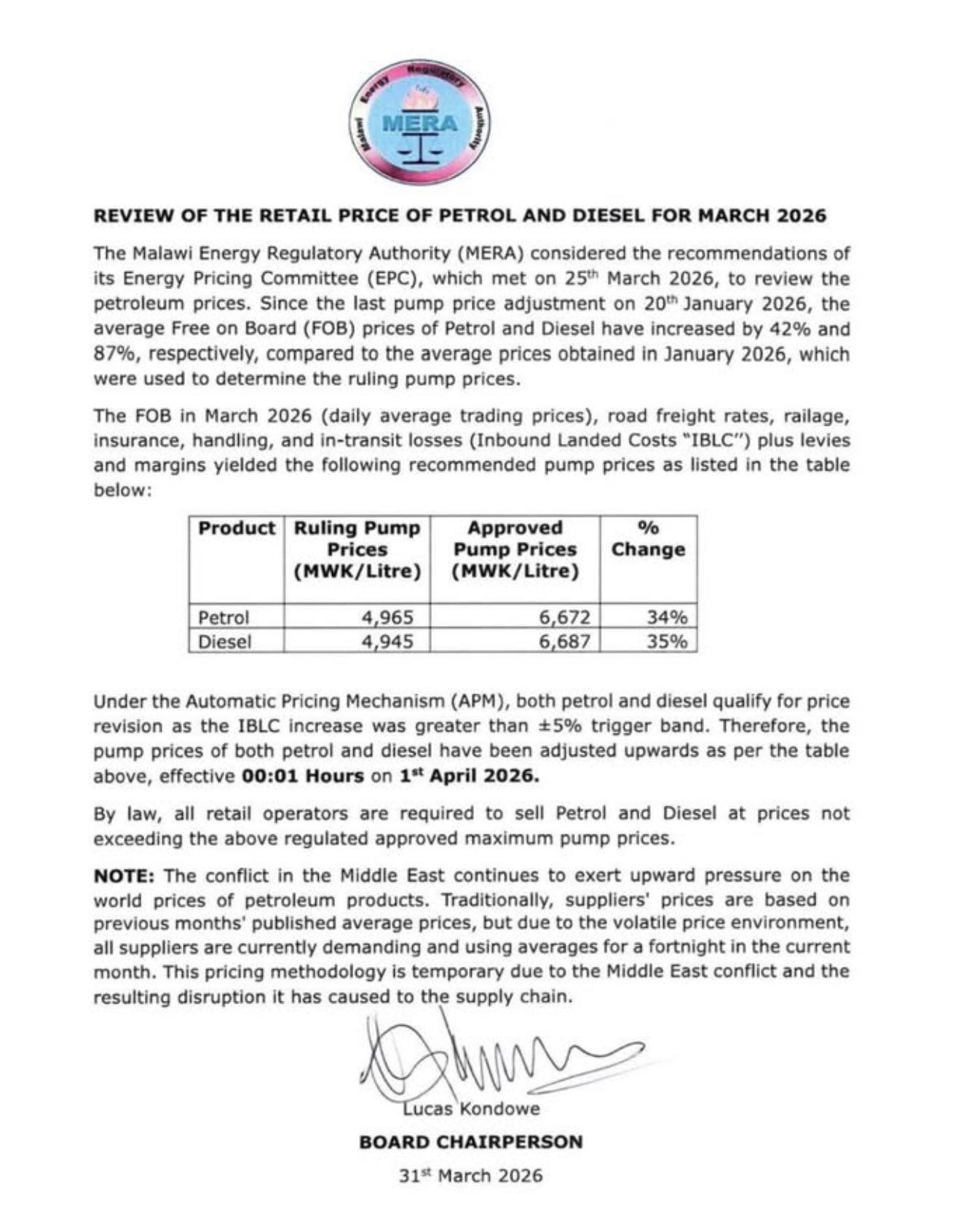
Malawi is reeling from yet another fuel price increase—the second in just eight months since the Democratic Progressive Party (DPP) returned to power—intensifying pressure on households and businesses already grappling with a fragile economy.
Screenshot
The latest adjustment, confirmed by authorities through a public notice on maximum pump prices, pushes petrol and diesel costs further upward, reinforcing a steady upward trend that has defined the fuel market since the change in administration.
While officials attribute the hike to global factors, including rising international oil prices and instability in the Middle East, critics argue the frequency and timing of the increases expose deeper structural weaknesses in Malawi’s economic management and foreign exchange position.
A note accompanying the price announcement explicitly links the adjustment to global pressures, stating that “the conflict in the Middle East continues to exert upward pressure on world prices of petroleum products,” a justification that has now become a recurring explanation with each revision.
This latest hike marks the second upward adjustment within eight months, a pace analysts say is unusually rapid and economically destabilising, particularly in a country where fuel costs directly affect transport, food prices, and overall inflation.
Economic observers note that fuel pricing in Malawi is highly sensitive to foreign exchange availability, import costs, and government policy decisions—factors that appear increasingly strained.
“This is no longer just about global oil prices,” said one economic analyst. “It reflects domestic vulnerabilities—especially forex shortages and policy inconsistency—which are now being passed directly to consumers.”
The immediate impact of the fuel increase is expected to cascade across the economy, triggering higher transportation costs, rising commodity prices, and increased cost of doing business.
Public transport operators are already adjusting fares, while traders warn of imminent price hikes on essential goods.
For ordinary Malawians, the consequences are stark.
“With each fuel hike, the cost of living rises sharply, but incomes remain stagnant,” said a Lilongwe-based vendor. “It becomes harder to survive.”
The back-to-back fuel increases are also fast becoming a political flashpoint, raising questions about the DPP administration’s economic strategy and its ability to stabilise prices.
Critics argue that while global factors are real, the government has failed to cushion citizens through proactive policy measures, including strategic fuel reserves, forex stabilisation, or targeted subsidies.
“There is a growing perception that government is reacting rather than managing the situation,” said another commentator. “People are feeling the impact directly, and patience is wearing thin.”
Malawi’s economy is heavily import-dependent, making fuel price stability critical. However, persistent forex shortages, rising import bills, and weak production capacity continue to undermine price control efforts.
As the second fuel increase in under a year takes effect, attention is now turning to whether further adjustments are imminent—and what that could mean for inflation, public confidence, and economic stability.
For now, the signal is clear: the cost of fuel is rising, and with it, the cost of living for millions of Malawians.