

Malawi Kwacha currency bucking the trend… for now
In the last six to eight months, most emerging and frontier currencies have weakened against the US dollar. One explanation is the likelihood of the US Federal Reserve raising rates at its September policy meeting, making US assets comparatively attractive. Meanwhile, the possibility of a ‘Grexit’ is exacerbating the need for investors to buy safe haven assets, of which dollar assets are among the most sought after.
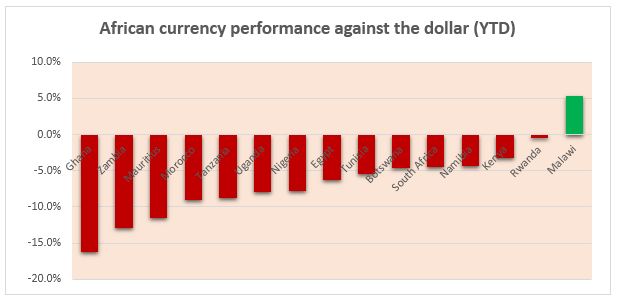
However, some EM currencies have bucked this trend. The Malawian kwacha is one. Indeed, it is the only African currency to have strengthened this year, as shown in the bar chart below:
For a country that is largely dependent on tobacco as its main export, one has to wonder why the Malawian kwacha has strengthened against the greenback.
Late last year the Reserve Bank of Malawi (RBM) took some aggressive steps to address what had been a persistent weakening of the currency. Firstly, it sold $200m of government securities to the Preferential Trade Area Bank, a regional development institution, to help shore up the central bank’s foreign reserves. Little was made known about the tenure and interest rate of the bonds, although it is known that they will be repaid in local currency.
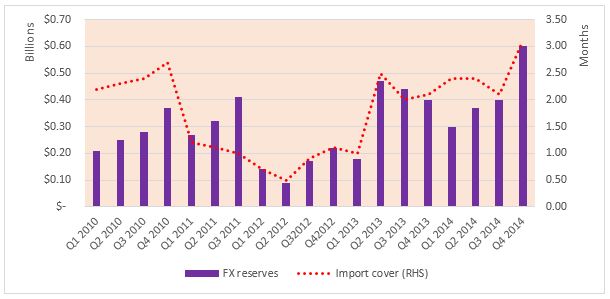
The jump in reserves to $646m in Q4 2014 represents an almost 50 per cent increase from the previous quarter, giving the RBM greater ability to supply the market with dollars. Unfortunately, this is a one-off increase and reserves will fall again when the bonds become due. It is likely that reserves will settle back to the $350m mark, giving import cover for just two months.
The second measure adopted by the RBM was allowing local banks to hold their reserve requirements in local currency, rather than in dollars as was previously the case, thus freeing up dollars within the financial system.
In addition, export proceeds from tobacco, together with relatively tight monetary policy, will help support the kwacha. However, we ask ourselves if this strength is likely to persist.
We believe that when the inevitable finally happens and the Fed raises rates, most currencies will gyrate in the short term. Despite the efforts of the RBM, the kwacha will feel the pinch. With limited options to fight a pending tidal wave of capital outflows, the sensible option would be for the RBM to maintain its tight monetary stance to at least limit the damage. However, this will be particularly challenging given this year’s delayed start to the rains and the floods that will likely weigh down on growth. It would be interesting to see if the RBM loosens the reins soon in anticipation of a hike in the last quarter of the year.
- Neville Mandimika is African macroeconomic equity strategist at Atria Africa, an asset management and corporate advisory firm focused on sub-Saharan Africa.