

UK grants Malawi £37 million for education expansion
The United Kingdom is to invest 37 million Pounds Sterling in the education sector in Malawi in a bid help the country expand access for more boys and girls to gain quality education.
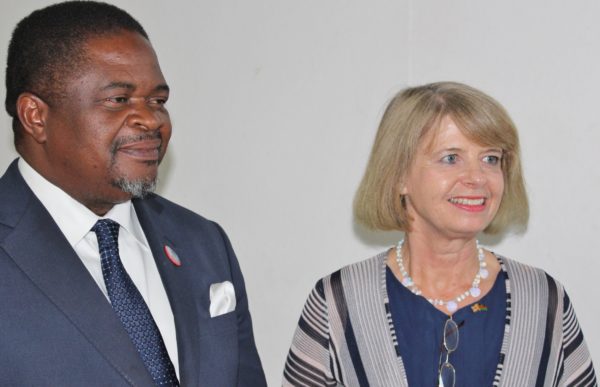
The UK’s Minister of State for Africa, Harriett Baldwin, made the announcement in Lilongwe on a recent visit to Malawi, enroute from the neighbouring state of Zambia, where she also signed a pact for UK’s commitment to support Malawi’s western neighbour in areas of clean and sustainable energy solutions to help prop up the country’s drive towards the ‘green transition’.
Baldwin broke the sweet news during her meeting with Minister of Education, Science and Technology, Bright Msaka, who welcomed the British politician to Malawi on behalf of State President, Prof. Arthur Peter Mutharika, who was away to South Africa for the BRICS summit.
Spread over a period of five years, the funds will be administered through UK’s Department for International Development (DfID), which is the largest UK government department operating in Malawi.
“By putting money in education of boys and girls, we are investing in the future of Malawi,” said Baldwin, who also discussed with Msaka how the two countries could deepen their cooperation on Malawi’s aspirations to achieve sustainable growth and prosperity.
While in the country, Baldwin was also expected to hold discussions with various other Government ministers, leaders of political parties and visit UK aid funded projects across the country.
On his part, Msaka conveyed Malawi’s gratitude to the British people for the continued support in different sectors, and assured the British Government that the resources will be used prudently to achieve greater success in the education sector.
“The funds will be used optimally to achieve the best results in education,” said Msaka, adding that education is central to the development of the country.
Malawi and Britain share a long and historical relationship, dating as far back as the 1800s when the British missionaries first came to Malawi and into successive years when Malawi—then known as Nyasaland—became one of Britain’s colonies out of Europe. Their bilateral relations were formalized in the early days of Malawi’s full independence in 1964.
Through the Department for International Development (DfID), Malawi has over the years enjoyed continued British support, which last financial year peaked at 80 million British Pounds.
Areas that have benefitted most from this funding are the Malawi Humanitarian Preparedness and Response Programme at 23.6 Pounds, Malawi Health Sector Support Programme at 14.1 million Poundsand Support to Family Planning in Malawi, which was funded to the tune of 11 million British Pounds.
Through British support, significant strides have also been made in Malawi in the areas of Governance and Security, Climate and Environment, Global Partnerships, and Human and Economic Development.
In education sector, DfID is assisting with construction of 28 primary schools at a cost of K6.3 billion kwacha. And in partnership with the United States Agency for International Development, DfID has provided technical and financial support for production and distribution of over 8 million text books for Standards 1-4 under the National Reading Program.
And working with the United Nations Children’s Fund and the Campaign for Female Education in Malawi (Camfed), the aid department is also involved in the provision of bursaries for female students as one way of promoting girl child education in the country.
According to available statistics, DfID has so far supported about 234, 000 children to gain decent education in Malawi.
Under other initiatives, Government through the Ministry of Education, Science and Technology, is increasing the number of school blocks to allow for increased enrolment, retention of learners, and provision of sanitation facilities in order to address some of the challenges that lead to dropout of girls in schools.
It is believed that keeping girls in school longer will also help to address issues of rapid population growth, apart from provision of family planning services
Follow and Subscribe Nyasa TV :