
INTERVIEW: Gothia Cup success opens European pathways for African talent, including Malawi
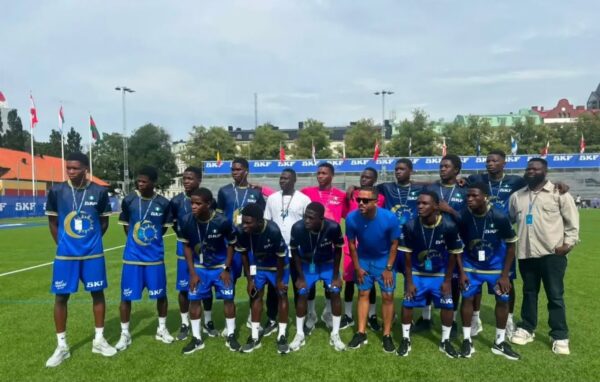
James Woods, the Malawian diplomat and Business of Sport expert, is part of the senior team at Inspire Academy, where he leads on international pathways, market development and strategic partnerships. He was in Gothenburg for this year’s Gothia Cup, where the academy’s young Nigerian side drew significant European attention. He spoke to Nyasa Times as the tournament concluded.

Q: Looking back now that the Gothia Cup has concluded, how would you assess the tournament for Inspire Academy?
I think it exceeded our expectations.
People naturally focus on results, but from our perspective the tournament was about much more than winning football matches. Gothia Cup is one of the biggest gathering points in world youth football. This year it brought together close to two thousand teams from seventy-eight countries, and over the course of a single week, thousands of players were watched by clubs, scouts, sporting directors and academy executives.
It is also worth saying that this was a strong tournament for Nigerian football more widely. Nigerian sides made a real mark in Gothenburg this year, and our players were part of that wider showing. To have these young Nigerians measured against the best youth talent in the world, and to come away with this level of interest, tells you where Nigerian football sits right now.
Our objective was twofold: perform on the pitch and create genuine opportunities for our players away from it. I believe we achieved both. These are young Nigerian players. The academy is based in Lagos but recruits from right across the country, and the football they produced demonstrated the quality within the academy, while our engagement with European clubs created opportunities that simply would not have existed a few months ago.
Q: What has been the biggest success story to come out of Sweden?
Without question, the level of European interest.
By the end of the tournament we had eight players attracting concrete interest from clubs and football organisations across six countries, spanning Sweden, Denmark, Portugal, France, Norway and Belgium.
Formal invitations and offers were being finalised before the squad departed Gothenburg.
What matters is where that interest came from. These are not lower-division sides. We are talking about top-flight clubs in each of those countries, and several of them are clubs competing for European football. That is the level at which our players were being assessed, and it tells us something important. European clubs were not simply impressed by one player. They recognised the overall quality of the academy.
There is also a story slightly apart from the tournament itself. One of our boys, Shedrack, was not part of the squad we took to Gothia because he had already been invited for trials at AIK, one of Sweden’s leading top-flight clubs. They had watched him, done their homework, and moved for him directly. That a club of that stature came looking for one of ours is exactly the kind of pathway we are working to build.
Q: Which clubs showed interest?
We engaged with a broad range of respected European clubs across six countries, and I would stress again that these are top-flight sides, several of them competing for continental football.
The conversations ranged from formal invitations and offers through to ongoing player monitoring and video analysis. Naturally we have to respect confidentiality while negotiations continue, but I can say that the level of engagement exceeded our initial expectations.
Q: Is this the beginning of a new recruitment model for Inspire Academy?
Absolutely. Modern football recruitment is changing. Clubs increasingly want direct relationships with credible academies rather than relying entirely on intermediaries. One of the strategic decisions we made was to engage clubs directly. That creates greater transparency, protects the interests of the players and gives the academy stronger control over long-term player development.
Our objective is not simply to complete transfers. It is to build sustainable international pathways that will benefit future generations of players.
Q: Several people have spoken about your role during the tournament. What exactly were you responsible for?
Before I answer that, let me be clear about where the credit belongs. The coaches and the technical staff are the heart of what happened in Sweden. They prepared these boys, they drilled them, they managed them through a demanding week, and they delivered the performances that everyone witnessed on the pitch.
And the players themselves were outstanding. They carried themselves with discipline and maturity well beyond their years, and they earned every bit of the attention that came their way. None of the conversations I had off the pitch would have been possible without what they did on it.
My own role was different. I focused on the strategic side of the tournament: building relationships with clubs, sporting directors, academy directors, recruitment managers and football executives across Europe, while helping position Inspire Academy internationally.
Football today is as much about relationships and trust as it is about talent. If those relationships are built properly, opportunities continue long after the final whistle. But that work only has something to sell because of the quality the staff and players put on show.
Q: Did anything surprise you during the week?
The speed at which interest developed.
Sometimes clubs monitor players for months before making contact. Here, conversations developed almost daily as performances continued. By the end of the tournament we had multiple live discussions progressing simultaneously. That reflects both the quality of the players and the professionalism with which the academy conducted itself throughout the week.
Q: What does this mean for African football more broadly?
African talent has never been the problem. Nigeria alone produces more gifted young footballers than most countries could dream of, and that talent is everywhere, not just in the big cities but in towns and villages right across the country. The challenge has always been creating structured pathways into the right football environments.
It is the same pattern I see in my wider work in minerals and investment. Too often Africa exports the raw material cheaply and imports the finished product at a premium, and a fifteen-year-old footballer can be treated no differently from a mineral. The value is captured somewhere else.
When academies become organised, professional and internationally connected, that begins to change and the opportunities increase dramatically.
I believe Inspire Academy is helping demonstrate what that model can look like. The aim is not simply to produce professional footballers. It is to build a sustainable bridge between African talent and European football, one where the institutions that develop these players share properly in what they go on to achieve.
Q: You are Malawian, yet much of this work is with clubs and academies elsewhere. Where does Malawi fit into all of this?
It is never far from my mind. I have spent a decade working across Europe, the Americas and Africa, with clubs, investors and federations, and the ambition has always been to bring what I learn out there back home.
I have tried to do that in concrete ways for some years now. Back in 2019, I managed the transfer of Yamikani Chester out of Be Forward Wanderers and into professional football in Europe and then the United States — one of the first Malawian players my team moved directly into the international market.
In 2023, I originated the partnership that put the Malawi, the Warm Heart of Africa tourism brand on the shirts of the Spanish La Liga club Leganés. Think of what Rwanda has done with this model. Arsenal wore Visit Rwanda on their sleeve for eight years, a deal that carried real weight because of the stature of that club, and today the brand is on Paris Saint-Germain and Atlético Madrid, and has just gone front-of-shirt at Aston Villa in one of the biggest tourism sponsorships in the English game.
Malawi was in this space early, with Leganés, but as a country we did not fully seize the moment or build on it the way Rwanda has. That is one of my regrets, and one of the things I want to put right.
More recently, I arranged a coaching attachment at Queens Park Rangers in London for Bob Mpinganjira, the head coach of Mighty Wanderers, so that a Malawian coach could spend real time inside the working environment of a professional English club — the conditioning, the sports science, the coaching detail at every age group.
Those are starting points, not endpoints. The honest truth is that some of what we have tried to do at home has been harder than it should be, because the dynamics were not always right at the time. But my appetite to do far more in Malawi has not changed. The key is working properly with the Football Association of Malawi and with serious investors who want to build something lasting. The talent at home is not in question. What we owe our young players is the structure around them. That is the work I most want to do.
The real work starts now. Interest is encouraging, but interest alone changes nothing.
Over the coming weeks we will continue formal discussions with clubs, evaluate every opportunity carefully and ensure each player is matched with the environment best suited to their long-term development. This tournament has given the academy significant momentum.
Now the focus is on converting that momentum into successful player pathways, long-term club partnerships and a model that continues to create opportunities for young African footballers for years to come.