

Prof Dzanja: Malawi’s agriculture is broken — sets out five-point fix
Newly crowned Professor Joseph Dzanja of the Lilongwe University of Agriculture and Natural Resources (LUANAR) has called for serious investment in agricultural marketing systems if Malawi is to realise its full agricultural potential.
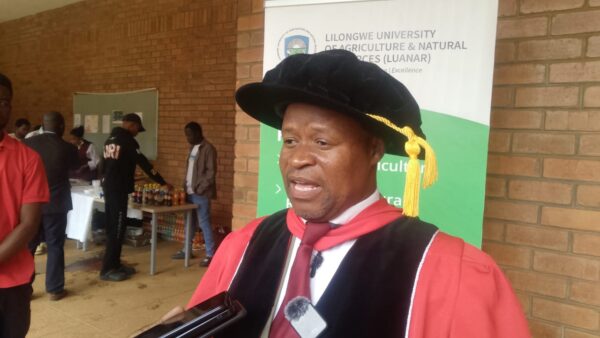
Professor Dzanja made the remarks on Thursday during his inaugural lecture as Professor at LUANAR, where he challenged policymakers, researchers and other stakeholders to rethink how agricultural markets are organised and supported in Malawi.
At the centre of his lecture was the argument that Malawi’s agricultural challenges are not only about production, but also about the systems that connect farmers to markets, consumers, processors and other actors along the agricultural value chain.
According to Professor Dzanja, the country’s market system is fragmented along five major dimensions: information, coordination, space, time and power.
On information, he said farmers and other market actors often lack timely and reliable data on prices, demand and market opportunities.
“This limits their ability to make informed production and marketing decisions,” he said.
On coordination, he said the absence of collective action among producers and other actors often leaves them with limited bargaining power and unable to take advantage of economies of scale when purchasing inputs or selling produce.
The third dimension, space, is characterised by a rural-urban disconnect, with many farmers operating far from major markets, processors and consumers.
He also discussed time, pointing to the seasonality of agricultural production and slow market adjustment, which can leave farmers facing periods of surplus immediately after harvest followed by shortages later in the year, contributing to price volatility and post-harvest losses.
The final dimension, power, reflects an asymmetry among actors in the market.
“Differences in access to information, finance, infrastructure and bargaining power can leave smallholder farmers in a weaker position when negotiating with other participants in the value chain,” he said.
Professor Dzanja argued that addressing these challenges requires Malawi to move towards what he described as a “coordinated systems market perspective.”
Under this approach, he said agricultural development should not focus on farmers or production in isolation, but should instead give attention to the entire market system and the relationships connecting producers, traders, processors, financial institutions, consumers, government and other stakeholders.
To activate this perspective, Professor Dzanja outlined five key areas Malawi needs to prioritise: investing in agro-processing and storage, strengthening farmer organisations, expanding affordable finance and insurance, improving rural infrastructure and logistics, and harnessing digital platforms.



I totally agree with Fletcher Tembo,,Malawi need to address political economy
Great observations, Prof Dzanja! But to be honest, these five dimensions are not new to Malawian scholars and policy makers. The main elephant in the room is our failure to deal with political economy factors such as rent seeking behaviour etc. The “coordinated market systems perspective” cannot work without unearthing these underlying historical realities, rules of the game and the power play among key actors. I am keen to dig these out with you Prof if you deem it necessary. I am also a Luanar alumni but branched out to study political economy of development, and worked on a number of such issues in Malawi and abroad. We should not be struggling this much as a country with this increasing population of excellent scholars in our Universities and think tanks. Something is definitely going amiss with the direction of travel, especially the difficult interfaces between development policies and practices.