

Portable water testing labs rolled out across Malawi to catch deadly cholera contamination BEFORE outbreaks strike
For millions of Malawians living in rural areas, the nearest water source is often little more than a borehole or shallow well — but simply having access isn’t enough.
Without knowing what’s actually in that water, entire communities remain dangerously exposed to cholera, diarrhoea and other waterborne diseases that claim lives every single year.
Now a new generation of portable water quality testing labs aims to close that deadly gap.
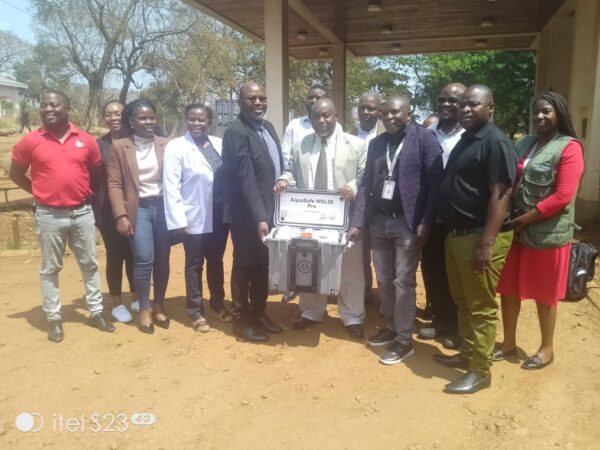
With financial backing from Charity Water, Self Help Africa (SHA) has been procuring the compact labs and distributing them to district councils as part of a wider push to strengthen water, sanitation and hygiene services across the country.
Speaking at the handover of equipment to Dowa District Council, District Commissioner James Jones Kanyangalazi said the donation arrives at a critical time, with waterborne diseases continuing to devastate rural communities.
“Most of our communities suffer from waterborne diseases because they don’t have tested water sources. Now, for us to verify or to know that, for example, a cholera outbreak has come from this area, we need to go to the area, test water bodies, and find out the quality,” Kanyangalazi said.
He explained that with the new portable lab, the council can now confirm within just hours whether water from a newly drilled borehole is safe to drink.
“No water source will be provided to the community without testing. Anything that will be provided to the community is of good quality, safe for drinking and good for purpose,” he added.
Dowa has already made significant strides in water provision, with coverage now sitting at roughly 78 to 80 percent for clean, safe drinking water district-wide — though the DC admitted coverage plunges to as low as 50 percent in some harder-to-reach areas.
At national level, government insists Malawi remains on track to meet Sustainable Development Goal 6, which targets universal access to safe, clean water by 2030, according to Peter Chipeta, Deputy Director responsible for Water Supply in the Ministry of Agriculture, Irrigation and Water Development.
Chipeta explained that urban areas typically rely on water boards, while rural communities depend heavily on boreholes and piped water supply schemes.
“We have several programs which are looking at trading centres. We want to make sure that the trading centre in a district must look as urban as possible. They must have at least safe drinking water from the tap,” he said.
He revealed a policy shift is now underway to install dedicated solar-powered piped systems directly onto boreholes, sparing residents the burden of walking long distances simply to fetch water.
However, Chipeta acknowledged a troubling gap in the system.
“Another concern has been lack of capacity by the ministry and councils to test water that people, especially those living in rural communities, are drinking,” he admitted, explaining that the portable lab donated to Dowa will allow the district to identify contamination quickly, without waiting for samples to be sent all the way to the Central Water Quality Lab in Lilongwe.
“For example, if there are any cases of diarrhea, the district will be able to check what are the sources of the contaminants in water or in advance, and make necessary remedial measures even before headquarters comes into play,” he said.
The ministry will work closely with the council to train and support dedicated staff to manage the new lab, with results also shared with the national laboratory for verification.
“This will help to identify possible sources of contaminations within the council and identify possible solutions to these contaminants,” Chipeta said.
SHA Deputy Country Director Smorden Tomoka revealed the organisation has been working with Dowa and Thyolo District Councils since 2011 to improve access to water, sanitation and hygiene.
“Through our ongoing interactions with the district council, we did observe that there was a gap in terms of the water testing kit, and we thought we need to come in and support to address the gap,” Tomoka said.
The donation forms part of SHA’s broader system-strengthening approach, which goes well beyond simply drilling boreholes to include rehabilitation, sanitation support, behaviour change initiatives, and now, crucially, water quality monitoring.
In Dowa alone, SHA is currently operating across seven Traditional Authorities, reaching over 300,000 people through water points it has either constructed or rehabilitated, out of a total district population estimated at 900,000.
Tomoka confirmed the organisation has a multi-year plan to eventually reach everyone, everywhere, and hopes to scale the water quality testing model to other districts across Malawi with further donor support.
Health experts warn that contaminated water remains a leading cause of child mortality in Malawi, with cholera outbreaks in recent years repeatedly traced back to unsafe water sources, particularly during the rainy season.
Follow and Subscribe Nyasa TV :