

Africa’s farming future: Malawi and Nigeria to share biotechnology lessons
AfSTA webinar on 8 September brings together seed industry leaders to examine biotechnology commercialisation, regulation and public awareness across the continent.
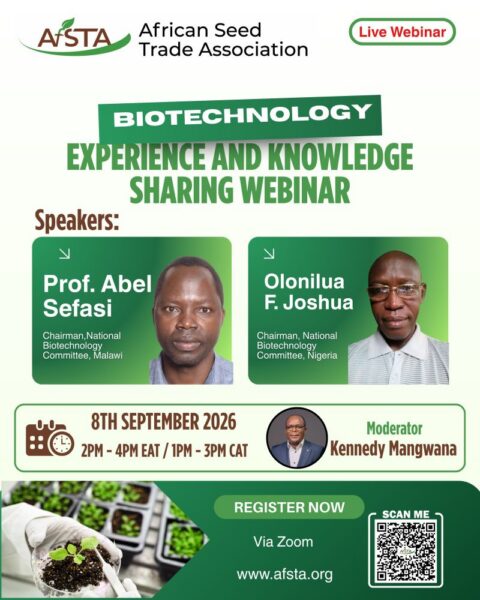
Malawi and Nigeria’s experiences with agricultural biotechnology will come under discussion tomorrow, Tuesday, 8 September 2026, at a regional seed industry webinar examining commercialisation, regulation and public awareness.
Organised by the African Seed Trade Association (AfSTA), the session is titled “Biotechnology: Experience and Knowledge-Sharing from Malawi and Nigeria”. It will run from 1 p.m. to 3 p.m. Malawi time, equivalent to 2 p.m. to 4 p.m EAT.
The programme names Prof. Abel Sefasi, chairman of Malawi’s National Biotechnology Committee, and Olonilua F. Joshua, chairman of Nigeria’s National Biotechnology Committee, as the speakers. AfSTA Technical Manager Kennedy Mangwana will moderate the discussion.
According to the organisers’ invitation, the webinar is aimed at National Seed Trade Associations across Africa, particularly their chairpersons, chief executives and members. The speakers are expected to outline their countries’ experiences and the lessons emerging from their committees’ work.
Four areas feature on the programme: technology promotion and commercialisation; policy dialogue and regulations; communication and awareness creation; and the establishment and functioning of National Biotechnology Committees.
The agenda therefore extends beyond scientific research to the institutions, policies and communication needed when technologies move towards commercial use. For Malawi’s seed sector, the country presentations will provide a comparison with Nigeria’s experience rather than a discussion confined to domestic developments.
The organisers describe the session as a knowledge exchange intended to strengthen collaboration among national associations. Their announcement centres on sharing experience and practical lessons, rather than announcing a new technology or regulatory decision.
Agricultural biotechnology encompasses more than genetically modified crops. Published case studies from the United Nations Food and Agriculture Organization (FAO) include tissue culture for producing planting materials and DNA-based methods for detecting pathogens. These illustrate the range of techniques used across crop, livestock and fisheries production.
FAO also notes that agricultural biotechnologies have not sufficiently benefited smallholder farmers. It calls for more research and development focused on their needs. That distinction separates the availability of scientific tools from their practical use by farming communities.
Seed distribution presents another dimension. A study published in 2020 on informal seed traders, drawing on research involving 287 traders in ten African countries, found that these traders played an important role in reaching smallholders, including those in remote and crisis-affected areas. The researchers argued that formal seed-sector interventions alone were not meeting the full range of farmers’ needs.
Prof. Abel Sefasi is a biotechnology academic at Lilongwe University of Agriculture and Natural Resources and chairs Malawi’s National Biotechnology Committee, according to the webinar programme. His published research covers sweet potato biotechnology, crop genetic diversity and the performance of amaranth varieties under different growing conditions. His work also includes studies on tomato tolerance to salinity and factors affecting the adoption of agroforestry and evergreen agriculture practices across Southern African countries.
Olonilua F. Joshua chairs Nigeria’s National Biotechnology Committee and Director of Quality Control at Nigeria’s National Agricultural Seeds Council. He has contributed extensively to training seed specialists on certification procedures, field inspections and laboratory testing. His presentation covers quality and purity standards, including checks on moisture content, germination and the absence of pests and diseases before seeds receive certification.
AfSTA is an umbrella organisation founded in 2000 with more than 120 members, including national seed trade associations, private companies and agricultural research centres. Its activities include advocacy on seed policies, biotechnology awareness and plant breeding initiatives, with projects covering Malawi and Uganda.
Registration for Tuesday’s webinar is available through the registration link circulated by AfSTA.
Follow and Subscribe Nyasa TV :