

Chilima attends Nkomano wa Maseko Ngoni : ‘A true Ngoni is not timid’
Vice President Saulos Chilima on Sunday attended the Nkomano wa Maseko Ngoni called by Inkosi Gomani V at his headquarters at Lizulu in Ntcheu.
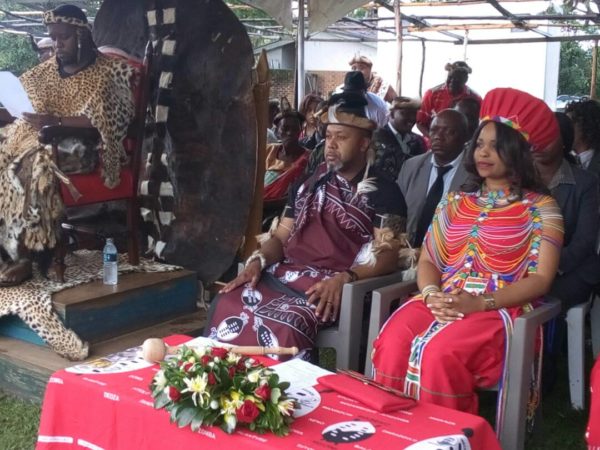
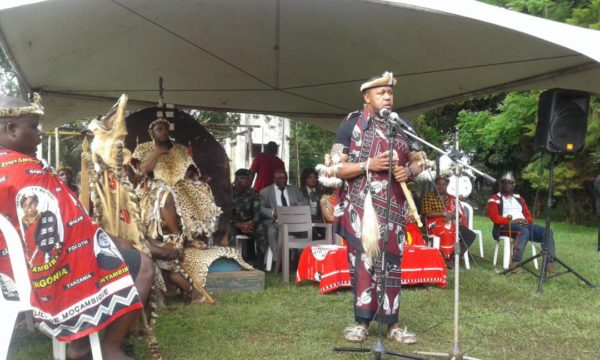
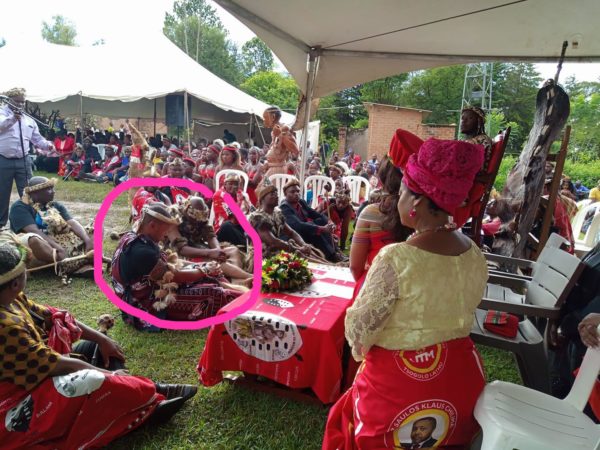
Chilima, who is also an Impi (adviser) to Inkosi Gomani, the supreme leader of the Maseko Ngonis in the country, was at one point seen sitting on the floor together with his wife Mary. Both were in traditional Ngoni regalia.
“He knows his place within the cultural set up. To think that he is the State Vice President and is sitting on the floor just shows how humble he is. He did not even use the red carpet or red chair which symbolizes power, ” said John Dzimwenje who attended the function.
Speaking at the function, Chilima observed that Ngonis are known for their spirit of observing cultural values and that there is need to embrace this characteristic and take pride in their culture.
“A true Ngoni is not timid and all Ngonis across the country must move according to this principle,” said Chilima.
He also asked Ngonis to take an active part in conserving the environment and all programmes that promote development of the country as a whole.
“I would also advise you to love one another and love this country that God has given us because he will not give us another country; this is the only country that He has given us. So let’s love our country, let us conserve the environment and let’slove one another,” said Chilima.
Inkosi Gomani V updated the gathering on his trip to South Africa where he was visiting Ngonis in the original home of the tribe where he was honoured with lion’s skin.
“This year we will launch a programme where I will be visiting various areas among the Maseko Ngoni to monitor progress of my people in areas of Education, Health and Environment,” said Inkosi Gomani V.
The Inkosi also said he is in the process of selecting members into the Ngoni Heritage Foundation steering committee to spearhead the operationalization of the Heritage.
He advised chiefs to take an active part in promoting the rights of women by making sure that the girl child is adequately educated and by ending gender based violence against women in all its forms.
Follow and Subscribe Nyasa TV :
Mukafuna gondolosi mpezeni Chilima Kwa Njewa kapena pa Africana. He is not timid to sell you some.
I am a Ngoni but only speaks Chichewa and Tumbuka pang’ono. I have accepted that Ungoni wanga udatha. Kwatsala nkumavala zikumba za a gologolo and clapping hands for Gulewamkulu. As Ngonis we need someone to teach our children the language. We can hire a Tchangane or Zulu to revive the language. Pano the Ngonis of Mzimba are full of Tumbuka and the Ngonis of Mchinji, Ntchisi, Dowa, Dedza, Ntcheu, Mwanza and Chileka are Chewas busy with gulewamkulu. The same applies to Lomwes. Alamu Pumani Mwakalamba amangodziwa moni yekha basi. The language is dying. I envy Tumbukas, Senas and Yaos. Pa mkumano wa a Ngoni busy kuyankhula Chichewa. Pa Mlakho wa Lomwe busy kuyankhula chichewa.
Am a Malawian of Mixed Tribe.As that’s the Reality of the New Malawi – we have so many People of Mixed Tribe.Intermarrying is the New Norm.We don’t Need leaders who Kakamula zinthu za Tribe.We need a leader who understand the New Malawi. So Chilima should be very careful on how he Projects himself.It may win him the Tribal Vote but Cost him the Majority Young Mixed tribe – Open minded Malawians. We don’t Want another Tribal Patron as President.
Countrymen, I am a Chewa from Kasungu and Ntchisi and I feel proud to be one. I am sure too that most Malawians do take pride in the “accident” of tribe, region, district or village that God “dropped” them when they arrived here on earth. In Chewaland we also take pride in the cultural values that our ancestors bethrothed on us of the modern generation. When I am home I take pride in seeing a variety of gulewankulu masks, women dancing chintala(li) or dusha or chisamba or chimdidi. When I grew up in the village my Kasungu side of village life was infiltrated by Vimbuza dancers who, usually, came from Mzimba which borders our district. All Vimbuza songs I can remember were in Tumbuka. Oh! life was beautiful then.
Of course, in those days, it did not really matter whether one sings in Chichewa or Chitumbuka or Chitonga. Our tribes were so intertwined that you hardly differentiated what language a person used because in those days language or culture was not used to define the difference between people but to weave you into one people. I grew up I had direct blood cousins who spoke Tumbuka only for the simple reason that they grew up in an area where Tumbuka was predominantly spoken. Hanyezi side for those who may know. Some spoke Tumbuka simply because one or two of my aunties got married to men from Mzimba or Nkhata Bay or somewhere up North. KuuNgoni -as we used to call it.
But, honestly, it did not really matter whether a cousin spoke Tumbuka or Chichewa. It did not really matter to what extent my cousin had absorbed the Tumbuka culture. What was most important was that he or she was my blood cousin or a member of my own community. The assumption was that I would learn something from them just as they would learn something from me. It was, actually, this type of life that has helped me to really not care who I work with in my organization, church, community, etc. To me, tribal, regional, district, family backgrounds are mere “accidents” that one does not really need to be too serious about particularly when I hold a position of leadership in society.
But, may be I think in this manner simply because I am not a politician yet. No? The many years I have spent with politicians in my adult life have taught me that identifying with one’s tribe is much more than an “accident” of birth. It is a pathway to political power. Blood is thicker than water – don’t they say? Tribe, I have discovered is, to a politician, a tool to amass votes in an election! I therefore, ask myself as I write this comment: “If I sought a political position in future: will my attitude to people of other tribes change? Will I see them different from the way I see them today or the way I used to see them when I grew up in my Kasungu village? How will I look at Yaos, Lomwes, Ngonis? Tumbukas, etc? But, most importantly, how will I look at people who are called “Chewa” like me? Will I have a reason for considering them more important or “closer to me” than those from the so-called “other tribes”? Why? But, are they really different from me? How?
Well, congratulations Rt Honourable Chilima and Madam Chilima for looking so “beautiful” in that Ngoni attire. But, the some questions ring in my head as I look at you knowing that you are a politician. For starters, male Chilima will run for the office of President this 21st May, 2019. Here is my question: How do you feel sitting there among “fellow” Ngonis who are known for “keeping” their culture and for “not being timid”? Do you think that they are different from us “Chewas” or those from the Tumbuka or Tonga or Sena or Lomwe families? If you think we are different then I understand why you decided to wear that attire.
Conversely, if you think we are the same, why wear what differentiates some Malawians from you yet you aspire to be the leader of all of them? Just to show that you are different from the rest of the people? Besides, why speak as if Ngonis are “different” from the rest of us? If Ngonis are “not timid” is there a tribe in Malawi that is “timid”? How did you arrive at that? History? DNA test? What? Suppose you became State President this May, will you use that difference in any way? How? To fuse us together into one or to separate us into camps of the “timid” and the “brave”; the “cultured” and the “uncultured”? No?
Mind you, if I were still in my village, these questions would not have been there. No. But, alas! I no longer live in that village. Back there, life was one for everyone. Chewa’s, Tumbukas, Tongas, Yaos, mingled freely with one another. “Osafusa za chibale,” my grandmother once shouted at me when I asked her how related we were in our village. “We are all one!” In those days, we had one life. One water point, one bush, one village one bwalo la a mfumu. Languages, tribes, clothes did not separate us although our elders knew the difference between and among us. They did not talk about them or show them off to us. Vimbuza and gulewankulu were for us all despite our languages and names.
Well, I am just thinking allowed here. I am not a politician yet. But, who knows?
Angoni timangokakamira ungoniwo. Pano tasanduka Achewa ndi Atumbuka basi. My father at least adaboola Makutu mwa ungoni but ended up in dambwe. Saulosi anali wa mu Nyambadwe uyu. Ndi oboola khutu? Did he wear zikumba at school? Today he is settled at Njewa and doesn’t have a village at Lizulu. What remains of Ngonis is kumwa Mowa and selling gondolosi at Lizulu.
@Kent Y.G. Mphepo:
I can’t believe I have actually read your piece in its entirety.
My only comment is: Don’t stress out about how Chilima discern people from different tribes in this country, or how he will essentially distinguish aNgoni from other people from the other tribes.
The guy has no political acumen, and he will NOT win the Presidency in the coming elections. Simple as that. A Malawi anachenjera.
And the sooner his supporters, like Kaliati (see her in the picture?) realize that the better; as they can head back to their homes kukalima nyengo ino.
Don’t use words you are not even sure about or what they mean. What does political acumen mean to you?
I personally do not like some arrogance with Chilima’s speeches.
But he’s the undoubtedly the man of the moment, charismatic, kutsitsa m’fundo, resonating with the populace across tribes, regions
Nchilima be careful. You can fool a Lomwe and will be just looking at you but when says enough is enough please take cover for your life. Ask lomwe peoplue the meaning of this word “MUHOME”
if you hear this word just run away he will not spare the knife. Kalindo and kaliati know very well.
Don’t think Lonwes are fools. Remember what Lonwes did to Nyngoni which led them to say “Nyemba vikulu vikulu zidapha Agigo”
Chimunthu chikulukulu chandefunso chonsecho kusegula pakamwa ndikumanena zinthu zopanda nzeru,ngati mulibe so kamba bwanji osagokhala chete. Chonde zipaseni ulemu
Angoni ambili ndima driver am’boma. Kuuma mitu kikiki
Iwe chilima samala!! Udzalira ngati Fayulu waku DRC. Candidates backed by the catholic church never win elections. Ask Gwanda Chakwamba’s friend.
kodi Kaliati akumadya kwa Chilima?? Or she is now Chilima’s MG 2?? Kuli konse akumakhala pa mbali pa Mary Chilima. Iwe Mary Chilima samala tseguka m’maso Kaliati yu akukudyera katundu ndithu. Sinkhani za ndale zokhazokha izi ayi. And Kaliati why putting on party clothes on cultural function?? Koma kunakakhala ku Mulhako ndiye ikanakhala nkhani koma just bcz its UTM on Ngoni cultural event even Nyasatimes reporter dint see anything wrong with this. Instead he is reporting some praises for Chilima kuti anakhala pansi. Mumafuna akhale muntengo?????
hahahahahaha very well written
kkkkkkkkk Shaft umandimvesa kukoma, sindionjezeraponso apa, Ife boma baasi.
I we ndiye waitha… Comment of the year…lol
Iwe mulakhoism sibwino kumanyozana mitundu. In my house for over 15 years the people I have employed as Housekeeper, cook, Gardeners have been lhomwes . Can you claim that Lhomwes are not educated? For your information at Independence Ntcheu (Maseko Ngonis) had more graduates than any other tribe. We began to see more graduates from the North where you probably come from after the 70s (Unima) for reasons which have been well documented. …favouritism, Donton Mkandawire at MANEB not forgetting what Kanyama Chiume did when he was Minister of Education.
Ndiye pano ma Northerners mukumawakhomelera ndi quota chifukwa chiyani…….kuwaopa? Angoni munalanda ng’ombe ndi minda yathu inu….nkhanza ndi kuba basi nchifukwa kamtundu kakang’ono ngati ka Chitumbuka kanakuthetserani chiyankhulidwe chanu chonse panopa simungayankhule chiyankhulidwe chanu mowilikiza ayi kkkkkkkkk koma nsanje, nkhanza ndi kaduka basi!
Alhomwe omwe amalankhula chiLhomwe ndi angati? Ankhale Peter Mutharika chiLhomwe amatochiziwa? Isaaaaa!!!
Iwe sopanda nzeru iwe. Mafunso achani amenewa? Loser baasi.
Ability to speak a language is NOT the only marker of someone belonging to a culture or tribe. Wanva?
Chiboda
Off topic, kayambireninso
Loading…. 🤣