

Chilima conceded defeat in Malawi presidential race before petitioning court
Malawi’s immediate past vice-president Saulos Chilima, who is contesting presidential results of the elections held on May 21 initially conceded defeat but changed his mind, it has emerged.


Chilima, who challenged President Peter Mutharika in the elections on a UTM Party ticket and came third, has also joined hands with Malawi Congress Party (MCP) president Lazarus Chakwera and some civil society organisations (CSOs) leaders in organizing demonstrations against the results.
Social media is awash with a statement circulating that Chilima conceded defeat on 24 May 2019.
But UTM party secretary general Patricia Kaliati said the statement was not released to the public. It is not clear why he did not release it.
In the letter with UTM emblem and signed, Chilima stated to his supporters that tallied votes that far showed that “we are nowhere near to making it to presidency as UTM.”
Chilima is contesting the Presidential election claiming that it was rigged in favour of the eventual winner, President Mutharika. Yet in the letter Chilima said regardless of reports of rigging attempts, Mutharika was the people’s choice and he accepted that choice.
UTM deputy spokesman Leonard Chimbanga is on record to have also amplified the statement in his post on Facebook on May 27.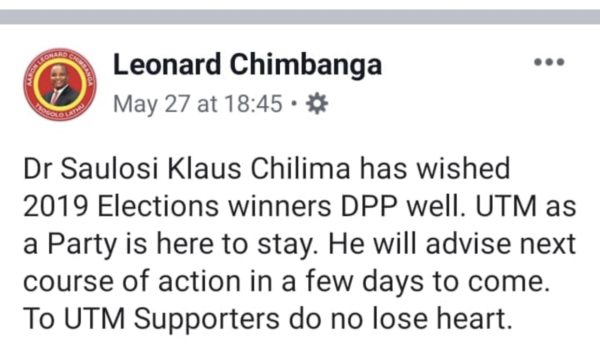
Votes tallied by the Malawi Electoral Commission (MEC) on May 24 showed Mutharika had a clear lead.
“I believe that Malawians decided what they want. To this effect, I have accepted the results and conceding defeat prior to the official announcement of the winner. Once the winner is declared, I will be making my telephone call to the President elect,” reads the letter.
Chilima further appealed to all supporters of his party to remain peaceful and accept the results, “respect the people’s choice” and embark on rebuilding the party in preparation for 2024 elections.
“This country is larger than UTM, and it is in this spirit that we must all exercise great responsibility in times like these when our unity is threatened,” the statement said.
At the time of drafting this letter, his opposition ally Chakwera had already set the country on the path of post-election violence.
On May 22, with the vote count only at 25%, Chakwera accused the elections body of delaying on releasing the results. At a news briefing he warned of blood shed if the results did not go in his favour.
Immediately after his address, his supporters started what were planned to be peaceful demonstrations that were marred by incidents of violence, especially in the Central and Northern regions.
The MCP supporters started beating up people that supported other political parties or were from other regions, destroying and looting property. These incidences of violence continue and Chakwera has not condemned them.
After the official announcement of the results, Chilima again spoke publicly against the violence. But he said they would challenge the results in court.
The combined case is in the hands of Constitutional Court.
But while the court is yet to make a ruling, Chilima has also joined Chakwera in attacking MEC chair Justice Jane Ansah, her commissioners and staff.
Chakwera and Chilima have mobilised supporters and civil society organisations (CSOs) for other vigils on July 4 and 5 to press for the resignation of Ansah at the electoral body.
The vigils will come after Catholic bishops under the Episcopal Conference on Malawi (ECM) have ondemned the post-election violence in strongest terms.
“We denounce the vice perpetrated on innocent people and their property based on political, regional and tribal lines. Violence is evil and unacceptable. It is contrary to the freedom we fought for when we chose multiparty system of government,” the statement reads, in part.
While acknowledging the right of Malawians to hold peaceful demonstrations as provided in the Constitution, the bishops call on citizens to maintain peace, calm and unity as the nation waits for the court’s determination on the matter.
As Chakwera and Chilima are disputing results of the presidential election, their
reaction contradicts the conclusion made by international election partners and observers who certified the elections as peaceful, free, fair and credible. These partners include European Observer Mission, SADC, African Union and the US government through USAID.
As part of the transparency in the conduct of the elections, MEC also allowed local organizations and political parties to operate their own independent tally centres. UTM operated its own tally centre.
Local organizations such as the Malawi Electoral Support Network, a coalition of civil society organizations in electoral issues, and the EU-funded National Initiative for Civic Education (NICE) also ran independent tally centres. Both of them found that Mutharika has won the election.
Follow and Subscribe Nyasa TV :