

Egenco boss Liabunya in hot water over ‘backdated’ K400M memo
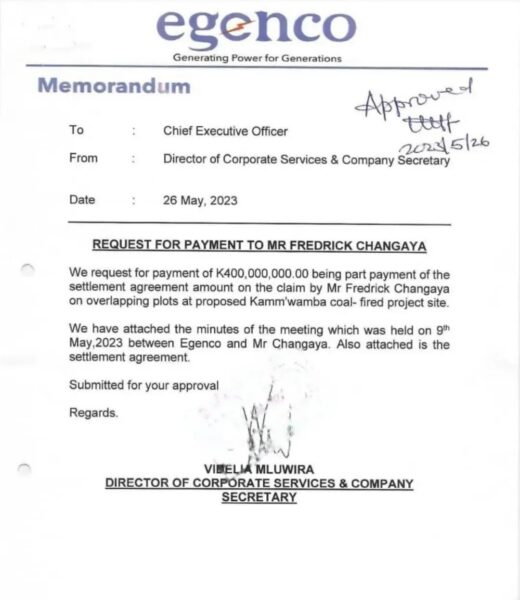 Allegations that a K400 million payment was documented retroactively add to scrutiny of the state power producer’s finances
A controversial memo from Egenco, Malawi’s state-owned power producer, has become the center of a widening dispute after claims that the document was signed years after the date it bears.
The memo, dated May 26, 2023, is headed “Request for Payment to Mr. Fredrick Changaya” and authorizes a K400 million payment linked to overlapping land plots at the proposed Kammwamba coal-fired power project site.
Critics are asking a simple question: If the memo originated in 2023, why were its signatures allegedly added only recently? Sources familiar with the matter say the handwriting and approvals were not placed on the document when it was dated but considerably later.
If accurate, that would suggest the paperwork was completed after the fact to justify a payment that had already been made. Egenco has not publicly confirmed when the signatures were added.
The memo says minutes of a May 9, 2023, meeting between Egenco and Changaya, along with a settlement agreement, were attached to support the request.
But key details remain unclear. It is not evident who ultimately benefited, what land was involved, what the full settlement was worth or what legal basis supported the claim.
The timing has done little to ease suspicion. Days before the memo was dated, the Ministry of Energy formally instructed Egenco to hand the troubled 300-megawatt Kammwamba coal project back to government by May 31, 2023.
The ministry said little progress had been made in the decade since the project was first agreed.
Egenco pushed back, saying it had already spent more than K4 billion on feasibility and environmental studies.
While the company was publicly fighting to keep control of the project, the memo suggests it was privately preparing to release K400 million to an individual with a claim to land at the same site.
No public announcement was made at the time.
For opponents of Egenco Chief Executive Liabunya, the episode fits a familiar pattern in which spending is approved first and the paperwork follows.
Egenco and Liabunya have consistently maintained that the transaction was lawful. The company says the payment was part of a settlement to clear land needed for a strategic national project.
The memo is not the only matter drawing attention. Egenco has acknowledged paying K2.6 billion to M&M Global Law Consultants as a collection fee for recovering funds allegedly owed by fellow state utility Escom.
The power producer says Escom owed about K30 billion and that the firm helped recover roughly K14.86 billion.
Documents circulated by Ireland- based whistleblower lawyer Alexious Kamangila, however, reportedly show billing rates of K75,000 an hour for a partner and K40,000 an hour for an associate.
Critics question how a fee arrangement of that kind could produce a final payment running into billions of kwacha.
A handwritten note dated Oct. 23, 2026, and reportedly found on Egenco records adds to the scrutiny.
It reads: “Joshua, pls proceed to pay as we await reimbursement from Escom.”
The note surfaced days after Liabunya publicly assured Malawians at Nkula Power Station that spare parts would soon arrive to restore 31 megawatts of generation capacity to the national grid.
To critics, the Changaya memo and the M&M payment form a troubling sequence. In one case, a 2023 memo is said to have been signed years later.
In the other, a K2.6 billion payment is alleged to have been approved before reimbursement arrangements were settled.
Several oversight bodies have now become involved. Treasury has ordered an investigative audit, and the Financial Intelligence Authority has reportedly frozen accounts linked to the K2.6 billion transaction.
On Nov. 17, 2026, the Egenco board suspended both Liabunya and Mluwira pending investigations into procurement, administration, performance and the use of company resources.
Parliament’s Public Accounts Committee has also said it intends to examine the matter.
Whatever the outcome of those inquiries, one question remains unanswered. If the memo was genuinely created on May 26, 2023, why does it allegedly carry signatures added years later?
Until Egenco offers a detailed explanation, the document is likely to stay at the heart of one of the most serious controversies facing Malawi’s state power producer.
Follow and Subscribe Nyasa TV :