

Goodall talks economic stimulus as Malawi Kwacha gains against US dollar
Minister of Finance, Economic Planning and Development Goodall Gondwe has said he Development Cooperation Strategy (DCS) which government has launched will act as one of economic stimulation measures for elimination of poverty and resurgence of economic growth.
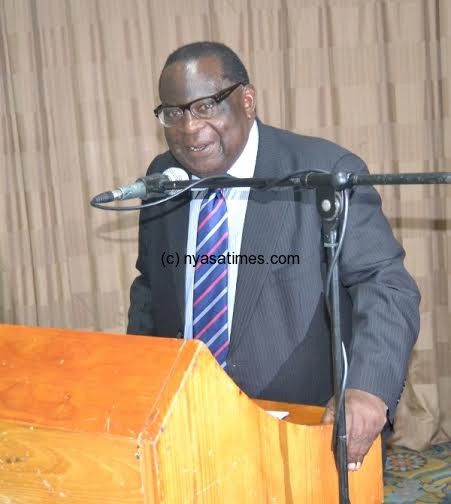
Gondwe said during the launch of Development Cooperation Strategy in the capital Lilongwe that it will enable implementation of the strategies of the Millennium Development Goal (MDG ll).
“The DCS aims at improving the quality and effectiveness of development cooperation in the country, and to ensure that all support is coordinated, harmonized, and focused on results,” said the Finance minister.
Gondwe said government has already started working on the recommendations highlightened to improve on the livelihood of Malawians.
“We have already started and the impact of the outcome will be seen soon. The Development Cooperation Strategy has also helped the government to find means of mobilizing resources which will have prompted developing partners map out ways of how to contribute to the development projects,” Gondwe said.
He added that the government has to have fiscal discipline and that the resources made available should be used according to the intended purpose(s).
“This is going to prompt developing partners to buy our programs and provide for the resources needed and finance the outlined projects,” he said.
The DCS has outlined principles and priorities in line with global agreements for joint efforts on poverty reduction, improved governance and service delivery for the poor people in the country.
Meanwhile, Reserve Bank of Malawi (RBM) has confirmed that the kwacha, which has been on a free-fall since September when tobacco sales closed, has slightly appreciated against the US dollar buoyed by minor export proceeds from some of the country’s commodities.
According to the RBM financial market development report, the kwacha appreciated against the dollar as it traded around K492.3047 against the dollar this week from a high of K520 some few weeks back.
RBM data show that gross official reserves—held in the custody of RBM to prop up the kwacha—increased to $478 million or 2.5 months of import cover during the week ending December 5 from $352 million or 1.84 months of import cover.
At the same time, private sector reserves, which constitute reserves under the direct control of ADBs and foreign currency denominated accounts balances, jumped to $309 million or 1.62 months of import cover from $297 million or 1.56 months of import cover the week before, according to the RBM.
The monthly import cover calculating figure is at $191 million.
RBM spokesperson Mbane Ngwira said the kwacha is responding to local economic developments such as the tightening of monetary policy and other instruments like liquidity reserve requirement (LRR) for forex deposits.
Following the directive on LRR—a fraction of deposits that commercial banks keep with central bank currently at 15.5 percent—the reserves on forex deposits are to be made in kwacha and not in their respective currencies.
“We have ensured that commercial banks should avail the market with forex that is there. The demand [for forex] that was there has been covered by the forex that is available on the market,” said Ngwira as quoted by The Nation.
He explained that minor export proceeds from sugar, tea and pulses have boosted foreign exchange reserves, stressing that the level of forex from tobacco only lasts two months.
Follow and Subscribe Nyasa TV :