

Handouts dependency is over, World Vision tells Malawi
World Vision Malawi has pointed out that the usual giving out of handouts by some NGOs, other partners as well as other stakeholders was over and that time has come for Malawians to stand on their own in issues that affect their wellbeing.


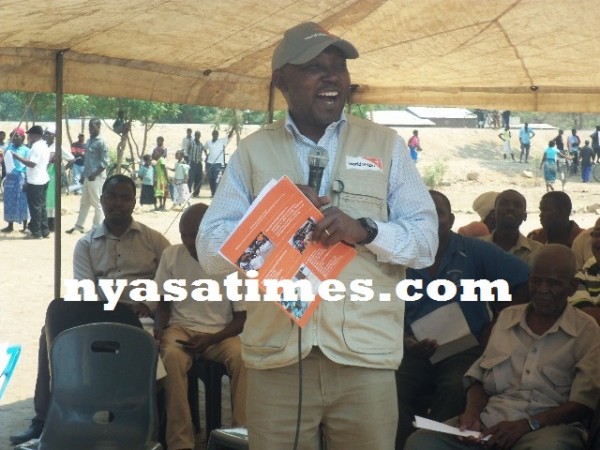
The remarks were made by World Vision’s National Director, Robert Kisyula at Mthumba Primary School in Chikwawa when the country’s Humanitarian Response which aims at assisting the people who were affected by floods and drought was launched.
Kisyula called on all Members of Parliament, council officials, NGOs to join hands so that the independency other than dependency among communities in the country was achieved.
“I hope this is the last time we are here to give handouts because Malawi is blessed with a lot of water and lucky enough 20 percent of its water is fresh. Look around you, there is enough water in the Shire River. What else should Malawians do other than making the best use of the water we have around us?
“We can do irrigation farming all year round and we can produce enough food that will make us food secure. We don’t need rains to grow maize all we need is water whether it is brought by a donkey, bucket, rain or tractor all we need is water to do farming,” said Kisyula
The WV’s National Director pointed out that Malawians were “not poor” adding that his organization believed in transformation development which would move people forward indicating the giving out of handouts was not transformation development.
“Look at me mothers, World Vision will not be giving out food every year,” he said.
“ We don’t give fish to a person but rather teach him/her how to fish because through that you will help him have food all the time. Let’s be fishers not eaters of the fish.”
Kisyula went on: “I call upon government through the guest of honor here to hold NGOs accountable to do sustainable development. My heart is bleeding inside here because last January we here to give relief food because of the floods and in October we are here again because of drought.”
He added: “MPs take this to parliament and say it to everyone that what we do is not development. The giving out of handouts is not development but rather let’s do some initiatives that would give Malawians a capacity to produce their own food for self dependency.”
He further stated that his organization was to work hand in hand with various NGOs, government to make sure that people had enough to produce adding that there was a need for bylaws that would protect and make those who carelessly cut down trees in the Shire Valley escarpments arrested saying deforestation greatly negatively affected climate change.
On his part, Principal Secretary in the Department of Disaster Management Affairs (DoDMA), Bernard Sande who was the guest of honor to the event said through the humanitarian response, 25 districts will be assisted with food and money depending on the recommendations from the Malawi Vulnerability Assessment Report (MVAC).
He said the response which started in October 2015 up to March 2016 is targeting 2.8 million people country wide but will start with eight district in the month of October 2015 adding that come November other four districts will be added and the remaining districts shall be incorporated in January 2016 list.
“According to MVAC report, the degree of food insecurity differs from one district to another hence we are not starting distributing food in all the districts at once,” said Sande.
He further stated that the beneficiaries of the response were likely to increase as MVAC November report which was yet to be released looking from afar indicated that the figure can rise from 2.8 million.
The Principal Secretary further urged all people who were involved in the response exercise to be more transparent and accountable indicating that anybody found abusing the process will be punished.
World Food Programme (WFP) Country Representative, Coco Ushiyama said Malawi food and nutrition security situation was complex adding Chikwawa district was one of the most prone districts in the country.
Ushiyama said ending hunger in Malawi was a challenge but possible if collective efforts were used in a manner that addressed food insecurity in a long term plan.
“At this time of unprecedented global need and despite resource challenges, WFP commitment to the humanitarian aid was imperative to save lives and livelihoods and to protect food and nutrition security remained stronger than ever.
“Through this response in total WFP will reach 2.4 million vulnerable Malawians with food and cash based assistance,” said Ushiyama
She further stated that government and other stakeholders as well as development partner’s work plan must incorporate disaster risk reduction, climate change adaptation, nutrition, gender equality and analysis and planning according to the changing context which also empowers people to drive local initiatives and tackle hunger in their communities.
This is not the first time Malawi has been advised to set measures that would help live independently, recently the Germany Ambassador to Malawi told a local radio that time was over when Malawians thought donors were Father Christmas.
The country has experienced the worst 2014/2015 growing season which was characterized by heavy floods and claimed over 100 lives in the process.
The launch of the humanitarian response follows the 2015/2016 food insecurity response plan which was launched on 21st September, 2015 where President Peter Mutharika admitted that over 2 million Malawians would not be able to meet their annual food requirement during the 2015/2016 consumption period.
Follow and Subscribe Nyasa TV :