

Horror of road carnage in Malawi
Statistics from the Directorate of Road Traffic and Safety Services (DRTSS) say it all; in just three months from July to September this year, a total of 329 lives were lost on the roads of Malawi.
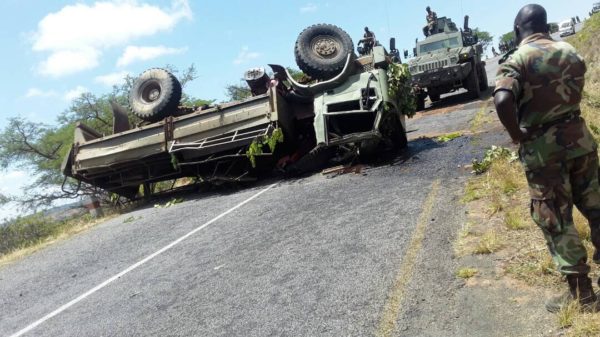
Traveling by road while enjoying the beautiful scenery across the country was once a marvel during yesteryears.
But for all its accessibility and affordability, travelling by road is no longer pleasurable. It has become so scary because people are not so sure whether they will arrive at their destinations in one piece.
The road accident on Thursday at Mapanjila in Mzimba, which claimed the lives of 21 Malawi Defence Force (MDF) soldiers, has left the nation horrified and chilled to the bone.
Every week there are reports of all types of vehicles, whether excellent or poor condition, involved in accidents.
Diseases like Cholera, HIV and AIDs, diarrhea and Malaria which were once feared as life threatening are now being undermined in the face of the numerous road accidents.
And Malawians are shifting the blame on different stakeholders tasked with the responsibility of making the country’s roads safe.
Public Relations Officer (PRO) for DRTSS Angellina Makweche attributes the soaring numbers in road accidents to over speeding.
Makweche says there were 854 road accidents between July and September this year with 329 human lives lost.
“The central region registered most road accidents totaling 500 where 150 were fatal. The southern region 262 road accidents,” says Makweche.
She says the Directorate is devising ways of ending frequent occurrence of accidents.
These include the introduction of a Toll Free line dabbed 4040 where people can call and report any road traffic violations. It has also intensified awareness and enforcement exercises and the reviewing of the Regulation and Road Traffic Act to suit the current environment.
Makweche further says road safety is a cross cutting issue and requires coordination from different sectors including general public in exercising caution when driving on the road.
Southern region police spokesperson Rodney Mushane says the conduct of most drivers on our roads is the major factor in the carnage on our roads.
“Most drivers ignore road signs, some drive under the influence of alcohol while others have a sheer excitement of over speeding,” Mushane says.
He refutes accusations that the traffic police have failed to control road accidents saying the police cannot be everywhere nor escort all vehicles on the country’s roads.
“The general public should be advised that they have a responsibility to prevent these accidents from happening.
They should ensure that their vehicles are road worthy, they are carrying the recommended load capacity. Passengers must ensure that drivers are driving responsibly and report them should they behave otherwise,” he says.
Speed traps, use of breathalyzers and ad-hoc road blocks are also other measures that the traffic police are using as means of reducing road accidents on the roads of Malawi.
On some instances, people attribute the road accidents to poor road conditions.
But the Road Authority (RA), an institution mandated to construct and look after the country’s main roads, says the increasing accidents have nothing to do with the road’s condition.
“Our roads are very safe and as Roads Authority, we are always ready to do maintenance works where we feel it is not safe for motorists,” says Portia Kajanga, the authority’s spokesperson.
She says driver’s mindset, condition of vehicles and fatigue are the major reasons behind the soaring road accidents in Malawi.
“People don’t check the conditions of their vehicles and this is dangerous. Motorists should always make ensure that their cars are in good conditions before embarking on a journey,” Kajanga says.
She adds that motorists should be discouraged from driving when they feel tired because fatigue result in lapse of concentration on the road.
Baxton Kapachira is a minibus operator in Blantyre City. While admitting poor road use by motorists as a major contributing factor to road accidents, he says that road accidents are just like any other catastrophe that cannot be predicted.
“An accident is an accident, we just need to be careful when on the roads,” Kapachira said.
In the face of threats from road accidents, a platform of opportunity has emerged for some people of God who offer prayers and sermons of comforts in buses.
There are mixed reactions to the motive of these sermons. While some trust their work of spreading the word of God anywhere, others see them as opportunists.
Some pastors deliver a 10 to 15-minute sermon as the bus is departing and they disembark just after a short ride and that is after the commuters make some cash offerings.
“They are making easy money by praying for commuters, they taking advantage of scared souls travelling long distances,” says one local in Chitawira Township, Blantyre.
Considering the numerous buses that travel daily on the roads of Malawi and the numerous road accidents taking place in the country, this emerging ‘lucrative trade’ may continue in the country’s public transport system.
Commuters will remain the prey by forking out some cash as an offering out of fear of losing their lives.
God being the answer to everything, maybe and just maybe, prayers are what the country needs to end this horror that is attacking the roads of Malawi.
Follow and Subscribe Nyasa TV :