

Malawi Kwacha floatation faulted – Economic expert
A professor in economics, Chinyamata Chipeta has spoken against the floatation of the Kwacha, saying the policy is wrong as the local unit continues to weaken further against the US dollar with the middle rate falling to about K440 compared to about K430.
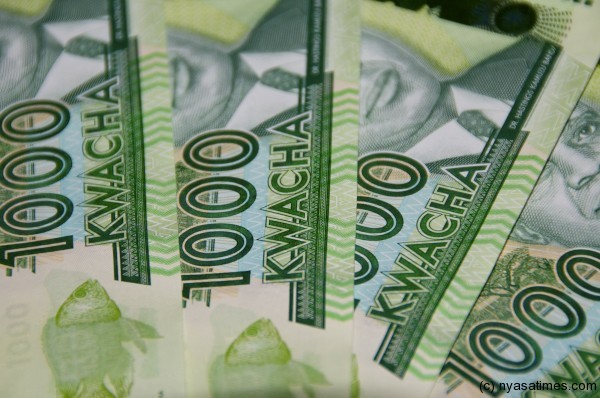
The floatation of the kwacha was made in 2012 by the previous Joyce Banda administration in an attempt to adhere to retain a renegotiated three-year Extended Credit Facility (ECF) arrangement for Malawi in the total amount of US$156.2 million approved on July 23, 2012.
However, Chipeta pointed out that the policy was adopted without proper research on the ground and cautioned the Peter Mutharika government against borrowing economic policies from the West ‘wholesome’.
“The devaluation was okay, but the floatation was wrong,” said Chipeta on Friday at the Malawi Institute of Management (MIM) in Lilongwe.
Chipeta, who is also executive director for Zomba-based Southern African Institute for Economic Research (Saier), added: “You do not float a currency when you don’t have enough foreign exchange reserves and when donor aid is uncertain.”
Chipeta, who conceived indigenous economics at Chancellor College, a constituent college of the University of Malawi, was speaking at a two-day national policy workshop designed to explore how Malawi can use indigenous knowledge in formulating appropriate policies for its economic development.
The meeting with funding from the Nairobi-based African Economic Research Consortium (Aerc), has drawn presenters such as RBM deputy Governor (Economic Services) Naomi Ngwira, University of Malawi deans Edge Kanyongolo, Patrick Kambewa, Sosten Chiotcha, Chiwoza Bandawe and also Malawi Economic Justice Network (Mejn) executive director Dalitso Kubalasa.
Chipeta said “not all foreign advice is consistent with characteristics of the local economy.”
Governor of the Reserve Bank of Malawi Charles Chuka is on record saying fixing the kwacha was not an option because that could lead to Malawi getting off track with its IMF programme.
Said Chuka: “Any attempt to abandon this exchange rate system will make matters worse. The market-determined exchange rate is the best for Malawi.”
“If a currency is free-floating, it’s a guarantee that you will find dollars on the market…I pray that this system is to stay for Malawi,” said Chuka.
He recalled that in 1994, Malawi ‘auctioned’ the kwacha and the currency shed its value from K4 to K8 to a dollar in a week before losing its value further to K18 after five weeks.
Chuka said during the same period, inflation rose to 91 percent and that interest rates soared to as high as 46 percent.
“After that period, inflation fell sharply to 9 percent and foreign reserves were built up. People should not forget that this is not the worst,” said the RBM governor.
Consumer Association of Malawi (Cama) boss John Kapito argues that while fixing of the currency is not a good option, a managed float would be appropriate for Malawi adding that this was not a new concept in Malawi as it has successfully been implemented before even under a programme with the International Monetary Fund.
The Kwacha has been facing renewed pressure and government said it needed donor support to keep the local currency from dropping into red zone territory.
Analysts are projecting that the local unit may hit K525 to the dollar by December this current average selling price of K460.
Follow and Subscribe Nyasa TV :