

MCP ‘Manifesto for hope’: Responds to key issues affecting Malawi
An analysis by governance expert on the manifesto presented by Malawi Congress Party (MCP) President Lazarus Chakwera for the upcoming election to Malawians on Saturday March 9 in Lilongwe indicates decisiveness on the so-called sensitive issues, a paradigm shift promise from “executive arrogance” leadership model to “servant leadership”.
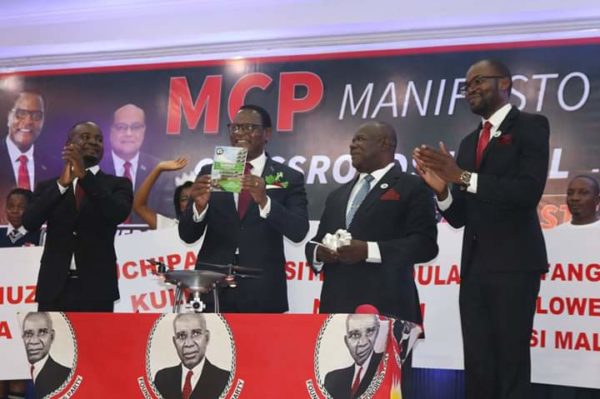

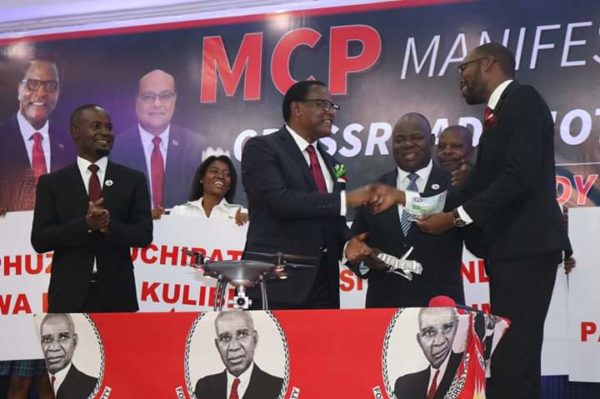
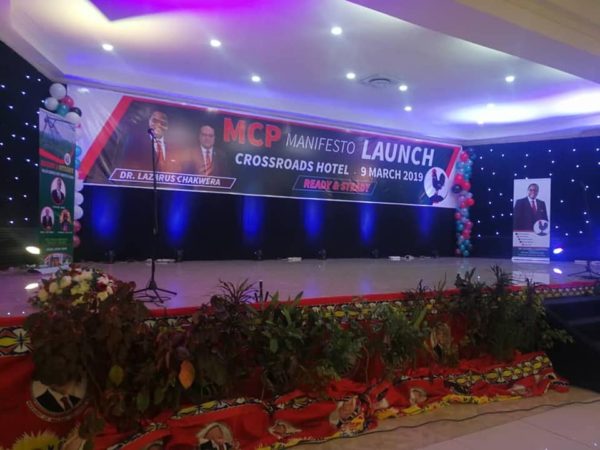
After much hype and fanfare, including appearances from civil society organisation leaders, diplomats and former official hostess Mama Cecilia Tamanda Kadzamira, Chakwera unpacked the vision the party hopes will convince voters to mark X for the MCP on their ballot sheets on the 21st of May this year.
“MCP must be commended for not only being the first [among the major parties] to release the manifesto but also producing a comparatively much improved manifesto – as compared to the 2014- which largely responds to the key issues affecting the country,” Makhumbo Munthali, a governance expert and commentator told Nyasa Times.
In his analysis of the MCP blue print solicited by Nyasa Times, Munthali said while the manifesto has some unrealistic promises, one of the striking features of the MCP electotalmpledge documfng is its ability to be decisive on some so-called sensitive issues such as land control, quota system in tertiary education, fertiliser subsidy, execution of death penalty in the context of the continued killings of persons with albinism, and the industrial or medical hemp.
“I think this is crucial in as far as stimulating debate across political parties and the public on these matters as we approach the elections,” he said.
Munthali noted the other positive that one sees in MCP manifesto is its emphasis on a paradigm shift in the way the Presidency is run from what may be called an “Executive Arrogance” leadership model- associated with the current DPP leadership- to a “Servant leadership” model.
“This is partly reflected in how MCP promises that it’s President would be bold enough to stand before Parliament to answer questions from MPs on various issues of national interest as guaranteed by the Constitution.”
President Mutharika, just like his predecessors, have often rejected calls to appear before Parliament to answer questions on various issues. It would be interesting, if MCP wins, to see whether Chakwera shall live to the promise.
Corruption Court and ending electricity blackouts
Munthali observed that some of the issues that Chakwera has raised such as the establishment of the Anti-Corruption Court have been raised in different forums including the previous anti-corruption conference organised by the Ministry of Justice where one Professor Lumumba suggested the need for Malawi to consider establishing an Anti-Corruption Court as one way of reducing the backlog of corruption cases as well as ensuring that the Court has the right capacity of judges in corruption related matters.
“It’s an issue that can be further debated but it’s good that MCP raised it.”
However, he stated that while MCP should be commended for touching on the issue of electricity blackouts, it remains not clear on how MCP would ensure that the blackouts end within the promised one year.
“Besides, MCP doesn’t recognise the current efforts by Mutharika’s regime put in place towards addressing the issue, and how it would build on that to come up with a solution. Nevertheless, the inclusion of this issue is important as it stimulates public debate across political towards finding a lasting solution to the electricity blackouts. It would be interesting to hear what DPP, UDF, PP and UTM will say in their manifesto on the matter,” the governance commentator said.
Re-introduction of JCE, Construction of Netball courts
On the issue of reintroduction of Junior Certificate of Education as a strategy to monitor and improve students’ academic progress and performance, Munthali said it would be important that before reintroducing it – if MCP comes to power- there will be need for a national dialogue over the matter.
”It’s unfortunate that the DPP government abolished the Junior Certificate of Education without consultations. It would be critical that we have a national dialogue on the matter towards an informed decision whether to reintroduce JCE or maintain the status quo. This is addressed in the National Youth Policy of Malawi. However, the current government has been very slow in implementing it.
“Certainly, it’s good that MCP has raised it as it’s something that just needs implementation,” Munthali said.
The introduction of a National Youth Service as promised in MCP’s manifesto is another positive that must be commended, he said.
Nevertheless, he pointed out that this is not new as it’s already provided in the National Youth Policy and the expectation is that MCP will just implement such a policy.
Munthali said the promise on the construction of a state-of-the-art national netball complex capable of hosting international competitions to fast tract the c-untry’s 10-year goal to become the number one netballing country in the world is welcome mindful of the fact that this sub-sector has been neglected despite being the best performing sport in Malawi with remarkable international and regional recognitions.
Truth Commission and Tax regime review welcome
The promise to review the tax regime in Malawi is also welcome, said Munthali .
“This is in line with the promise of the Malawi Growth and Development Strategy III for a comprehensive review of tax regime in Malawi. Malawi continues to lose its revenue due to corruption, illicit financial flows, irrelevant tax incentives to multinational companies, under collection of corporate taxes and others,” he pointed out.
MCP’s promise to establish a Truth and Reconciliation Commission is long overdue, and indeed if voted into power this should be one of the first things MCP government will need to implement, Munthali stated.
“This is so because some victims of MCP’s 30 years dictatorial rule are still alive and such a Commission would be critical to addressing the historical wounds of not only the one party era but also the DPP-led government July 20, 2011 killings during CSOs organised nationwide demonstrations.”
Already some scholars such as Professor Kenneth Ross in a book “Democratisation in Malawi: a stocktaking” (edited by Kings M. Phiri and Kenneth R. Ross, 1998) recommended the establishment of the Truth Commission so that the Truth about the one party system (atrocities) is known, and reconciliation, justice and healing takes place.
Summary
In summary, Munthali said it’s clear that MCP has been able to come up with some “decisive positions” in its manifesto capitalising on the observed governance weaknesses of Mutharika in the past 5 years.
However, it will be interesting to how other political parties including DPP will respond to the issues MCP has made its position on. This, he said, is important so that the public makes informed decisions on who is offering better alternatives.
Follow and Subscribe Nyasa TV :