

Mutharika says ‘power hungry politicians’ perpetuating anarchy: Speaks on labour disputes
President Peter Mutharika has finally commented on the spate of withdraw of labour in public service over demand for higher perks, saying his government is dealing with the matters through wage harmonization under civil service reforms.
The President has since declared that the huge and haphazard salary demands by the strikers will not be granted.
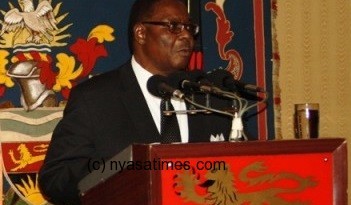
He said in his year-end State-of-the-Nation feed from Kamuzu Palace in Lilongwe that was beamed on radio and television stations on Saturday night that the Democratic Progressive Party, in its manifesto, adopted public service and public finance management reforms as priority programs of the needed transformation programme of action and wage harmonization in the public service, which is made the cornerstone of the public service reforms.
“Wage harmonization is not only necessary to revitalize the service but it is considered an important means of curbing the propensity for fraud in the service. Equally important is the fact that it restores the principle of ‘equal pay for equal work’ in the public service as was the case up to 1998 before a multiplicity of salary scales emerged,” said the President.
Economic analysts have warned that Malawi is likely to see more strikes by disgruntled workers grappling with an economic gloom with donor freeze.
Meanwhile, the country’s judicial system is paralysed after courtroom staff went on a strike while primary school teachers also at one time boycotted classes to obtain salaries not paid for almost six months.
Labour militancy appears to be on the rise.
Last week, supporting staff of the University of Malawi launched a sit in to demand a 45 percent salary hike while the country’s Anti-Corruption Bureau has its operations at a halt following similar strikes. The medical personnel are also serving notice to withdraw their labour if their salary hike demands are not met.
The President explained that the principle of “equal pay for equal work” in the form harmonization must be a core element of the transformation process and must be implemented.
“ For it simply does not make sense that a newly recruited doctor in the mainstream Civil Service should receive a starting salary that is equal to the salary of a driver in the Anti-Corruption Bureau or in Human Rights organisation.
“Nor does it make sense that a Budget Director or the Accountant General for example should receive just about half the salary of his counterparts in the Judiciary or in the National Assembly. We are unlikely to get the best from such people and we have created an environment that is conducive to fraud which progressively led to a disregard for public money as we saw during the cashgate days,” said Mutharika.
The Malawi leader said government has decided that as part of the needed transformation, salary scales in the public service be harmonized as they were between 1964-1998.
“In order to achieve harmonization, the government decided that, within the budgetary limit of an average wage bill increase of 24.4 percent, the mainstream Civil Service should have a higher increment that would permit their salary scale to be notionally higher than other salary scales in the public service except for the Anti-Corruption Bureau that remains the highest.
“We then allowed other scales to increase up to the new mainstream Civil Service salary scale. But because their scales were originally higher than that of the Civil Service, it followed that their increment were smaller,” explained Mutharika.
He stated that the gist of the strikes and other controversies is that those who had privileged salary scales want to continue to earn more than their mainstream Civil Service colleagues.
“In short they demand equal salary increments that would maintain their superiority over the mainstream Civil Service. To do this, of course means, that we would have to find extra money from somewhere. There is just no money for us to increase their salary scales,” he said.
He said Malawi government has recently signed an IMF programme premised on expenditure and therefore wage containment.
“If we break this agreement with the IMF, the chances of reducing inflation and interest rates and returning to normality will have vanished,” he said.
Mutharika said between wage containment demanded by the IMF and finding means to perpetuate privileges for a few people, the country must choose wage containment.
“However, I am aware that there is need to resolve the controversies so that the country can resume normality. For this reason, I am prepared to continue to negotiate with those who feel aggrieved,” the Head of State said.
But he said the negotiations must be within the legal framework.
“We are prepared to prevent the prevalence of anarchy that is being fuelled by a few disgruntled power hungry politicians within and outside the country,” said Mutharika but did not mention the names.
He however challenged that his government has “the means, within the law, to deal with such elements of people.”
Mutharika insisted that “unscrupulous politicians within and outside have taken advantage of the situation to perpetuate the controversy and extend it to other sectors inside and outside the public sector.”
Follow and Subscribe Nyasa TV :