

Malawi business leaders warn taxes, energy crisis choking investment
The country’s private sector giants have revealed they hold over ten trillion Kwacha in assets, but say heavy taxes, forex shortages and persistent energy challenges are choking investment in Malawi.
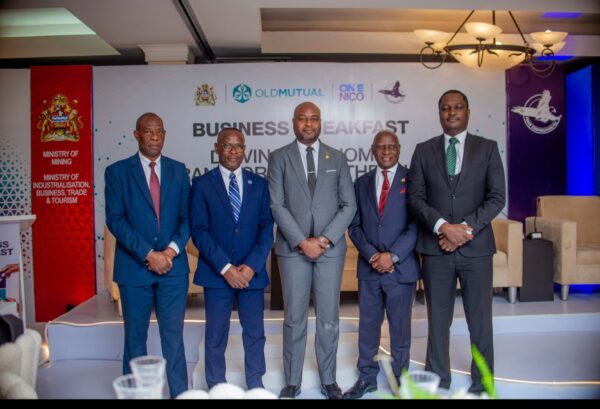
The sentiments were shared in Blantyre on Thursday during a Business Breakfast held under the theme “Driving Economic Transformation Through Collaborative Partnership”, which brought together government officials and captains of industry.
Speaking at the meeting, Minister of Industrialization, Business, Trade and Tourism Simon Itayi said government is banking on the private sector to drive exports.
“Malawians need to do more in exportation for the economy to boost,” he said, adding that government is working on a Smuggling Bill and an import substitution strategy.
He said Malawi has huge investment potential in natural and agricultural resources that can be exported to make the country competitive.
“Why should people invest in Malawi? Firstly natural resources, agricultural resources, all these can be exported. Malawi needs to export so that it should be competitive on the market,” he said.
Itayi disclosed that while Malawi has an opportunity to grow 800 to 1,000 tonnes of soya beans, this year it has only produced 200 tonnes, adding that the Malawian environment is becoming investor friendly by looking at processing for the market.
He said government is working to procure markets for soya beans, pigeon peas, sugar and macadamia nuts, noting that countries like China and America are looking for these products.
He further said government is working on cooperatives in the value chain in mining, especially gold, but the challenge remains finance and bargaining power.
He announced that special economic zones are to be opened by government for manufacturing, agro-processing and export-oriented production.
On tourism, he said government is looking at the lake and mountains and wants to partner with the private sector to develop tourism destination centres in Mangochi, Salima and Mulanje.
He said government has confirmed that it will provide a conducive environment for anyone to do business.
Minister of Mining Thoko Tembo admitted that Malawi is earning very little from its mining resources.
“For government right now to get money through mining is through mineral licensing and corporate tax and only ten percent is what Malawi is earning,” he said.
He said one issue that Malawi is failing on in mining is that it does not have enough resources, including skills and finances, to conduct profitable mining.
“The ministry has then invited the private sector to finance the cooperatives running gold mining in order for Malawi to benefit,” Tembo said, adding that some cooperatives are using solar-powered electricity to produce gold and need to be financed.
“There is so much that Malawi can do so that it becomes competitive on the market in terms of mining,” he said.
Responding, Press Corporation Chief Executive Officer Professor Ronald Mangani said mobility challenges and energy are the main factors stopping both local and international players from investing in Malawi, and asked government to consider the issue with much attention.
Old Mutual Managing Director Tavona Mbiza said Malawi cannot industrialise without finances, lamenting forex scarcity.
“Malawi cannot industrialize without finances and lack of forex is among key issues that Malawi is facing, other financial challenges include difficulty of the stock exchange. When forex is scarce it means goods will also be expensive thereby not staying competitive on the market,” said Mbiza.
NICO General Chief Executive Officer Vizenge Kumwenda was more direct in accusing government, saying huge taxes are stifling investment.
“Huge tax by government is failing people to invest in this country. The continuous review of government tax is giving a lot of problem to people wishing to invest,” said Kumwenda.
Kumwenda said as a private sector they are currently working with several cooperatives dealing with small-scale mining so that these people should be adding value to the gold they are mining, citing poor and insufficient energy supply as the main challenge, since mining requires huge amounts of electricity.
Together, NICO General, Old Mutual and Press Corporation hold over ten trillion Kwacha in assets, a financial muscle the private sector says government must unlock by fixing tax, energy and forex policies.
Follow and Subscribe Nyasa TV :