

Ben Phiri calls for food self-sufficiency in new WFP partnership
Malawi must stop relying on donor support and focus on producing enough food to feed its own people, Local Government and Rural Development Minister Ben Phiri has said, as the government signed a new partnership with the United Nations World Food Programme (WFP) aimed at tackling hunger from the grassroots.

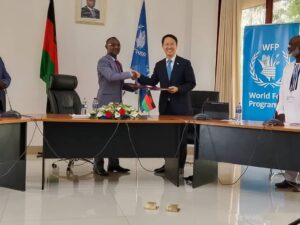
Speaking at the signing of a Framework of Cooperation between the ministry and the WFP, Phiri delivered a blunt message on the country’s food security challenges, arguing that Malawi can no longer afford to depend on external assistance when it comes to feeding its population.
The minister said the new agreement would help channel resources through the Constituency Development Fund (CDF) to boost agricultural production across the country’s districts and make better use of available land.
“As you’re aware, CDF has got an agriculture component. However, the question is, as we use CDF in agriculture, what do we want to achieve?” Phiri said.
“This MoU therefore defines exactly what we want to do, which is to increase food production and maximise the use of our land and every investment that goes into it.”
The move comes as Malawi continues to grapple with recurring food shortages, rising input costs and the effects of climate-related shocks on agricultural output.
Meanwhile, WFP Country Director Hyoung-Joon Lim pointed to the success of the organisation’s Zero Hunger Initiative, which supports vulnerable smallholder farmers with maize seed.
According to Lim, the pilot programme has already transformed harvests in 14 villages, with some farmers increasing yields from as few as three bags of maize to more than 15.
“People who used to harvest three or five bags have now harvested more than 15 bags,” he said.
“They used to have food coverage only for three or four months after harvesting, but now they have 12 months or more, with some using the surplus to invest in seed and buy their own fertiliser.”
Officials believe the new agreement will allow the programme to reach more communities, while strengthening district councils’ oversight of government and WFP-backed projects under the Malawi Country Strategic Plan 2024-2028.
The partnership is being presented as a key step in Malawi’s push to achieve food security, with authorities insisting that long-term solutions will depend not on aid deliveries, but on increasing production at household and community level.
Follow and Subscribe Nyasa TV :