

Exit Mudzi Trust, enters DAHSP: Mutharika launches cement, malata subsidy program
Malawi President Peter Mutharika on Thursday launched the Decent and Affordable Housing (Cement and Malata Subsidy Programme) at Msampha 1 Village, T/A Chadza in Lilongwe.

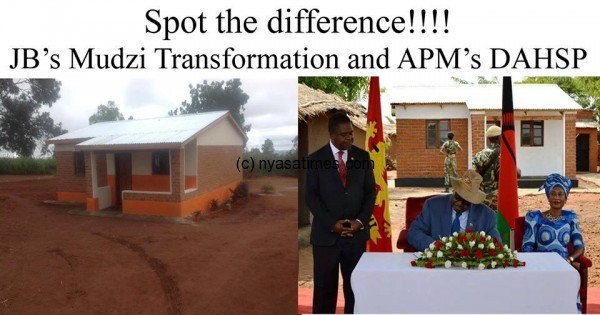
Critics says the programme mirrors the Mudzi Transformation Trust initiative by former president Joyce Banda meant to support social and economic projects for the transformation of lives of Malawians.
But government has said the new program has different objectives
The Decent and Affordable Housing (Cement and Malata) Subsidy Programme (DAHSP) has so far benefitted 9 households in T/A Chadza’s area.
Some of the DAHSP beneficiaries include Emily Chiwaya, Preacher Banda, Rosemary Maganizo, Telezio Dzoole and Falesi Chalendewa.
Besides the housing projects in the area, government has also built modern pit latrines that produce manure for Agricultural products.
Building costs in Malawi are said to be the highest in the southern African region and it is estimated that it costs 55 percent higher to construct any building in the country compared to other countries within the region, according to a recent study by the University of Malawi.
The study, conducted in 2012, shows that the high costs of construction in Malawi are to blame for the astronomical costs of construction in the country.
Mutharika said government is committed to address the housing needs of low income and
vulnerable households.
“Further research carried out by the Malawi Government with support from the United Nations Human Settlement Programme shows that Malawi needs to be constructing 21,000 housing units per annum the urban areas for a ten year period in order to bridge the gap between demand and supply of houses in the country,” said Mutharika.
Mutharika said adequate and decent housing is a catalyst for development and one of the requirements for sustainable livelihoods.
“Adequate and decent shelter forms the foundations of basic needs together with food, health, education and employment.
“It is, therefore, a given fact that lack of adequate housing compromises development and it eventually leads to the escalation of many social ills that usually arise from homelessness,” said Mutharika.
Mutharika urged all traditional authorities and their subjects, members of parliament and ward councillors to support the programme by proving sound leadership and encourage self help spirit among households wherever necessary.
Speaking during the function, Malawi Congress Party (MCP) Parliamentarian for the area, Titus Dzoole Mwale commended Mutharika for launching the programme in his area.
A quantity surveyor at the Malawi Polytechnic, a constituent college of the University of Malawi, Rodrick Chipunde is on record criticising the cement subsidies.
He argued that reducing the cement price is a welcome idea but should be done through inviting more players into the cement manufacturing business, stressing that the proposed subsidy programme is not good for the country’s economy.
Chilipunde, who is the Head in the Department of Land Economics and Quantity Surveying, suggested that the DPP government is “trying to gain political mileage at the expense of economic gains.”
University of Malawi’s Chancellor College political analyst Blessings Chinsinga—who has published studies on subsidies in Malawi—is on record saying that subsidies on their own are not bad but, he explained, it is the design of the subsidised projects that is problematic.
Chancellor College political science lecturer Boniface Dulani is also on record arguing that subsidies have not helped Malawi over the past years and that it has deprived government of money that should have been used to provide essential services in sections such as health and education.
According to Dulani, other than promoting subsidies, “the best way is to create jobs so that people can earn enough to buy food, iron sheets and cement.”
Follow and Subscribe Nyasa TV :