

First Lady Monica Chakwera Calls for Greater Investment in TB and Leprosy Fight
Malawi’s First Lady, Madam Monica Chakwera, has issued a strong call for increased investment and collaboration in the fight against tuberculosis (TB) and leprosy, warning that despite significant progress, the battle is far from over.
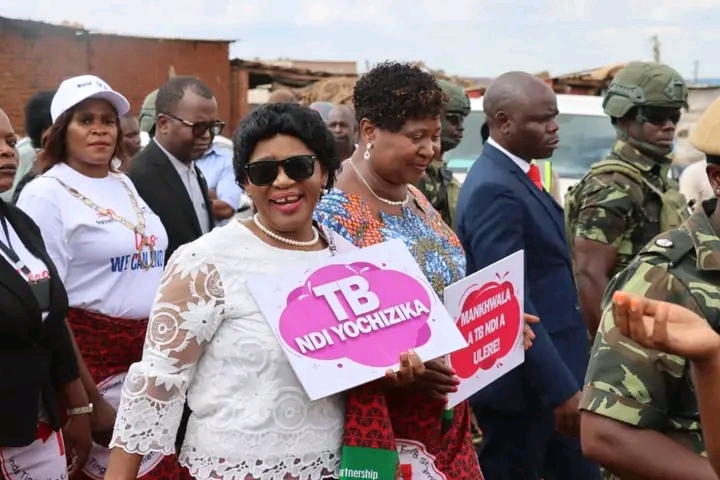
Speaking at the World TB and Leprosy Day commemoration at Mgona Ground in Lilongwe, Chakwera emphasized the urgent need for sustained funding, community engagement, and a united front to ensure that Malawi does not lose its hard-won gains. She stressed that stakeholders, both local and international, must strengthen collaboration and unity of purpose in tackling these diseases.
“We must continue to mobilize resources, combat stigma, and support those affected,” said Chakwera. “I call upon all partners and stakeholders to strengthen their commitment to this cause. The fight against TB and leprosy is not over, and we cannot afford to be complacent.”
The First Lady acknowledged that Malawi has made remarkable progress in tackling these diseases. She cited a 40 percent reduction in TB incidence, from 197 cases per 100,000 people in 2015 to 119 per 100,000 in 2023. She also noted that treatment success rates had surged from 82 percent in 2015 to 91 percent in 2023, while HIV co-infection among TB patients had decreased from 50 percent in 2018 to 43 percent in 2024. In addition, she highlighted that drug-resistant TB treatment success rates had improved significantly, rising from 55 percent in 2018 to 72 percent in 2022.
“These figures give us hope that we are on the right path,” she said. “If we stay the course and remain committed, I believe Malawi can achieve the End TB targets within the next five years.”
Despite these achievements, the World Health Organization (WHO) has warned that Malawi’s fight against TB remains fragile due to critical financing gaps. A WHO representative at the event stressed the urgent need for bold and diversified funding to ensure widespread access to TB prevention, treatment, and care.
“TB cannot be defeated without proper financing,” he said. “We need a bold approach to funding, not only from international partners but also from domestic resources. Malawi has made significant progress, but the fight is far from over. More investment is needed to close gaps in access to TB treatment, improve diagnostics, and drive research and innovation.”
The WHO representative praised Malawi’s efforts in integrating TB and HIV services, which have contributed to a 54 percent decline in TB mortality among HIV-negative individuals and a 60 percent decline among those living with HIV. However, he cautioned that Malawi remains on the WHO list of high-burden TB/HIV countries, with a co-infection rate of 56 per 100,000 people.
Madam Chakwera’s passionate plea serves as a wake-up call for policymakers, development partners, and the private sector to step up and take decisive action. She warned that without urgent investment, thousands of Malawians remain at risk, and the country’s efforts to eliminate TB and leprosy could be derailed.
“We have come a long way, but the stakes are too high for complacency,” Chakwera declared. “Every Malawian deserves access to quality healthcare and treatment. We cannot rest until TB and leprosy are eradicated from our country.”
Follow and Subscribe Nyasa TV :