

From political historian and economist on Malawi ‘moment of hope’: Tinalema abale!
A hearty congratulations to the Tonse Alliance for their victory in the just held elections.The battle for this victory was long and costly: demonstrations ground the economy to a halt, public and private property alike was damaged and destroyed. Malawians were united in making the country ungovernable in the process of reclaiming their stolen vote.
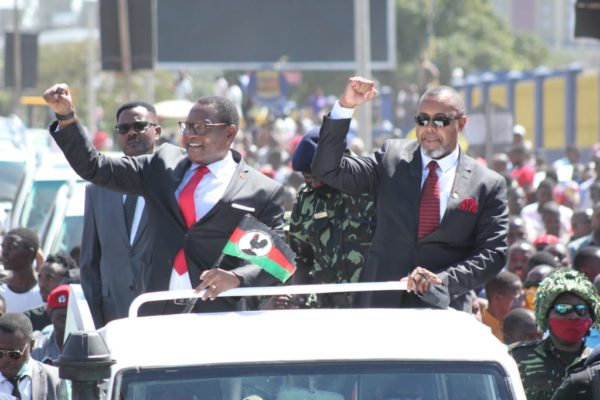
But why are we using the word battle? What was being battled against? Professor Danwood Chirwa implied that it was a battle of ‘good versus evil’, an evil ‘still intent on holding [its] knee on the neck of innocent Malawians’. Strong words! The alliance therefore comes in at a time when Malawian citizenry are tired and annoyed!
There is no doubt that Malawians were tired of the ‘DPP System’, one they saw as corrupt, tribalistic, nepotistic, characterised by impunity and thuggery, one that muzzled decent civil servants and police and let opportunists and ill-educated cadres and cadets run the nation. Malawians are tired of seeing their tax money squandered building houses and being spent on building personal fortunes. They were equally tired watching a deaf president, surrounded by a coterie of hangers on making promises and laying foundation stones which he could not fulfil. Malawians are tired of rigged elections and pilfering of public funds.
Malawians were so tired that 82 percent of people that claimed to be DPP supporters in an Afrobarometer survey in 2018 were of the opinion that the country was going in the wrong direction; likalimba tsoka amakuluma ndi galu wako amene in poetic display. This is the litany of woest hat finally did it for Arthur Peter Mutharika and his version of the DPP.
To our new leaders and to all of us: as we celebrate your win it is worth pointing out that we have been here before. If in 1994, we chose democracy, in 2020, we nearly went back, willingly or unwillingly, to an autocracy, rigged, elected or otherwise. Former president Bakili Muluzi once said: ‘A Malawi amaiwala msanga? The new regime would do best to avoid some of these past mistakes. Arguably most important is an immediate stop to state sponsored lies.
Malawians are tired of the disreputable state broadcaster, the MBC. The MBC, under the late Bingu and then Peter Mutharika deteriorated to a level that few, even DPP loyalists, could trust. An essential and crucial ingredient in maintaining public trust is a free and honest flow of information between government and its people. The MBC was telling people kwacha when people could see with their eyes that, really, kwada! The media is an important ingredient. We do not want to depend on manongonongo a pa social media.
We want our vibrant Zodiak, Times, MIJ FM, Capital and others to be free to give us various aspects of news. Rumours did it for previous regimes (remember the Chilobwe murders, Vampires, et cetera) and in the age and world of social media rumour is even more rampant than the old orality. The provision of accurate information is essential. We do not need another tiring Nicholas Dausi boring us with his English and empty rhetoric, no matter how amusing. It does not fill the belly, never mind the mind.
For longevity and delivery, alliance leaders and supporters alike must learn from lessons on political alliances globally. National progress depends on strong, firm but fair governance. And that in turn depends on the leadership. If there is a characteristic political alliance share with businesses, it is the fact that 98 percent of them fail if leadership is errant. Lazarus Chakwera and Saulos Chilima must practice, show and maintain a united developmental leadership. The elections are over. It is time for work, not egos.
The followers must also help here. Too often in the past, beginning with Kamuzu Banda, passing Bakili Muluzi, Bingu wa Mutharika, Joyce Banda, through to Peter Mutharika, the unity at the top has been destroyed by opportunists singing manong’onong’o, lies and sycophancy to the presidents. Leaders like Muluzi, Bingu and, particularly, APM allowed ill qualified sycophants to cheat or mislead them. One suspects that even now Peter Mutharika is being told that, really, most Malawi people love him! In a coalition this risk of opportunists misleading leaders is even greater.
It’s also worth observing that Malawians clearly won’t allow a political culture that includes long presidential motorcades holding them back from going home at 5pm; stopping traffic for one hour on the M1; making policemen and women queue all the way from Blantyre to Lilongwe.
All the while people starved or lacked medicines in hospitals. An ‘animal farm’ political culture that meant that ‘all animals were equal, but others were more equal’ is a thing Malawians are yearning to see the back of. The people are also tired of a timid civil service. A service reduced; some say by their own volition to being agents of a ruling party. One hopes the new administration’s cadre won’t throw their collective weights about in offices and parastatals.
The scenes that have played out throughout the country since June 2019 show that Malawians were tired of the inefficient police, a police force that had been politicised and was scared even to say boo to ‘ana adadi’. The evidence is not anecdotal and is supported by a fact that is very illustrative.
While 62 percent of Malawians said they trusted the army a lot in 2018, only 36 percent held similar sentiments towards the police. Instead of tackling crime, the police were becoming DPP cadets ‘B Team. Malawians need an efficient police force, like they had in the past. The police are an essential ingredient in law and order maintenance. It must be reformed to enable it to become truly independent and impartial. We do not need a police force that spends its time harassing motorists on the roads for bribes or one that watches helplessly as ana a anthu olamula attack civilians.
Lastly, if we are leaving an era of ‘evil and corruption’ behind we need serious and lasting reforms. The sequencing of reform is as important if they are to be long lasting. It is often the case that people are misguided in their belief on how to implement reforms. World renowned economist Milton Freidman learned this lesson in China. Urging the Chinese to implement reform the same way as one would conduct an operation to cut of a rat’s tail; Freidman’s advice was direct – just cut off the tail with one swing.
The Chinese, aware that implementing lasting reform in developing countries is much more complicated than that; were gracious in their acceptance of the advice while offering further clarity to the problem at hand: “… our problem (Professor) is that our rat has many tails and we don’t know which one to cut first”.
Similarly, your excellences, Malawians are tired of the multi-tailed rat that keeps growing more tails every year. It would be an honour to see you tackling them efficiently.
Follow and Subscribe Nyasa TV :