

IMF declares Malawi on-track for Extended Credit Facility
International Monetary Fund (IMF) says Malawi is on-track to revive the Extended Credit Facility (ECF) programme with the fund which has been attributed to good management of domestic finance since September 2015.

ECF, approved in July 2012, is IMF’s main tool for medium-term financial support to low income member countries such as Malawi.
IMF Chief of Mission to Malawi Oral Williams says IMF appreciates the hard work that government put in to bring programme back on track.
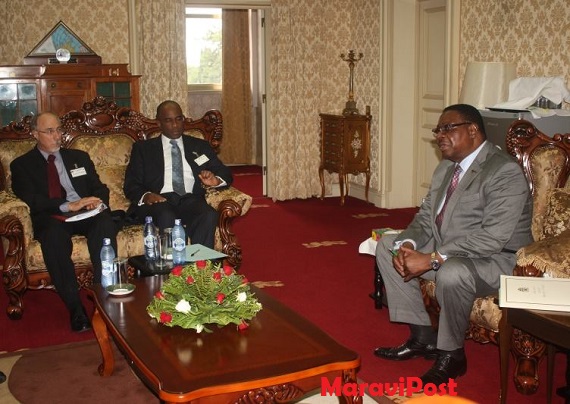
Williams was speaking to the media after meeting government officials led by Minister of Finance Goodall Gondwe in Lilongwe on Wednesday.
“Regarding program performance, the authorities have demonstrated a concerted effort to put the program back on track. Program targets on net domestic financing and net domestic assets of the Reserve Bank of Malawi for end December 2015 were met,” said IMF.
However, IMF noted that the buildup in net international reserves fell short of the end-December program floor owing to lower-than expected export revenues and some smoothing of the excessive volatility in the foreign exchange market.
“ On the structural side, reforms in the financial sector were carried out as planned. Improvements in public financial management (PFM), in particular bank reconciliations, are gaining momentum but this needs to be sustained,” said IMF.
In November last year the IMF noted that Malawi was in a “tight situation” to revive the off track ECF programme but pointed out that it was encouraged with measures government was implementing, including cutting the 2015/16 National Budget as recommended by the fund’s mission that certified ECF off track.
The latest IMF brief assessment on Malawi came on the back of another end-June 2015 review undertaken by the fund’s mission in September which prompted IMF to declare the ECF off track due to government’s failure to meet some key agreed programme targets mostly on net domestic financing and on the Public Finance Management Reforms.
Malawi’s headline inflation rate is one of the highest rates the country has registered in recent years as average prices for most goods and services are soaring unabated.
“ Rising food prices and a sharp depreciation of the kwacha contributed to annual inflation increasing to about 25 percent at end-December 2015. Inflation has since fallen slightly to 23.4 percent in February 2016 and non-food inflation has been on a clear declining trend, suggesting that the appropriate adjustments in monetary and fiscal policies are having their intended effects,” IMF noted.
IMF also said commitment to the flexible exchange rate regime and the automatic fuel pricing mechanism have helped Malawi to respond to external shocks.
“ The kwacha which depreciated by more than 35.6 percent from July 2015 to early March 2016—a trend mirroring that of neighboring countries—has begun to stabilize. This in part reflects efforts by the central bank to absorb excess liquidity from the banking system, greater fiscal discipline, and the advent of the tobacco season.”
The global lender said it reached understandings to ensure that recent improvements in macroeconomic policy implementation in Malawi are sustained.
“Restoring macroeconomic stability by bringing inflation—which has been stuck above 20 percent since mid-2012—down to single digits, remains the most important policy challenge in the near term. The revised fiscal framework recently approved by parliament is sufficient to meet the end-June 2016 program target on net domestic financing.
“Prudent fiscal policy, when combined with a tight monetary stance to maintain positive real interest rates, should place inflation on a downward path.”
IMF mission said it welcomed Malawi government’s efforts to strengthen commitment controls over spending, by requiring Ministries, Departments, and Agencies to provide detailed fiscal reports before receiving additional allocations.
The fund appealed to Malawi government to “exercise restraint “on the wage bill which now accounts for about 34 percent of revenues.
It also underscored the need to mobilize domestic revenues in line with Malawi’s sustainable development goals by broadening the tax base and strengthening tax compliance.
“Based on progress to date, it is anticipated that a request to complete the seventh and eighth reviews under the ECF-supported program could be submitted for consideration by the IMF’s Executive Board in May 2016.”
IMF mission met with President Arthur Peter Mutharika, Minister of Finance Goodall Gondwe, Governor of the Reserve Bank of Malawi (RBM) Charles Chuka, other senior government and RBM officials, a broad range of national stakeholders outside government, as well as representatives of Malawi’s development partners.
Meanwhile, IMF has promised to assist the government in formulating the 2016/17 budget so that domestic borrowing remains in check. –Additional reporting by Thom Chiumia, Nyasa Times
Follow and Subscribe Nyasa TV :