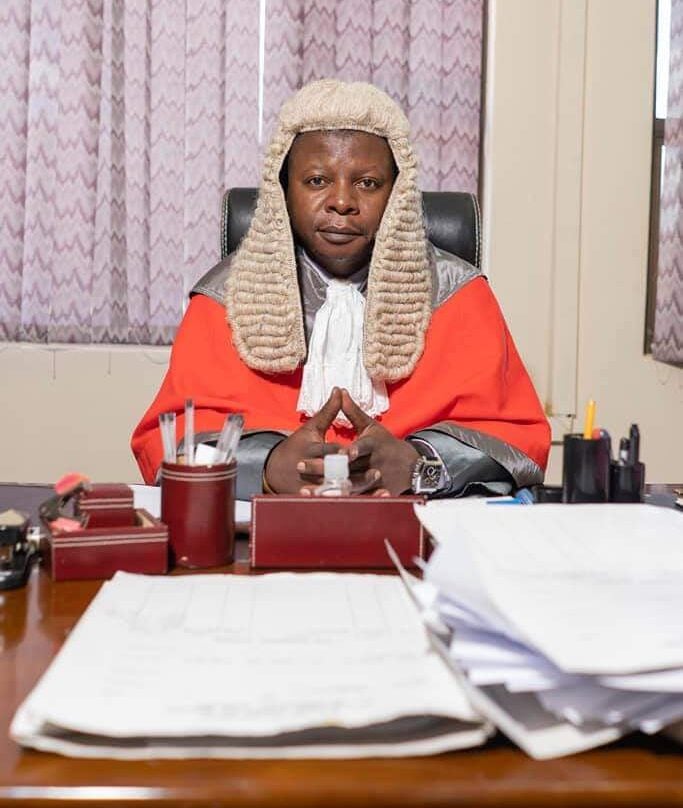
Questions are mounting over the apparent silence from both the Judiciary and the Financial Intelligence Authority (FIA) as serious corruption-related allegations surrounding High Court Judge Kenan Manda continue to circulate, with no clear public update on investigations that were triggered more than a year ago.
Justice Kenan Manda: Facing serious accusations
At the centre of the controversy are multiple complaints involving Judge Manda’s conduct while presiding over cases in the Commercial Division of the High Court—allegations that have raised concerns within financial crime enforcement circles and among legal stakeholders about possible inconsistencies in judicial decision-making that could undermine Malawi’s financial crime framework.
The Financial Intelligence Authority first formally escalated concerns on April 4, 2024, writing to the Chief Justice and warning of what it described as troubling patterns in judicial decisions that risk weakening the enforcement of financial crime laws.
One of the key cases cited involved Zahra Ali versus First Capital Bank, where a preservation order freezing K100 million issued by the Financial Crimes Division was later effectively neutralised by a parallel injunction from the Commercial Division ordering the release of the same funds.
To the FIA, this raised a serious systemic concern—one that allowed litigants to navigate between divisions of the High Court in what has been described in legal circles as “forum shopping,” effectively undermining state efforts to enforce financial crime measures.
While the Chief Justice reportedly acknowledged the gravity of the matter and referred it to the Judicial Service Commission (JSC) for disciplinary review, the process that followed has drawn criticism for its lack of transparency and prolonged delays. The Malawi Law Society has since described the inquiry as “overly secretive and slow,” noting that although investigations were initiated, there has been little public communication on findings or outcomes.
By January 2025, reports indicated that at least four complaints against Justice Manda had been substantiated and were under further investigation. However, as of early 2026, no final report or conclusive disciplinary determination has been made public, leaving the matter unresolved within the system tasked with ensuring judicial accountability.
Complicating the situation further is the absence of a fully operational oversight framework, despite the enactment of the Judicial Service Administration Act in 2025, which was intended to strengthen disciplinary mechanisms and establish an Independent Complaints Commission for the Judiciary. According to the Malawi Law Society, key structures under the law have not yet been fully implemented, leaving gaps in enforcement and accountability.
“The investigations ought to have been concluded promptly,” the Malawi Law Society observed in its communication to PIJ Malawi, warning that delays and institutional gaps continue to undermine public confidence in judicial oversight.
At the same time, the Financial Intelligence Authority has not issued any updated public statement on the progress or outcome of its referral, despite the seriousness of the allegations involving potential interference with financial crime enforcement mechanisms.
Meanwhile, Judge Manda has also filed a defamation lawsuit against private legal practitioner Alexious Kamangila, who publicly alleged judicial corruption in a series of social media posts. Kamangila accused the judge of being part of what he termed a “certified list of corrupt judges,” citing several rulings he believes reflect systemic bias or irregularity.
One of the most contested cases referenced by Kamangila involves an injunction relating to Salima Sugar Company, which he argues was legally indefensible and indicative of deeper problems within the judiciary. However, these allegations remain untested in a formal disciplinary conclusion.
In response, Justice Manda obtained a court injunction restraining Kamangila from repeating the allegations and is pursuing K250 million in defamation damages, effectively shifting part of the dispute into a parallel courtroom battle.
The situation has created what legal observers describe as a complex overlap of processes: an unresolved judicial disciplinary inquiry on one hand, and an active civil defamation case on the other—both centred on the same underlying allegations, but proceeding on separate tracks.
Kamangila, meanwhile, claims he is facing intimidation and professional isolation as a result of his allegations, saying he relied on a combination of personal legal analysis and information from sources within the justice system. The Malawi Law Society has acknowledged the importance of whistleblower protections but maintains that formal channels remain the appropriate route for raising judicial misconduct concerns.
Despite these developments, neither the Judiciary nor the Financial Intelligence Authority has issued a comprehensive public update clarifying the status of the investigations, the findings of the Judicial Service Commission, or the future of the disciplinary process.
This silence has intensified public scrutiny, especially given the sensitivity of cases involving financial crime enforcement and high-value commercial disputes, where judicial consistency is critical to maintaining investor confidence and rule of law credibility.
Justice Manda, the FIA, and the Judiciary had not responded to requests for comment at the time of publication.
_______________________
This story was first published by the Platform of Investigative Journalism (PIJ).
Follow and Subscribe Nyasa TV :
Follow us in Twitter
One reply on “Judiciary and Financial Intelligence Unit Silent as Corruption Allegations Against Judge Ken Manda Deepen”