

Kangankunde builds skills, partnerships and foreign exchange for Malawi
The Kangankunde Rare Earth Mine in Balaka District is getting ready to start production. The mine was connected to the national grid ink early October 2026, staged commissioning of the process plant is scheduled for late November, and the first monazite concentrate is targeted for December 2026.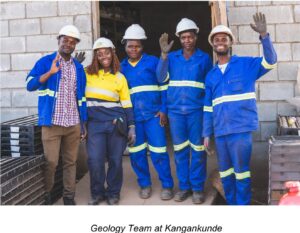
For Lindian Resources and its Malawian company, Rift Valley Resource Developments (RVRD), reaching production has never been only about building a plant.
Over the past two years the project has invested in schools, roads, community safety, banking and skills for people who live around the mine.
As Kangankunde prepares to send out its first product, the focus is widening to two things Malawi needs urgently: foreign exchange and trained Malawians who can do the skilled work a modern mine requires.
Bringing foreign exchange into Malawi
Malawi depends on foreign currency to import fuel, fertiliser, medicines and machinery, and every new source of export earnings makes a difference. Kangankunde is set to become one of those sources.
The benefit has started even before production. More than US$100 million of private capital has already been invested in Malawi to build the project.
That money has been used to invest in the community and infrastructure, pay Malawian workers, contractors and suppliers, and buy goods and services from Malawian businesses.
The project has also chosen to work with local suppliers and Malawian financial institutions. In April 2026, RVRD secured a US$11.6 million facility from NBS Bank, a member of the NICO Group.
This shows that local banks can play a real part in financing a new mining project, and it keeps more of the project’s financial activity inside Malawi.
The company also reportedly bought about US$10 million in capital equipment from local suppliers, along with millions of dollars in sundry items needed for site construction, a much-needed boost to the local economy.
Once production begins, Stage 1 of Kangankunde will mine about 500,000 tonnes of ore a year and process it at the mine to produce up to about 20,000 tonnes of monazite concentrate annually.
The concentrate will travel by rail through the Nacala corridor to international customers. Sales are paid in US dollars, and the export proceeds will flow back through the Malawian banking system, with NBS Bank processing RVRD’s export proceeds.
Lindian is also looking beyond its initial Stage 1 mining and beneficiation. Under the guidance of Minister of Mining Thoko Tembo and the Mining and Minerals Regulatory Authority (MMRA), the company has said it will apply to upgrade its mining licence from medium to large scale as soon as possible.
Tembo toured Kangankunde in September 2026 with officials from her ministry.
In October 2026, the Reserve Bank of Malawi provided export compliance training to RVRD’s finance, procurement and inventory teams, alongside representatives of NBS Bank, to support preparations for mineral exports.
Exports will also generate significant royalties and taxes for the Government of Malawi. Stage 1 is estimated to contribute about US$25.5 million a year in royalties, foreign exchange and corporate income tax, supporting public services and economic development across the country.
Training the people who will run the mine
During construction, Kangankunde employs more than 3,500 people, including contractors, and more than 90 per cent of them are Malawian nationals.
Many come from the 15 Group Village Heads surrounding the mine, so the jobs are reaching the families who live closest to it.
As the mine moves from construction into operations, the site will require about 400 full-time workers, most drawn from local communities.
The type of work is changing, and so is the training. Operator training for local workers has started at the process plant, based on the plant’s standard operating procedures.
The first plant supervisor and control room operators have already been trained, and more supervisors and control room operators will join in early November 2026. With the control room now powered up, new operators can train on the same control systems they will use once the plant is running.
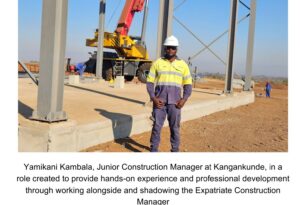
Expatriate staff at Kangankunde hold only specialised positions where the skills are not yet readily available in Malawi.
An important part of their job is to work side by side with their Malawian colleagues and pass on what they know, so that over time more of these positions are filled by Malawians.
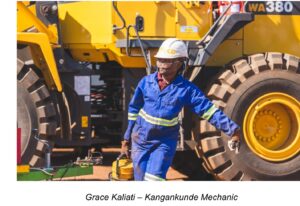
The results can already be seen in the people. Grace Kaliati, from Sanudi Village near the mine, started at Kangankunde as a security guard in February 2026.
When a mechanical position opened up, she applied and moved into a mechanic’s role, putting to use the mechanics certificate she earned at Andeamo Technical College in Balaka.
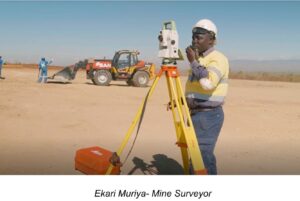
Ekari Muriya, a qualified surveyor, is a middle manager at the mine. He trains and supervises a team of six people from the surrounding communities, while working under an experienced mining professional with global expertise.
In this way, skills move from one level to the next. One member of his team, Thoko Magombo, joined the mine as a gardener. Today she is a trainee surveyor and her team’s safety champion.
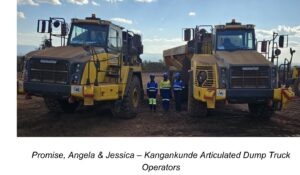
Women are also taking up roles once seen as only for men. When a delegation from the MMRA and the Manifesto Implementation Unit in the Office of the President and Cabinet visited Kangankunde on 14 October 2026, they commended the project’s community employment and gender inclusion.
They pointed in particular to young women from the surrounding communities who now operate some of the articulated heavy-duty dump trucks on site.
Training is not limited to the pit and the plant. Office teams have been trained by the Reserve Bank on export procedures, and NBS Bank plans to run financial literacy lessons for staff and interested community members.
For many newly recruited workers, especially those from nearby villages, this is their first regular income. Knowing how to save and plan makes that income go further.
Listening first: a renewed Community Engagement Plan
Under Section 289 of the Mines and Minerals Act 2023, every mine must have a community engagement plan. The plan is also the foundation on which a Community Development Agreement is negotiated with traditional authorities and government institutions.
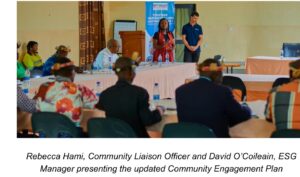
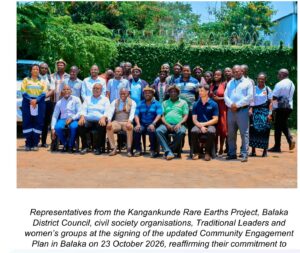
On Friday 23 October 2026, the Kangankunde Rare Earths Project team met in Balaka with Balaka District Council, civil society organisations, traditional leaders and women’s groups to review and sign an updated Community Engagement Plan.
The new plan renews the one first agreed in 2024 and reflects where the mine is today, as it moves from construction towards production.
Meaningful engagement goes beyond sharing project information. The plan sets out how the project will keep two-way communication open with surrounding communities, share information, gather feedback and manage grievances, so that community voices remain at the centre as the mine grows.
The plan names priority areas for social investment: education and skills, including school infrastructure, bursaries, technical training and adult literacy; health and wellbeing, including primary care, malaria and maternal health; local enterprise and livelihoods, through support for small businesses and local suppliers; essential infrastructure such as water and sanitation, roads and energy; cultural heritage and community life, including sport and small grants; and the environment, through protection and rehabilitation of degraded land.
The plan is equally clear about what the project will not fund. There will be no cash or personal gifts to individuals, traditional leaders or officials, and no donations to political parties or campaigns.
The project will not fund activities outside its area of influence without a documented reason, duplicate government services without a formal partnership, spend outside the Community Development Agreement or annual plan, or support organisations that lack basic governance and financial transparency.
Setting clear expectations from the start promotes transparency and accountability, and allows the community and the mine to plan together with confidence.
What has been delivered on the ground
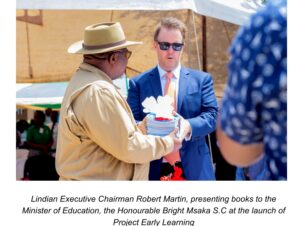
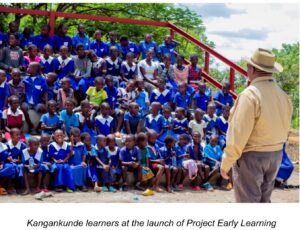
The renewed plan builds on work the project has already completed. At Kangankunde Primary School, which serves around 400 learners, Lindian Resources has invested over US$1 million, working with the Ministry of Education. Two existing classroom blocks and the teachers’ office block have been refurbished, and four new classroom blocks, a sick bay, a netball court with a supporters’ stand and a school fence have been built.
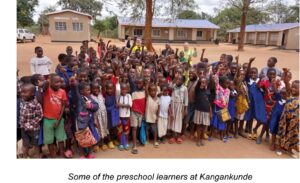
Two pre-school classroom blocks were also built for children aged two to five. In Malawi, only 34 per cent of children have access to early learning, which is crucial for brain development and a smooth start in primary school.
More than 100 young learners now attend the pre-school. The project also built modern toilets and girls’ changing rooms and repaired the school’s broken borehole, so the school once again has its own safe water supply.
Beyond the school, the project built an access road linking Kangankunde to the M1, about six kilometres away. The road serves the mine, but it also makes it easier for residents to reach Balaka town, where the district hospital and local government offices are, and opens the area to trade with Blantyre and Lilongwe.
In Traditional Authority Chanthunya, residents had mobilised their own resources to build a police unit but could not finish it. Lindian stepped in to complete the building, which was officially opened by Eastern Region Police Commissioner Barbara Mchenga Tsiga on 1 November 2024. According to Senior Traditional Authority Inkosi Chanthunya, having police in the area has made the community safer.
Women, culture and banking close to home
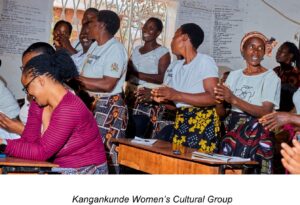
On 6 September 2026, the project’s Community Relations team launched the first Kangankunde Women’s Cultural Group under Group Village Head Makolera. About 50 women attended, and the initiative will grow to cover five group village heads.
Through the group, women will access financial literacy, health, nutrition and awareness programmes, take a more active role in community development and help preserve local culture.
At the first meeting, the women were already sharing ideas for home-based businesses to serve the growing economic activity around the mine.
That activity has also created demand for banking services closer to the mine. Kangankunde is working with NBS Bank to open a service agency at the site. It will bring unbanked people into the formal banking system and cut about an hour and a half from the journey to the nearest bank.
It is encouraging to see a mining company invest so early and so practically in the people around its mine, before the first tonne of product has been sold. Lindian’s approach of building skills, working with Malawian institutions and agreeing clear rules with the community is an example other aspiring miners in Malawi would do well to follow.
For the communities around Kangankunde, Senior Traditional Authority Inkosi Chanthunya says progress will be measured by the lasting opportunities created for people who live nearby and across Malawi.
With foreign exchange about to flow, Malawians being trained for skilled roles, and a renewed plan agreed with the community, that journey is well under way.
Follow and Subscribe Nyasa TV :