

Malawi lockdown raise suspicion, backlash
From all the corners of the country, the message is clear: the nationwide 21-day lockdown announced by the Minister of Health Jappie Mhango together with President Peter Mutharika this week, in the awake of Covid-19, will hurt the poor and other vulnerable groups in the absence of cushioning measures.
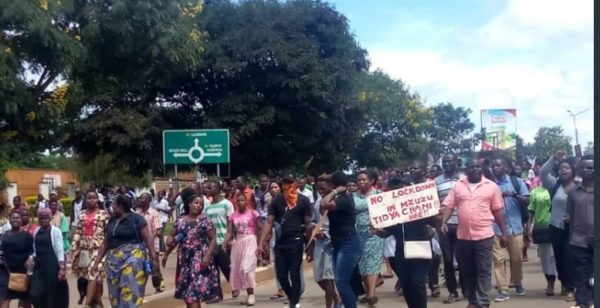
The majority of the people are in the informal sector who live from hand to mouth. A lockdown of 21 days will not only kill their small scale businesses on which they survive, but push them into hunger and more poverty.
The already fragile Malawian economy cannot afford to have a prolonged lockdown without adversely the vulnerable groups. It has suffered external shocks because of the Global Covid-19 pandemic which has affected tourism and other sectors.
Opposition political parties and other interest groups see the move as a political ploy by DPP to delay July 2 presidential elections following the Constitutional Court’s nullification of 21 May 2019 elections. They accuse Mutharika of trying to extend his term beyond July 2. They also accuse government of copying lockdown restrictions from other countries without assessing the relevance of the conditions to Malawi.
While lockdown may be necessary to stem the spread of the coronavirus, government should have carried out an in-depth analysis of the pros and cons of the measures to lessen the burden on the poor and other vulnerable groups.
From the available statistics of Covid-19 cases, Malawi registered its first case on April 2. By 16 April, there were 16 cases with two deaths. The cases have been reported in the southern and central regions. The fact that northern region has not registered a single case, does not mean that some people may not have it.
However, in the absence of any confirmed case, we can assume that there is none. This means that the disease is not yet a pandemic. What is the justification of declaring a 21-day lockdown with such low cases? Why not start with 14 days? Then extend the number of days if the situation is getting worse.
The other option could have been to restrict movements of people within regions or districts and carry out a mass screening exercise in streets, hospitals, clinics and other makeshift centres to assess the extent of the disease. Those found to be positive should be quarantined. Citizens entering the country should put them on mandatory quarantine.
You don’t just lockdown a country and do nothing. Lockdown the country and begin to test people everywhere and disinfect buildings and other public places. However, knowing how shambolic the government is, there are no plans for a random or mass testing exercise so that people know their Covid-19 status. Thus there will be no activity that will be carried out during the lockdown other than keeping people at home. So people will just be staying at home to prevent a disease that is not widespread.
Some rules governing the lockdown are also contradictory in certain aspects and one wonders how they can prevent the disease from spreading. One rule says: ‘‘all central markets shall be closed. Notwithstanding the generality of the preceding measure, local markets within localities shall remain open from 5:00 am to 6:00 pm on any day.’’ Will there not be overcrowding at these markets as people from different places go to buy food? Will this not be a recipe for spreading the virus?
Another rule says: ‘‘Except for enforcement officers, no person shall be allowed to leave their homes unless they are listed under Rule 11(3)(a)(i) 6 of the Public Health (Corona Virus Prevention, Containment and Management) Rules 2020.’’ This rule does not make any sense because the other rule allows them to leave their home to buy food at a local market. Is government saying people have to stockpile food for 21 days or they starve? This is not Europe or US where people can buy food and store it in the fridge for months.
And how will small businesses, poor people and other vulnerable groups survive with such hostile conditions? Mind you, some workers may not earn a salary this month or next month. How will they survive? That is why there is such backlash from many Malawians to the lockdown.
Leaders need to be critical when making decisions and not to put their political survival first at the expense of the welfare of the people. And politically, DPP has shot itself in the foot because the lockdown has made the government very unpopular.
Unless government relaxes some lockdown conditions, they should expect ugly scenes. It is human nature to resist anything that threatens their survival.
Follow and Subscribe Nyasa TV :