

Mutharika’s audit of his own presidency
There is something almost disarming about a politician marking his own homework in public, and President Peter Mutharika did just that on Wednesday, awarding himself precisely 50 per cent for the first half of his self-appointed mission and a rather more generous “maybe halfway” for the second.
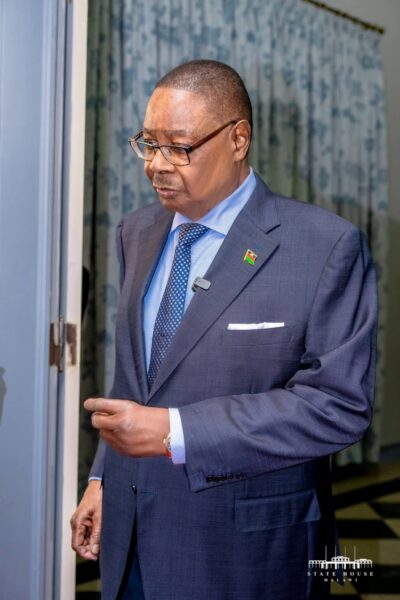
The occasion was his departure for South Africa – a private visit, his fourth in seven months, though the President did not pause to explain what draws him there so regularly.
Instead, he used the moment to offer Malawians a progress report on the comeback he embarked on with the promise of two objectives: rescuing the country from the spectre of one-party rule, and rescuing its economy from rather more mundane troubles.
On the first, he was unequivocal. “That I succeeded,” he declared, “so I achieved 50 percent of my objective” – a formulation that treats democratic preservation and economic revival as equally weighted halves of a single ledger, which is either a neat rhetorical device or a genuine account of how the President ranks his priorities.
On the second, the language grew notably softer. Malawi’s economy, he said, is “almost successful, maybe halfway” – a phrase that manages to claim credit and hedge against scrutiny in the same breath. Indicators, he assured his audience, point “in the right direction.” Which indicators, and how far in that direction, he did not say.
This is, of course, a familiar posture for a leader who has governed before and knows the value of patience as a political argument.
Mutharika’s insistence that recovery “takes time” and cannot happen “overnight” draws implicitly on his 2014-2020 tenure, when similar assurances met with rather mixed results.
It is not an unreasonable point – economies rarely turn on a single budget cycle – but it is also a convenient one, allowing incomplete outcomes to be recast indefinitely as work in progress.
The appeal for unity that followed was equally telling. “There have been a lot of talkings,” Mutharika observed, without specifying whose talking troubled him most – though it is not hard to guess that some of it originates within his own Democratic Progressive Party, where the question of who inherits the presidency in 2030 is presumably already being discussed with more urgency than the President finds comfortable.
His answer was to close the subject rather than open it: the succession, he said, will be settled by contest, in due course, among party members, and not a moment sooner.
What emerges is a leader confident in the first half of his self-assessment and considerably more circumspect about the second – and rather less forthcoming than most would like about a fourth undisclosed trip taken while delivering the verdict.
Follow and Subscribe Nyasa TV :