

Power Shifts from Capital Hill to Villages as CDF Jumps to K5 Billion Per Constituency
Perhaps the most politically transformative announcement in the entire address was the expansion of the Constituency Development Fund from K220 million to K5 billion per constituency per year, a move that fundamentally reconfigures how development resources flow within the Malawian state.
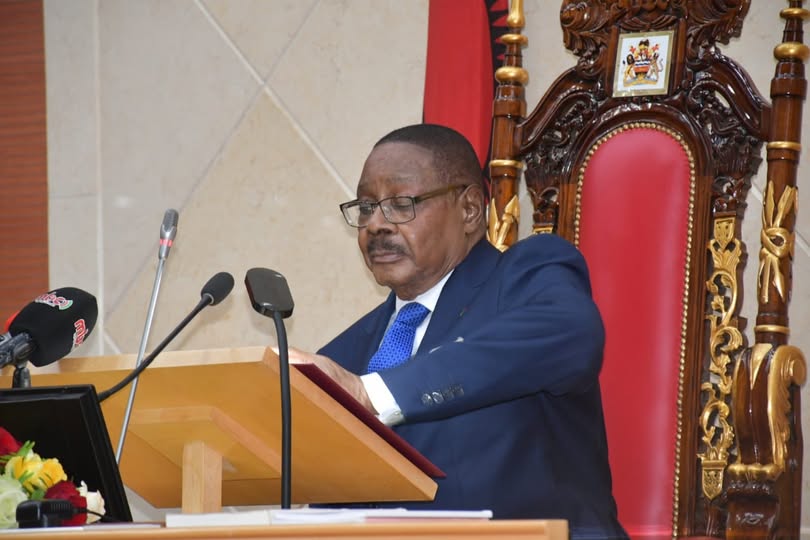
President Peter Mutharika, making his State of Nation Address in Lilongwe, framed the reform as a correction of historical injustice, arguing that for decades development decisions had been monopolised by ministries and technocrats in Lilongwe, far removed from the realities of rural communities.
He said the new CDF structure would allow communities to directly finance clinics, school blocks, irrigation schemes, bridges and market infrastructure without waiting for approval from central government agencies that often delay or politicise projects. According to the President, decentralisation was no longer an administrative experiment but a deliberate political choice to shift power from the capital to the grassroots.
Mutharika also announced the introduction of a national digital monitoring system that would allow citizens to track CDF-funded projects online, including budgets, contractors and completion status.
He said this was designed to close what he called “the corruption gap between policy and practice”, where funds are allocated on paper but never materialise on the ground.
Political analysts argue that the sheer scale of the new CDF makes Members of Parliament more powerful than at any point in Malawi’s democratic history, effectively turning constituencies into semi-autonomous development units.
While civil society organisations have warned that the reform risks institutionalising corruption if oversight mechanisms fail, the President insisted that accountability would follow the money, not disappear with it.
Follow and Subscribe Nyasa TV :