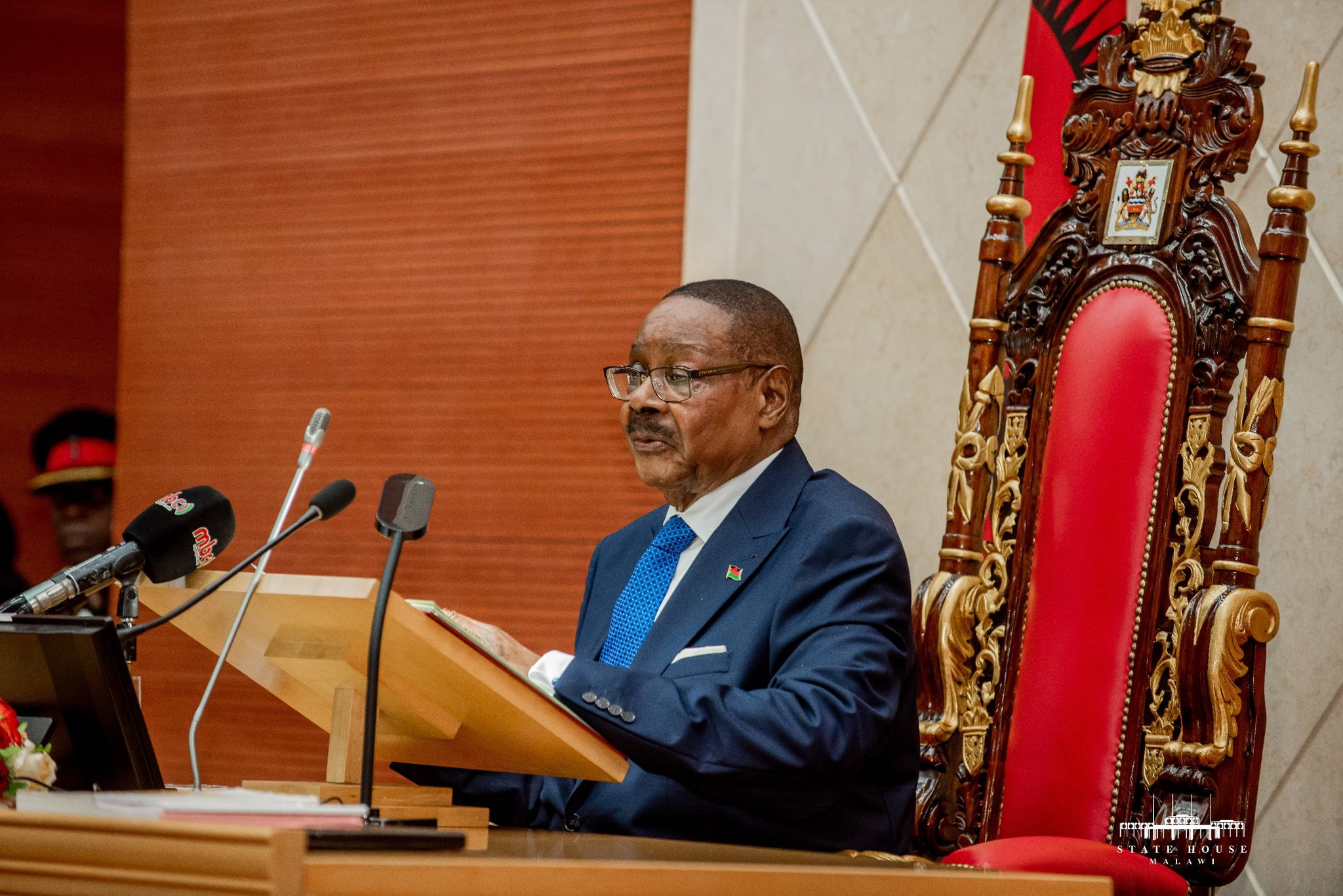
When Peter Mutharika delivered the State of the Nation Address (SONA) earlier this year, he painted a picture of a country on the brink of economic recovery — promising a shift from crisis management to bold structural reforms that would revive Malawi’s struggling economy.
Mutharika making his SONA address
But weeks later, the national budget presented by Finance Minister Joseph Mwanamvekha has exposed a stark contradiction between the optimism of the SONA and the brutal reality of Malawi’s fiscal situation.
At the centre of the contradiction is the country’s ballooning debt.
Malawi’s public debt has now reached K23.9 trillion, equivalent to 90.9 percent of Gross Domestic Product (GDP) — a level economists warn is dangerously high. Even more alarming, the government is expected to spend K2.793 trillion this year on interest payments alone, meaning a massive portion of public funds will go toward servicing old loans rather than funding development.
The figures raise a troubling question: Can Malawi realistically achieve the economic transformation promised in the SONA when the country is already buried under debt?
In his SONA, Mutharika projected an improving economy, forecasting economic growth rising from 2.7 percent to 3.8 percent in 2026, and further to 4.9 percent in 2027. Inflation, he said, would fall from 28.7 percent to below 21 percent, suggesting that the worst of the economic crisis was behind the country.
However, the national budget tells a more sobering story.
While the government aims to narrow the fiscal deficit from 11.9 percent to nine percent of GDP, analysts argue that this reduction is far too small to stabilise Malawi’s growing debt burden.
Even more worrying is that nearly 79 percent of government revenue is already locked into statutory obligations — including public sector wages and debt repayments. This leaves very little room for new investments or the ambitious reforms outlined in the SONA.
In simple terms, most government income is already committed before development spending even begins.
Some economic leaders have cautiously welcomed the budget.
Phillip Madinga, chief executive officer of Standard Bank Malawi and president of the Bankers Association of Malawi, praised the government for attempting to restore fiscal discipline.
He said the budget signals a commitment to economic stability and suggested that prudent financial management could help Malawi overcome its economic challenges.
But other economists are far more sceptical.
Scotland-based Malawian economist Velli Nyirongo argues that reducing the deficit to nine percent will not be enough to stabilise debt levels that are already approaching the size of the entire economy.
Nyirongo warns that without a strong primary surplus — meaning government revenue exceeding spending before debt payments — Malawi’s debt trajectory will remain fragile and investor confidence will remain weak.
Despite the tight fiscal environment, the government has placed heavy emphasis on infrastructure as the engine of economic recovery.
The 2026/27 budget allocates K664.4 billion to transport and ICT — about six percent of the K10.978 trillion national budget.
Key projects include rehabilitation of major road corridors such as the M1 and M5, upgrades to the Nsipe–Liwonde–Zomba and Mangochi–Monkey Bay routes, and development of railway links including the Nacala Rail Corridor and the Kanengo–Mchinji line.
These investments are expected to reduce transport costs and improve trade across agriculture, mining, and tourism sectors.
The government is also investing in air and lake transport infrastructure, including upgrades to Kamuzu International Airport and Chileka International Airport, alongside port rehabilitation projects at Likoma and Chipoka.
Energy development has been allocated K219.8 billion, while irrigation projects are receiving significant funding — including K241.1 billion for the Shire Valley Transformation Project and K40 billion for the National Irrigation Development Programme.
Taken together, the infrastructure push suggests the government is hoping large-scale investment will stimulate growth and pull the economy out of crisis.
But the numbers reveal a deeper problem.
With debt nearing the size of the entire economy and interest payments swallowing a huge portion of public revenue, Malawi’s economic ambitions risk being trapped between bold political promises and harsh fiscal realities.
In short, while the SONA promised transformation, the budget shows a government struggling just to keep the country financially afloat.