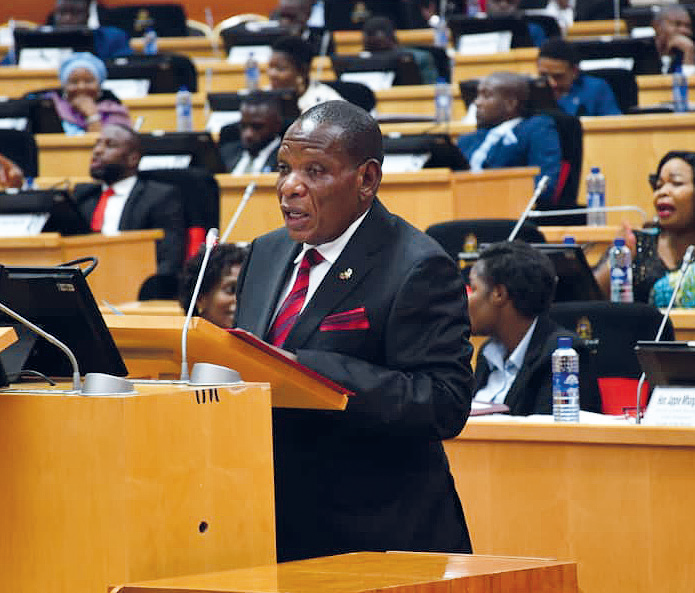
Malawi’s deepening economic strain has taken a revealing turn, with Minister of Finance Joseph Mwanamvekha admitting he does not yet know how much the country will request from the World Bank under its Rapid Response Facility (RRF), even as the government moves urgently to secure emergency support.
Mwanamveka: Malawi’s finance boss
Speaking from Washington, where he is attending the Spring Meetings of the World Bank and the International Monetary Fund, Mwanamvekha confirmed that Malawi has effectively been given a green light to apply for the facility—an emergency funding window designed to help countries respond quickly to shocks such as conflict, fuel crises, and inflation spikes. But his inability to indicate the size of the request raises a more troubling question: is Malawi negotiating from a position of strategy, or desperation?
The RRF is not ordinary financing; it is a crisis instrument. Countries turn to it when economic pressures become acute and immediate. Mwanamvekha himself pointed to the ongoing US-Israel-Iran tensions as a key trigger, noting that rising global prices for fuel, fertiliser, and other essentials are already hitting Malawi hard. “As you are aware, because of that war, our fuel, our fertiliser and most of the commodities have gone up,” he said, adding that the World Bank has urged Malawi to apply “as soon as possible” and stands ready to disburse funds.
That urgency tells its own story. Malawi is not just responding to global shocks—it is exposed to them. Like Kenya, which has also moved to seek rapid financial support, Malawi’s heavy dependence on imports leaves it vulnerable whenever global supply chains tighten or prices surge. But unlike more resilient economies, Malawi’s buffers appear dangerously thin, forcing it to turn quickly to external lifelines.
What makes the current situation more unsettling is the lack of clarity around the scale of the intervention being sought. In high-level financial negotiations, uncertainty over figures is rarely a sign of strength. It suggests either that the government is still scrambling to assess the depth of the crisis or that it is approaching lenders without a fully defined strategy. Either way, it raises concerns about how prepared Malawi is to navigate a rapidly worsening economic environment.
At the same time, Mwanamvekha indicated that discussions with the International Monetary Fund have been positive, with the IMF expressing satisfaction with Malawi’s progress on fiscal and monetary reforms. On the surface, that endorsement offers reassurance. But it also sharpens the contradiction: if reforms are on track, why is Malawi already seeking emergency financing whose very purpose is to stabilise economies under distress?
The answer may lie in the widening gap between reform on paper and pressure in reality. Rising import costs, forex shortages, and inflationary shocks are converging faster than policy adjustments can take effect. The result is a government caught between maintaining reform credibility and managing immediate economic pain.
The World Bank’s willingness to extend support is significant, but it is not a solution in itself. Emergency funding can cushion the blow, but it does not remove the underlying vulnerabilities—Malawi’s narrow export base, chronic forex shortages, and heavy reliance on imported essentials. Without addressing these structural weaknesses, each external shock will continue to push the country back to the same point: seeking urgent assistance.
For now, Malawi stands at a delicate moment. The door to emergency funding is open, but the fact that the country is stepping through it without a clear figure underscores the depth of uncertainty it faces. The real question is not just how much Malawi will request, but whether this latest lifeline will stabilise the economy—or simply buy time before the next crisis hits.