

Government Shifts From Subsidies to Mega Farms in Bid to Revive Economy
The Malawi Government has unveiled an ambitious economic recovery blueprint that seeks to fundamentally transform how the country produces food, earns foreign exchange and finances development, marking what officials describe as a decisive break from years of economic stagnation.
At the heart of the National Economic Recovery Plan (Nerp) 2025-2030 is a dramatic shift away from dependence on traditional subsidy programmes towards large-scale commercial agriculture driven by solar-powered irrigation schemes, mega farms, contract farming and agro-processing industries designed to boost exports and create jobs.
The strategy proposes the establishment of commercial irrigation corridors across the country, expansion of anchor farms, promotion of contract farming arrangements and creation of agro-processing clusters for crops such as maize, soya beans, rice and cashew nuts to guarantee markets and increase export earnings.
Government hopes the reforms will help push economic growth to 6.5 percent by 2030 while reducing inflation to single digits and restoring macroeconomic stability.
But behind the bold promises lies a grim economic reality.
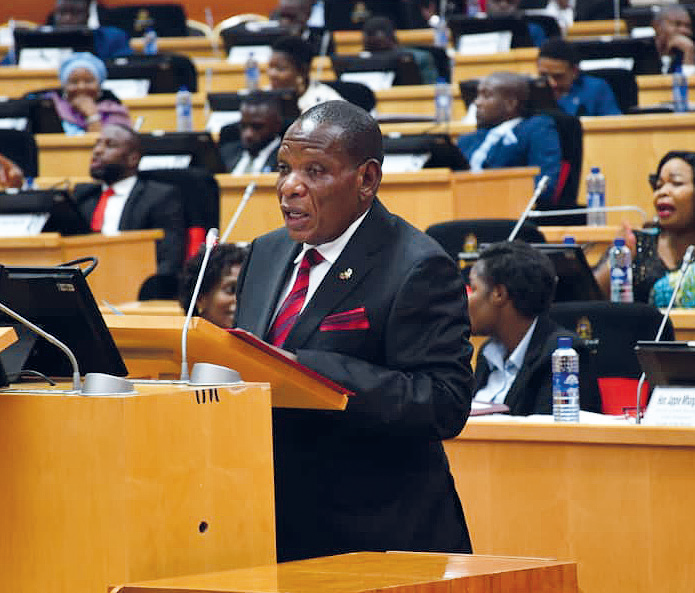
Presenting the plan at a stakeholders’ consultation meeting at the Bingu International Convention Centre in Lilongwe yesterday, Minister of Finance, Economic Planning and Decentralisation Joseph Mwanamvekha painted a picture of an economy under severe strain.
“Let us be honest with ourselves as a nation,” Mwanamvekha told delegates.
“The economic situation we are facing today did not emerge overnight. The challenges we are confronting are deep, structural and accumulated over many years and exacerbated in the past five years.”
The figures presented during the meeting reveal the magnitude of the challenge.
According to Mwanamvekha, public debt has ballooned from K4.1 trillion in 2019 to K24 trillion in 2025, representing an increase of nearly 485 percent in just six years.
Foreign exchange reserves, once covering more than four months of imports in 2019, had collapsed to less than one week’s import cover by September 2025.
Inflation surged to around 30 percent while debt servicing obligations grew so rapidly that they now consume more than half of government’s domestic revenues.
The figures underscore why government believes incremental reforms are no longer enough.
The administration argues that Malawi inherited an economy on the brink following the September 16, 2025 General Election, burdened by soaring debt, widening fiscal deficits, foreign currency shortages and slowing economic growth.
Yet some of the most explosive remarks came from Reserve Bank of Malawi Governor George Partridge, who challenged the widely held belief that Malawi’s crisis is simply a shortage of dollars.
Partridge argued that foreign currency is still circulating within the economy, but distortions in pricing and demand have created severe pressure on the market.
“If the country doesn’t have foreign exchange, the first sign and symptom is that you see most of the supermarkets are empty,” he said.
His diagnosis was blunt.
The governor suggested that years of excessive borrowing, rapid growth in money supply and fiscal indiscipline have fuelled demand for foreign currency beyond sustainable levels.
He revealed that money supply had expanded by 51 percent while the economy itself was growing at less than two percent, creating enormous pressure on the exchange rate.
“Fifty-one percent money supply growth while your GDP is growing at less than two percent tells you a lot about the pressure that you are putting on foreign exchange in terms of demand,” he said.
Partridge also signalled possible changes to foreign exchange regulations, warning that excessive market controls can worsen distortions rather than solve them.
“With excessive controls, you actually lose control,” he cautioned.
Business leaders welcomed government’s willingness to confront the crisis but warned that recovery will depend on more than policy declarations.
Daisy Kambalame, chief executive officer of the Malawi Confederation of Chambers of Commerce and Industry, said economic recovery must be driven by stronger collaboration between government and the private sector.
“Economic recovery is not a government project. It is a national project that requires deliberate collaboration between government and the private sector,” she said.
Representing the banking sector, Temwani Simwaka argued that banks alone cannot finance the country’s long-term development ambitions.
She called for greater use of capital markets and the stock exchange to mobilise investment for strategic projects.
The consultation exposed a growing consensus among economists, financiers and business leaders that Malawi’s economic difficulties are structural rather than temporary.
Years of weak productivity, low export diversification, rising debt, inadequate industrialisation and dependence on imports have left the economy vulnerable to repeated shocks.
Government believes Nerp can reverse that trend by repositioning agriculture as a commercial export-driven sector while strengthening private-sector-led growth.
The plan is closely aligned with Malawi’s long-term development blueprint, Malawi 2063, which aims to transform the country into an industrialised, self-reliant upper-middle-income economy.
However, officials acknowledged that the road ahead will be difficult.
“There comes a time when a nation must choose between temporary discomfort associated with reforms and permanent economic decline caused by inaction,” Mwanamvekha said.
His warning captures the central challenge facing Malawi.
The success of the recovery plan will not be measured by the number of policy documents produced or conferences held, but by whether it can reverse a debt burden that has exploded from K4.1 trillion to K24 trillion, rebuild depleted foreign reserves, tame inflation and restore confidence in an economy that many believe is at a crossroads.
For now, the government has unveiled its prescription.
The harder task begins now: convincing Malawians that this latest recovery plan will succeed where many others have failed.
Follow and Subscribe Nyasa TV :