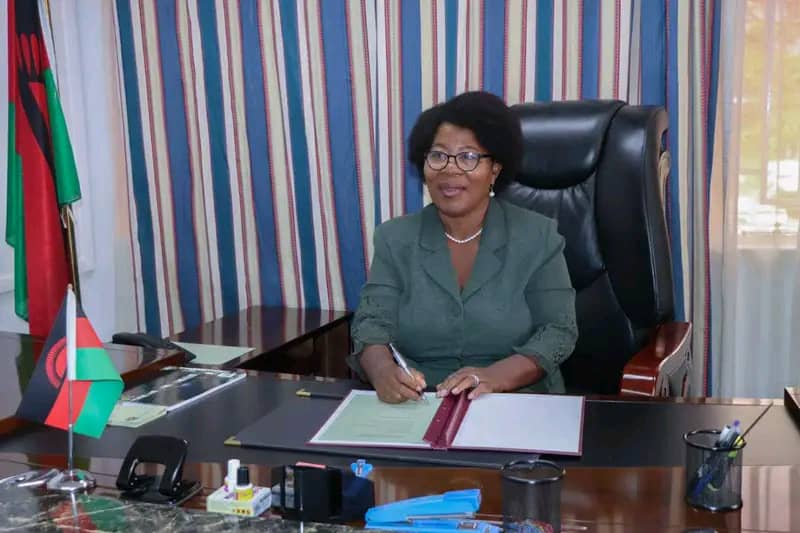
Just 100 days into office, Malawi’s Vice President Dr. Jane Ansah has effectively been stripped of all meaningful authority. First, the Department of Disaster Management Affairs was quietly removed from her office. Then followed the Department of Public Sector Reforms, another strategic institution transferred to the President’s Office.
Jane Ansah in office today
Two key departments, two removals, one clear political direction: neutralise the Vice President.
This is no longer administrative reshuffling. It is institutional disarmament, and the timing is too precise, too coordinated, too politically convenient to be accidental.
While the Vice President’s disaster portfolio is being dismantled, something else is happening in parallel. The First Lady’s foundation, Beautify Malawi (BEAM), has become the public face of national disaster relief.
Just today, the First Gertrude Mutharika visited Ntandire Township in Lilongwe, where she distributed relief items worth K31 million to about 500 people affected by floods. Banks and corporate institutions are now mostly channeling donations through BEAM.
And let’s be honest: disaster relief is not just humanitarian work. It is political capital. It is visibility. It is legitimacy. It is the most emotionally powerful space in governance, where leaders are seen comforting victims and performing compassion in full public view.
So the uncomfortable but unavoidable question must be asked: was Jane Ansah deliberately removed from disaster management so that the political credit, media spotlight and donor relationships could be monopolized somewhere. Because that is exactly what is happening in real time.
And this is where the situation becomes even more disturbing. Per the Constitution of Malawi, Jane Ansah is not a ceremonial figure. She is a President-in-waiting. Automatically. Instantly. Without debate.
In any serious democracy, that reality alone would demand that the Vice President be deeply embedded in state machinery, entrusted with major portfolios, exposed to crisis management, and prepared for continuity of leadership. Especially in a context where persistent questions surround the health and capacity of the current President.
Instead, Malawi is witnessing the opposite: the person constitutionally designated to take over the presidency is being systematically stripped of operational power, institutional presence and public visibility. This is not preparation. This is political quarantine. It is as if the system is quietly saying, you may inherit the presidency on paper, but never in practice.
And this is not new.
The DPP has a long and toxic history with its vice presidents. Joyce Banda was sidelined and expelled for refusing to endorse Bingu wa Mutharika’s succession plans. Saulos Chilima was stripped of influence, humiliated and eventually pushed out for appearing too ambitious under Peter Mutharika. Now Jane Ansah is being hollowed out before she has even settled into office. Different personalities, same pattern, same outcome. In the DPP, the Vice President is not treated as a partner in governance but as a threat in waiting.
So, who is afraid of Jane Ansah?
It is not the President, who will not be on the ballot in 2030. The fear lies elsewhere, among those positioning themselves for the post-Mutharika era, those controlling access to State House, those benefiting from keeping real power within a tight inner circle. Because this level of institutional stripping does not happen without powerful hands behind it, and certainly not without political intent.
The deepest irony is that while the Vice President is being reduced to a ceremonial shadow, non-elected actors, foundations and informal networks are exercising real executive influence over critical state functions. That is not democracy. That is the quiet privatisation of the state. It signals a system where constitutional offices are weakened while personal power centres are strengthened, where legitimacy flows not from institutions but from proximity to the presidency.
This is no longer just about Jane Ansah.
It is about a political culture that is actively sabotaging its own constitutional safeguards. At a time when Malawi should be strengthening the office of the Vice President in the name of continuity, stability and preparedness, the country is instead watching that office being deliberately emptied of substance.
And that leaves one final, deeply unsettling question: if something, God forbid, happens to the President tomorrow, are we prepared for a Vice President who has been intentionally denied experience, authority, systems and power? Or is that precisely the point?
Because what is unfolding looks less like governance and more like a silent coup against the Constitution itself.
Politics rarely whispers without reason, and right now, it is screaming.