

Malawi Crowned Shining Model of Democracy in Africa
Traveling across Malawi, one topic lingers in people’s minds: the transition of power from former President Lazarus Chakwera of the Malawi Congress Party (MCP) to President Peter Mutharika of the Democratic Progressive Party (DPP) after the September 16, 2025, general elections.
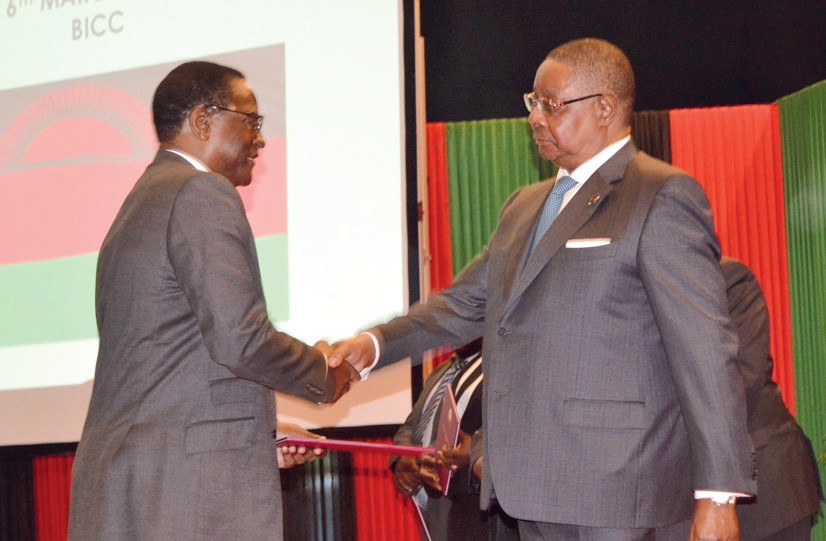
Mutharika captured about 57% of the votes, defeating 15 other presidential candidates. The Malawi Electoral Commission (MEC) declared him the winner in polls that political and governance pundits described as free and fair.
This stands in stark contrast to election outcomes in neighbouring Mozambique and Tanzania, which were marred by irregularities, according to political and human rights campaigners.
While some election observer missions—including the African Union (AU), Commonwealth, European Union (EU), and Southern African Development Community (SADC)—along with political commentators, view the peaceful handover of power as evidence that Malawi’s democracy has reached its peak, room for improvement remains, despite voter apathy.
Zomba-based political scientist Ernest Thindwa from the University of Malawi argues that while others may see the peaceful conduct of elections every five years as a hallmark of full-fledged democracy, the Southern African nation still has work to do.
“For instance, in the lead-up to the 2025 elections, the environment was tense because some stakeholders distrusted the MEC’s leadership under Justice Annabel Mtalimanja,” Thindwa said. “Yet, even with those concerns, there was no post-election violence when results were announced. The same skeptics ultimately trusted how the leadership managed the process.”
For Thindwa, true democracy goes beyond peaceful transitions. It requires a champion leader who understands the country’s political culture and how citizens view governance institutions. “Such leadership would carve out a strong political landscape to foster full-fledged democracy,” he added.
Professor Happy Kayuni, also from the University of Malawi, disagrees. He believes Malawi’s peaceful power transition proves it has fully embraced democracy.
Kayuni challenges the idea—held by some scholars—that a country needs three successive elections to claim democratic maturity, especially where a dominant party rules.
“Countries like Tanzania and Mozambique once had one-party dominance and held consecutive elections, but that alone didn’t mean full democracy,” he said. “However, when power consolidates from one ruling party to another, we can say democracy is taking shape.”
Compared to other African nations, Kayuni places Malawi at a higher level of democratic consolidation, where incumbents can be challenged without manipulating governance systems. He cites the 2020 court-sanctioned presidential election, where Mutharika’s DPP government lost to Chakwera’s MCP, and Chakwera’s recent concession as proof of Malawi’s maturing democracy.
That said, Kayuni warns of vulnerabilities, such as each incoming government hiring new staff in key institutions while redeploying veterans.
“While changing top army and police leadership is normal, it shouldn’t trickle down to statutory corporations and other bodies,” he said. “This erodes public trust and risks unrest.”
Analysts urge Mutharika and his DPP to act swiftly on voter expectations from the campaign trail.
Mutharika, 85, who served as Malawi’s fifth president from 2014 to 2020, staged a historic comeback by reclaiming the presidency from Chakwera, who had ousted him in the 2020 fresh polls.
In the September 16 race, Mutharika garnered 3,035,249 votes to Chakwera’s 1,765,170, securing 57% and crossing the 50%-plus-one threshold for an outright win.
Chakwera conceded defeat in a televised address on the state-funded Malawi Broadcasting Corporation (MBC), calling the result a reflection of Malawians’ will for change and pledging a smooth handover.
Initially billed as an “electoral super cycle,” 2024 saw 13 African countries elect heads of state.
Democracy passed the test in places like Botswana, Liberia, Ghana, and Senegal, with South Africa forming its first governing coalition.
Yet this occurred amid growing dissatisfaction with governance: Afrobarometer data shows most Africans want democracy but are unhappy with its delivery.
Coups in Madagascar, and attempted ones in Nigeria and Benin, highlight the ongoing risk of military overthrows.
Follow and Subscribe Nyasa TV :
Unnecessary accolades, when people can’t feed themselves 😥😥