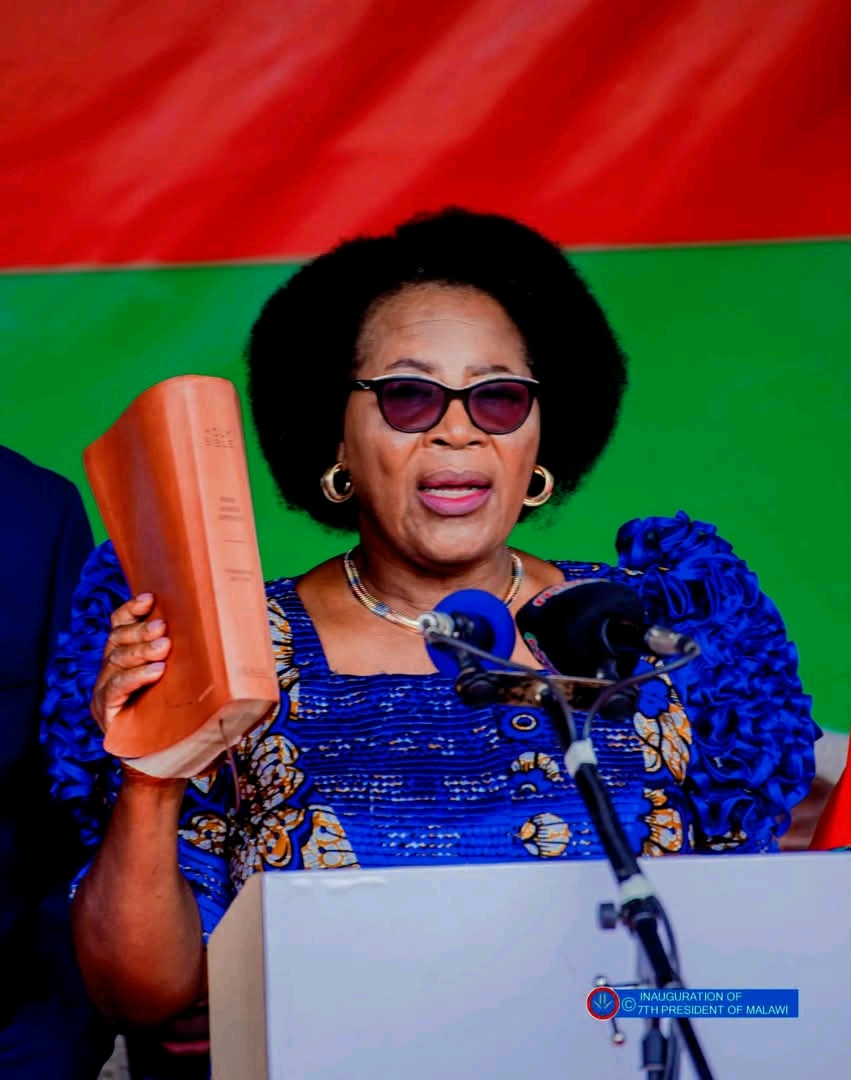
A storm has erupted on social media and in governance circles after respected governance commentator Onjezani Kenani questioned the sheer size of Vice President Dr Jane Ansah’s entourage for what has been officially described as a private visit to the United Kingdom, at a time when the government is preaching painful austerity to ordinary Malawians.
Jane Ansah
The delegation list, now circulating widely, shows 16 people attached to the Vice President for the trip — a line-up that reads less like a private visit and more like a full-scale state mission, complete with accountants, protocol officers, multiple security personnel, aides-de-camp, administrative staff and even a “special guest”.
Kenani did not mince his words.
“The Vice President is travelling on a private visit to the United Kingdom. It strikes me as odd, however, that for such a private visit, and during such a period of austerity, the entourage is this huge, and the taxpayer will have to foot the bill. The government needs to walk the talk when it comes to austerity,” he wrote.
The outrage is sharpened by context. Malawi is in the grip of one of its harshest economic periods in recent history. The Kwacha has collapsed, fuel and medicines are scarce, civil servants are underpaid, universities are struggling, and hospitals routinely ask patients to buy their own drugs. Government has repeatedly justified cuts, delays and belt-tightening measures under the banner of “austerity”.
Yet, critics argue, that austerity seems selective.
Analysts say it is indefensible for a so-called private visit to be accompanied by multiple senior government officials whose roles have no plausible private justification, especially when every air ticket, hotel bill, allowance and logistical cost ultimately lands on the taxpayer.
“Private visits do not require chief accountants, principal accountants, deputy directors of administration, protocol officers and layers of security,” said one governance analyst. “That is public money being spent, however you try to dress it up.”
This is not the first time Dr Ansah’s travel habits have come under scrutiny. Over the past year, analysts and civil society voices have raised concerns over what they describe as an unusually frequent series of domestic trips, many of which have been criticised as poorly explained, low-impact and disproportionately costly.
From ceremonial appearances to short-notice regional visits, critics argue that the Vice President’s travel schedule has increasingly appeared detached from tangible economic or governance outcomes — especially when contrasted with the administration’s repeated calls for restraint.
“It is the pattern that worries people,” said another analyst. “When you combine frequent domestic travel with now a heavily staffed ‘private’ foreign visit, the message to struggling citizens is that austerity is for them, not for those at the top.”
The most damaging aspect of the controversy is not just the numbers on the delegation list, but the symbolism. In a country where citizens are told there is no money for essentials, optics matter.
To many Malawians, the image of a Vice President flying to the UK with a convoy-sized entourage sends a blunt message: sacrifice is demanded from the poor, while privilege remains protected at the top.
Kenani’s intervention has therefore struck a nerve, amplifying a question many are now asking openly: Is austerity a genuine national policy, or merely a talking point used to justify hardship for ordinary people?
As pressure mounts, calls are growing for full transparency on who is paying for the trip, which costs are being covered by the public purse, and why a private visit requires such an expansive official apparatus.
Until those answers are provided, the UK trip risks becoming more than a travel controversy — it may stand as a case study in how government rhetoric on austerity collapses when tested against elite behaviour.