

Chilima backs Mutharika decision to appeal election ruling: ‘He is exercising his right’
Malawi vice president and UTM party leader Saulos Chilima says it is President Peter Mutharika’s constitutional right to appeal against the Constitutional Court ruling that overturned his re-election last May.
Mutharika said he will lodge an appeal against the ruling by five judges.
Presidential spokesman Mgeme Kalirani said the ruling “cannot be allowed to stand … it will create a lot of problems in the country’s jurisprudence.
“It is a great miscarriage of justice,” he added in a statement.
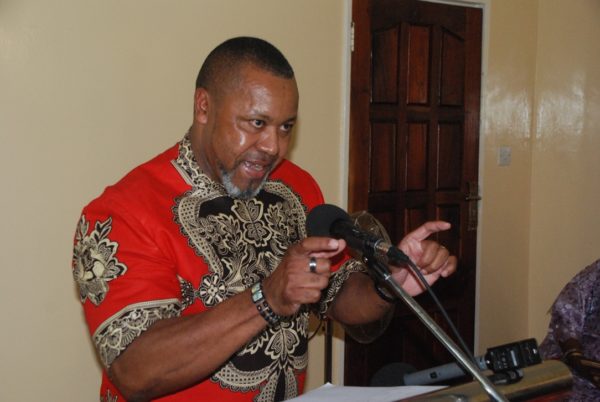
Speaking at a news conference on Wednesday in Lilongwe, Chilima said Mutharika just like any Malawian, has a right to appeal.
“We all have rights. We exercise our right to present our issues to the Supreme Court of Appeal. People have a right to appeal or waive that right. It is not up to me to be stamping on peoples’ rights,” said Mutharika.
He said his legal team is ready to defend the Constitutional Court ruling.
Chilima has also called upon the Malawi Electoral Commission (MEC) commissioners and the chief executive officer Sam Alufandika to resign or face a new wave of protests.
He also said he has not yet spoken to president Peter Mutharika since the Constitutional Court reinstated the UTM president to the Republican vice presidency.
“I hold no grudge against him. We should forgive each other, we should move on, we can’t be stuck in the past,” Chilima said.
The reinstatement of Chilima as vice president automatically axes Everton Chimulirenji from the same post.
Analysis by BBC’s Andrew Harding
In essence, the judges argued that Malawians deserve, and should expect, an A- grade election – not perfect, perhaps (who can boast that?) but free of systemic abuse. They should not have to make do with the more familiar C+ election that some nations and institutions still seem to tolerate or encourage.
Secondly, the court directed Malawi’s parliament to consider recalling the current electoral commission to “ensure the smooth conduct of fresh elections”.
In so doing, they sent a signal that the supposedly neutral bureaucrats in charge of organising such flawed elections should be thrown out. They also implied that a slap on the wrist was not enough, and that Malawi’s precious democratic institutions needed to be properly defended.
This was an important blow against a widespread culture of impunity.
Thirdly, the judges said the current first-past-the-post system of picking a new president was unconstitutional.
In future, they said, the winner needed to gain more than 50% of the vote, which could mean a second-round run-off.
That could have dramatic political implications for Malawi and is, above all, sure to encourage opposition candidates and parties to enter into strategic coalitions, giving them an unanticipated boost.
Fundamentally, the court ruling weakens the power of incumbency – a power that is often stronger, and more open to abuse, in relatively young democracies.
Lawyers for Mr Chakwera and Saulos Chilima, another losing candidate, said correction fluid – known by the brand name Tipp-Ex – had been used on some of the tallying forms sent in by polling stations.
The changes were made after they had been signed by party agents, they said.
The lawyers also said that in some cases polling officials sent in the wrong copy of the results sheet to the main tallying centre.
They also found some mathematical errors in a small number of cases.
Though in each case there were not a huge number of errors, the lawyers said that the evidence pointed to a flawed process.
Since the disputed results were announced last May, there have been regular anti-government protests. Some of these have resulted in looting and the destruction of property, including government offices.
Two people – one police officer and one civilian – are known to have been killed during the demonstrations.
Follow and Subscribe Nyasa TV :