

DPP fields most female candidates followed by UTM – Report
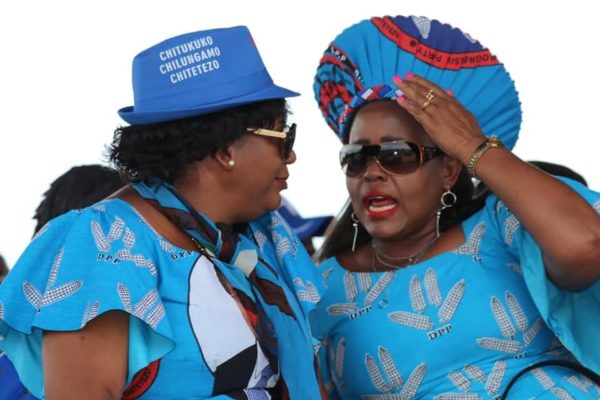
Ruling Democratic Progressive Party (DPP) has featured the largest number of women standing on the party ticket, followed by the political new kids on the political block, the UTM Party.
On the other hand, Lilongwe has featured the highest percentage of female candidates standing for parliamentary office at 35 percent, followed by Ntchisi (33.3 percent) and Dedza (31.1 percent).
This is according to a gendered analysis of the Malawi Electoral Commission (MEC) 2019 Presidential and Parliamentary statistics.
The analysis was conducted by the NGO Gender Coordination Network (NGO-GCN).
The analysis states that a majority of the female candidates are, however, standing on independent tickets and considering preceding voting trends in these districts where voters generally vote along party lines and the region being predominantly a Malawi Congress Party (MCP) stronghold, the likelihood of most of the independents being elected to parliament is lean.
“Political party backing is the most significant factor for female candidates and the absence of such backing can disturb one’s chances of being elected into office. For instance, only three of the 23 constituencies in Lilongwe have a female a candidate on an MCP ticket, in Kasungu only one of the nine constituencies has a female candidate on MCP ticket, in Mzimba only two of the 12 constituencies have a female candidate standing on a MCP ticket while in Nsanje there is no woman standing for office under the MCP ticket,” reads the analysis in part.
Interestingly, of the 33 constituencies in the Northern Region, only two have women standing on MCP ticket.
In Chitipa, Karonga, Nkhatabay, Likoma, Mzuzu, and Rumphi there are no female candidate standing on a MCP ticket while UTM and DPP have fielded an average of one female candidate in these districts.
Among the parties currently represented in parliament, People’s Party (PP) is the most progressive as regards inclusion of women in politics and decision-making, the analysis says.
“The party has a female presidential candidate and has the highest number of women standing on a party ticket. 30.8 percent of the candidates for PP are women compared to 26.5% for DPP, 22.5 percent for UTM, and 15.3 percent for MCP. This is an indication that having women as political party leaders can contribute to many women participating in politics and decision making.
Most of the women are contesting as independent candidates. At least 123 of the 304 women contesting for parliamentary office are independents.
The analysis says this partly indicates the frustration that most female aspirants have had with the glass ceilings in political parties as most of them lost in the party primary elections owing to a number of factors including institutionalised systematic gender barriers in political party participation.
“Most of the political parties did not take the necessary steps to ensure that their primaries were conducted in a free and fair manner. The percentage of female candidates in 2019 has increased from 261 in 2014 to 304. This is a progressive output as it points to increased interest in women to stand for political office. In addition this points to increased agency among women to be active in civic participation.
Forty four (44) out of the 193 constituencies, representing 22.79 percent, have no woman as a parliamentary candidate. This is a likely drawback to the achievement of 50:50 representation of men and women in parliament,” it concludes.
NGO-GCN network coordinator, Innocent Hauya, said in an interview on Tuesday that the increased number of women standard for presidential and parliamentary office in 2019 is a progressive result in achieving increased participation of women in politics and decision-making.
However, Hauya said learning from past voting trends and considering that a lot of the women in 2019 are competing on an independent ticket, the success rate of the women standing for parliamentary office is likely to remain similar to 2014.
Follow and Subscribe Nyasa TV :