

Investment Slump Hits 11-Year Low, Threatens Jobs
Malawi’s investment climate is deteriorating at an alarming pace, with fresh figures showing that the country is attracting significantly less capital than it did just a few years ago—a trend economists warn is crippling job creation, slowing economic growth and dimming prospects for long-term development.
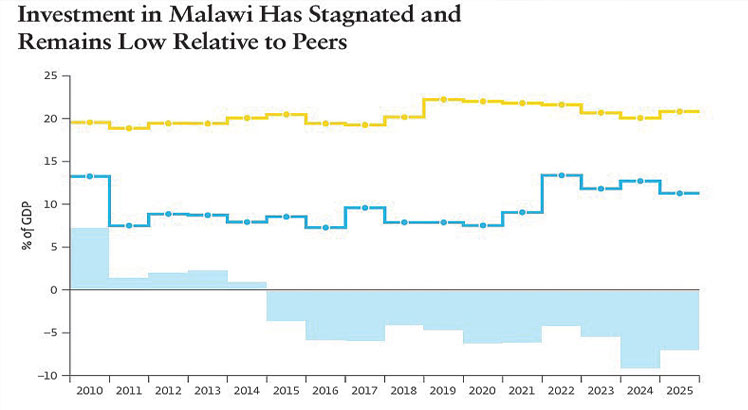
Data contained in the World Bank’s June 2026 Country Private Sector Diagnostic paints a worrying picture. Gross investment fell to 11.1 percent of Gross Domestic Product (GDP) in 2024, down sharply from more than 20 percent recorded between 2017 and 2019.
Over the past five years, Malawi has averaged just 15 percent of GDP in total investment, far below the 23 percent average among comparable countries in the region.
The private sector has been hit even harder.
According to the report, private investment averaged only nine percent of GDP during the same period and accounted for less than 60 percent of total investment, signalling weakening confidence among businesses to expand operations or establish new enterprises.
Foreign investors are also pulling back.
The World Bank says net Foreign Direct Investment (FDI), which reached 6.8 percent of GDP in 2014, has fallen dramatically, averaging only 1.5 percent of GDP between 2019 and 2024.
The Malawi Confederation of Chambers of Commerce and Industry (MCCCI) says these figures reflect deep-rooted structural problems that continue to discourage investment and weaken the country’s productive capacity.
MCCCI Director of Business Environment Lucky Mfungwe said businesses continue to operate in an environment characterised by persistent foreign exchange shortages, soaring inflation, high lending rates, unreliable electricity and inconsistent government policies.
“These constraints have significantly weakened private sector confidence, reduced production capacity and discouraged both domestic and foreign investment,” said Mfungwe.
“This underinvestment has constrained the expansion of productive sectors, job creation, export growth and economic transformation.”
The chamber’s own 2025 Annual Economic and Business Review reinforces those concerns.
It found that 74.1 percent of businesses identified foreign exchange shortages as their biggest challenge, making it the single largest obstacle to doing business in Malawi.
Another 70.4 percent cited inflation, while 55.6 percent blamed rising production costs for eroding profitability.
Perhaps more worrying is what is happening inside factories and businesses.
According to the review, 51.9 percent of firms are operating at less than half of their installed production capacity, largely because they cannot access enough foreign currency to import raw materials and equipment.
Only 11.1 percent of businesses are operating above 75 percent of their production capacity, highlighting the scale of idle industrial potential.
National Working Group on Trade and Policy chairperson Frederick Changaya said declining investment should concern policymakers because it provides an early warning about the future direction of the economy.
“We ought to be tracking capital formation more seriously because it points to future economic outcomes,” he said.
Changaya, who is also Director General of the National Planning Commission, said restoring investor confidence will require structural reforms, policy consistency and a predictable business environment that encourages long-term investment.
Despite government reforms aimed at improving the investment climate—including the creation of Special Economic Zones, liberalisation of the electricity sector, establishment of the Malawi Mining Authority and the Agriculture, Tourism, Mining and Manufacturing (ATM+M) Strategy—the Malawi Investment and Trade Centre has acknowledged that inadequate infrastructure continues to limit investment opportunities.
The figures suggest that unless Malawi succeeds in reversing declining investor confidence, the country risks remaining trapped in a cycle of low investment, weak industrial expansion, limited job creation and sluggish economic growth.
For an economy seeking to create employment for its growing population, the shrinking flow of investment capital may prove one of its greatest challenges yet.
Follow and Subscribe Nyasa TV :