

Kaphale shreds Chilima, Chakwera petitions: ‘No valid vote was affected in Malawi elections’
Lawyers for the Malawi Electoral Commission (MEC) winded up the hearing of the historic case in which first petitioner Saulos Chilima and second petitioner Lazarus Chakwera are seeking a nullification of presidential results in the May 21 Tripartite General Elections by tearing into the evidence of the both Chilima and Chakwera asserting that the case had not been proved and was not supposed to be brought to court.
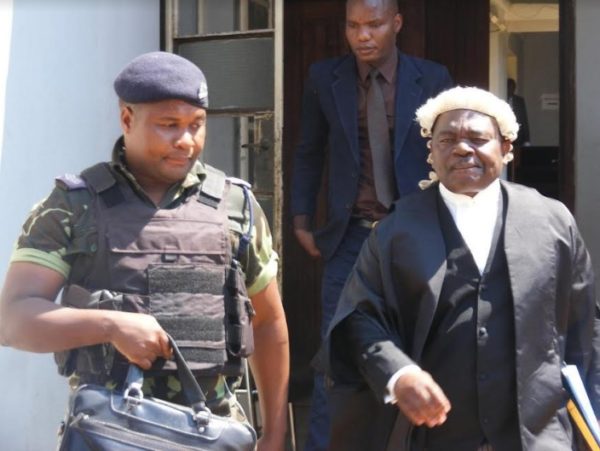

Attorney General Kalekeni Kaphale, who is MEC lead lawyer, queried why the petitioners both failed to come up with alternative results from their parallel tally centres six months after the May 21 elections.
“Daud Suleman [It expert who was witness of Chakwera] confirmed that this was the mandate of the party parallel tally centre. He even said he was able to get the final tally from the system he designed.
“For all what Mr Suleman has been able to say, demonstrate and dramatise about result management, what has prevented the party from aggregating the data and come up with a different result from what MEC has, they had all copies which were placed on the website,” queried Kaphale.
The MEC lead lawyer, said the burden laid with the petitioners to prove whatever they were alleging regarding the result management system (RMS) that it malfunctioned and came up with wrong results.
“We spent hours demonstrating but the main issue was to show that the results received were wrong or different from those sent from the constituency tally centres and they failed,” he said.
Regarding absence of commissioners to present evidence in court, Kaphale said the Electoral Commission Act (ECA) allowed for delegation for the Commission in the discharge of its duties.
“There is a statutory provision within the ECA to delegate. The Act talks about the functions of the Commission and the manner in which delegation should be done.
“I don’t think by any stretch of imagination that the delegation which was provided under the law was an irregularity. There was no way anyone expected the Commissioners to be at 5002 centres and 11,000 plus streams. They had an ability to delegate,” he wondered.
Kaphale added that MEC brought the officers who had first hand evidence with the elections process like Director of Elections, Henzily Munkhondya and Chief Elections Officer, Sam Alfandika who ably answered the questions.
Kaphale also noted that the petitioners did not prove intimidation, influencing voters, unauthorized person being found with ballot papers and ballot boxes.
“They withdrew witnesses relating to this allegation. They can’t rely on general pleading of irregularity,” he reasoned.
He added to the list of allegations not proved, the claims that in some cases the total results were more than the number of registered voters, that ballot papers were not handled with maximum security and presiding officers not signing tally sheets.
Kaphale also observed that both Chakwera and Chilima did not demonstrate how use of the fake results sheets affected the valid votes of any candidate.
“Someone alleges, that votes were affected, he had monitors then he should show the contrary results. MEC asked the same question before announcement of results but the second respondent went to the court demanding a recount instead.
“It should worry everyone that with all the facilities that are there, someone can report that this result was a duplicate, throw it away, yet their monitors were at a polling station, witnessed the polling and know how many votes their candidates got. The question should be, what do you say about the vote count because the process was so transparent?” he explained.
Regarding the use of altered tally sheets, Kaphale maintained that the use of Tippex was for correcting errors and no valid vote was affected, a fact that was attested to by both Chakwera and Chilima during cross-examination.
He explained that the auditors verified any form with problems by verifying with the results in the record log book and even MEC staff at the main tally centre before approval by the Commission.
“Is it very surprising that they have not brought any monitor? If you had a contrary result would you still have it in your jacket? What we have here could not have been a case here at all,” he said.
Kaphale said it was not proper to throw away valid votes when their validity has not been challenged just because a monitor or presiding officer did not sign.
“Chakwera was asked what are you saying about the results, should they be thrown away, he said ‘no‘ adding that every vote counts. But Counsel (Modercai Msisha) seem to suggest that they should be thrown away,” he wondered.
President Peter Mutharika, a 78-year-old former law professor, through his lawyer Frank Mbeta, also argues that the election results reflect the will of the people and that he legitimately won.
The Court has finished receiving oral submissions and is now going to analyse the evidence and come up with judgement within 45 calendar days.
Constitutional Court chair Judge Healey Potani making concluding remarks in court thanked all stakeholders in the case for their discipline and commitment to pursuing justice, pointing out that the journey had been long and epic.
Potani is leading a panel of High Court judges including ivy Kamanga, Dingiswayo Madise, Mike Tembo and Redson Kapindu.
Follow and Subscribe Nyasa TV :