

Mutharika’s return is a rebuke to Malawi’s rumour merchants
For nearly four weeks, Malawi’s social media ecosystem was awash with increasingly extravagant claims about President Peter Mutharika’s stay in South Africa.
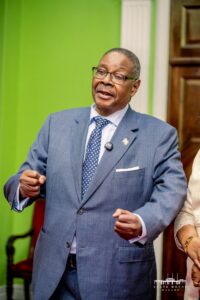
Mutharika’s return exposes the poverty of rumour-based discourse
What began as speculation about his absence soon spiralled into a familiar cycle of rumour, insinuation and outright fabrication.
Anonymous Facebook pages, political agitators and clickbait merchants competed to outdo one another with increasingly dramatic assertions: the President was critically ill; he had been admitted to a military hospital; he was incapacitated; some even suggested he was on the brink of death.
Evidence was rarely offered. Certainty, however, was abundant.
When Minister of Homeland Security Peter Mukhito publicly stated that he had personally met Mutharika in South Africa and had held lengthy discussions with him, his intervention did little to calm the fevered speculation.
Instead, he became a target himself. Social media commentators dismissed his account, mocked his assurances and treated first-hand testimony as less credible than anonymous online conjecture.
Yet politics, as ever, has a way of colliding with reality.
Mutharika’s return through Kamuzu International Airport on Saturday afternoon provided a stark contrast to the narratives that had dominated social media in recent weeks.
Far from the portrait painted by rumourmongers, the President appeared publicly and spoke directly about his stay in South Africa, insisting that he had remained fully engaged in the affairs of government throughout his absence.
According to Mutharika, he maintained regular contact with senior officials, including Chief Secretary to the Government Justin Saidi and cabinet ministers, sometimes communicating multiple times a day to ensure government business continued uninterrupted.
Whether one supports Mutharika politically is beside the point. The episode raises a broader and more troubling question about the state of public discourse in the digital age.
When speculation is rewarded with clicks, shares and engagement, truth becomes secondary to sensation. The incentive is not to be correct but to be first, dramatic and viral.
This is where the contrast with mainstream journalism is instructive. Established news organisations and credible media outlets were criticised by some for refusing to run with the endless stream of unverified claims.
Yet restraint is not a weakness of journalism; it is one of its defining obligations. Reporting what can be verified may appear less exciting than amplifying rumours, but it remains the cornerstone of responsible public communication.
In recent weeks, many professional newsrooms resisted the temptation to convert gossip into headlines. They understood that a claim circulating widely online does not become true merely because it is repeated often enough.
The lesson from this episode extends beyond one President or one political moment. It is a reminder that social media, for all its democratising potential, is also an ecosystem that rewards outrage, speculation and confirmation bias.
The loudest voices are not always the most informed, and virality is no substitute for verification.
Those who spent weeks confidently announcing a medical crisis, a military hospital admission or an imminent death now face an uncomfortable reality.
The burden of proof was always theirs. Instead, they offered certainty where there was little evidence and derision where there were legitimate attempts to provide reassurance.
The real story may not be Mutharika’s return itself. It may be how readily a section of the online commentariat embraced rumour over fact, and how difficult it has become, in an age of instant publishing, to convince people that verification still matters.
Follow and Subscribe Nyasa TV :