

PMI, Pyxus expand Malawi’s Agricultural Mechanisation Initiative
Minister of Agriculture, Irrigation and Water Development, Roza Fatch Mbilizi on Thursday officially launched the second phase of Malawi’s Agricultural Mechanisation Initiative which aims at boosting the country’s agriculture production through the adoption of modern farming methods and increased crop diversification.
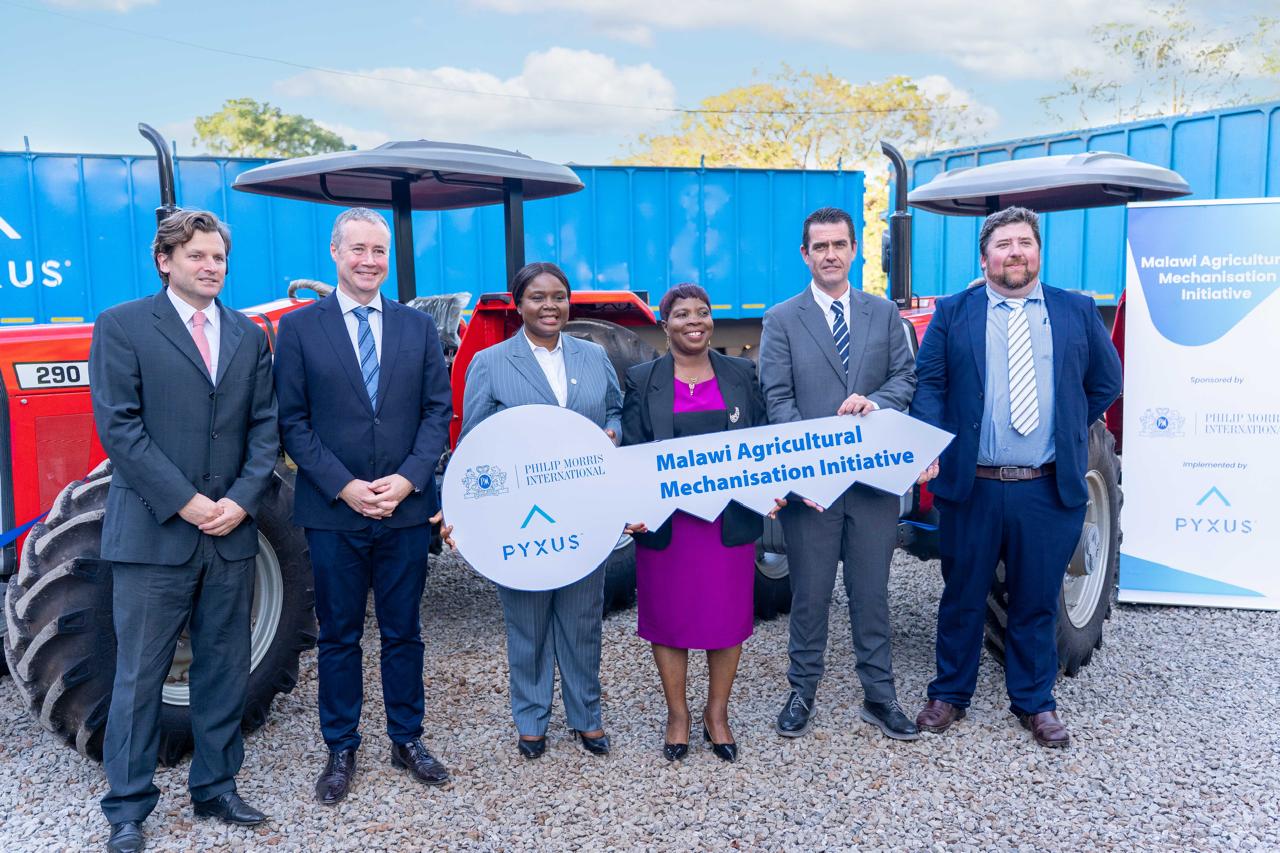
The initiative is being championed by Phillip Morris International (PMI) in collaboration with it’s local partner Pyxus Agriculture Limited which so far about 7,800 hectares of farm land covering crops such as maize, tobacco and groundnuts have already been cultivated during it’s first phase which began in 2024.
In addition, the initiative is also focusing on empowering local farming entrepreneurs to adopt the use of mechanical based farming through provisions of tractors.
The initiative which began in 2024 with a fleet of 23 tractors that were given to some farmer entrepreneurs on loan, has been expanded to 40 tractors during this second phase.
Speaking during the launch of the initiative, Mbilizi said the initiative will help the country to transition from manual to modern mechanized farming.
According to the Minister, this initiative will help to boost productivity and agricultural output through timely land preparation, planting and harvesting while at the same time reducing heavy manual labor and child labor.
The Minister said the initiative will ease burdens on women smallholder farmers and will do so sustainably via training, entrepreneurship development and scalable public‑private partnerships aligned with Malawi 2063 and national agriculture policy.
Mbilizi said , agricultural mechanisation is not merely a policy directive; it is a foundational pillar of Malawi’s national development agenda.
“It is firmly anchored in Malawi 2063, the First Malawi Implementation Plan, and the National Agriculture Policy 2024,” said Mbilizi.
In this regard, the minister said promoting mechanisation based farming remains a top priority for her Ministry and commended PMI for the initiative.
“I would therefore like to sincerely commend and thank Philip Morris International for aligning its support with one of the key priorities of both the Ministry and the Government of Malawi,” she said.
Adding ; “This priority is driven by the urgent need to transition from predominantly manual, hand-hoe farming to modern, efficient, and mechanised agricultural practices,” she said.
The Minister said , the emphasis on training entrepreneurs in both business management and technical maintenance, alongside a long-term self-financing structure, provides a strong foundation for continued success.
“The Government is fully aware of the challenges that have constrained similar efforts in the past. These include the high cost of machinery, limited access to appropriate technologies, a shortage of skilled operators, and weak supply chains for spare parts. I am pleased to note that this initiative has been designed with these challenges in mind and aligns well with our national objectives,” She said.
In his remarks, Phillip Morris Chief Global Operations Officer Scott Coutts, commended the local farmers for demonstrating their committiment and determination through the adoption of this mechanisation farming model.
“Again and again, I have seen farmers whose expertise outpaces the tools
available to them. When that happens, the challenge is not a lack of effort or knowledge it is a lack of access. And
when access improves, the results can be immediate and transformative,” said Coutts.
According to Coutts, his company is supporting the country’s national priorities by ensuring that the values created through a sustainable farming model should remain within the local communities and also at the same time enabling business to boost productivity.
“Our continued investment in Malawi goes beyond business. It is an investment in the resilience of the entire supply chain and the prosperity of the communities that sustain it,” said Coutts.
He described Malawi as a country defined by skilled farmers, resilient communities, and a long tradition of agricultural excellence.
“What we see here, time and again, is commitment, capability, and ambition often achieved despite real constraints,” he said.
He said, Malawi Agricultural Mechanisation Initiative is built on a simple but important premise: which include; access to modern equipment, access to opportunities, and access to business
models that allow local enterprise to grow and endure.
The initiative is initially supported through capital investment by Philip Morris International and implemented in partnership with Pyxus Agriculture.
According to Coutts, this initiative is designed as an entrepreneur-led, self-financing model that places local business owners at the centre of the solution, rather than relying on one-off interventions.
During this second phase about 2,500 hectares of farm land is expected to be cultivated and benefiting an additional 600 local famers in the process.