

Why Iceland Has Given Malawi $12.9 Million: A Push to Fix Broken Local Services
The Government of Iceland has committed $12.9 million to Malawi, not as a routine gesture of goodwill, but as a targeted response to persistent gaps in basic public services affecting millions of ordinary Malawians.
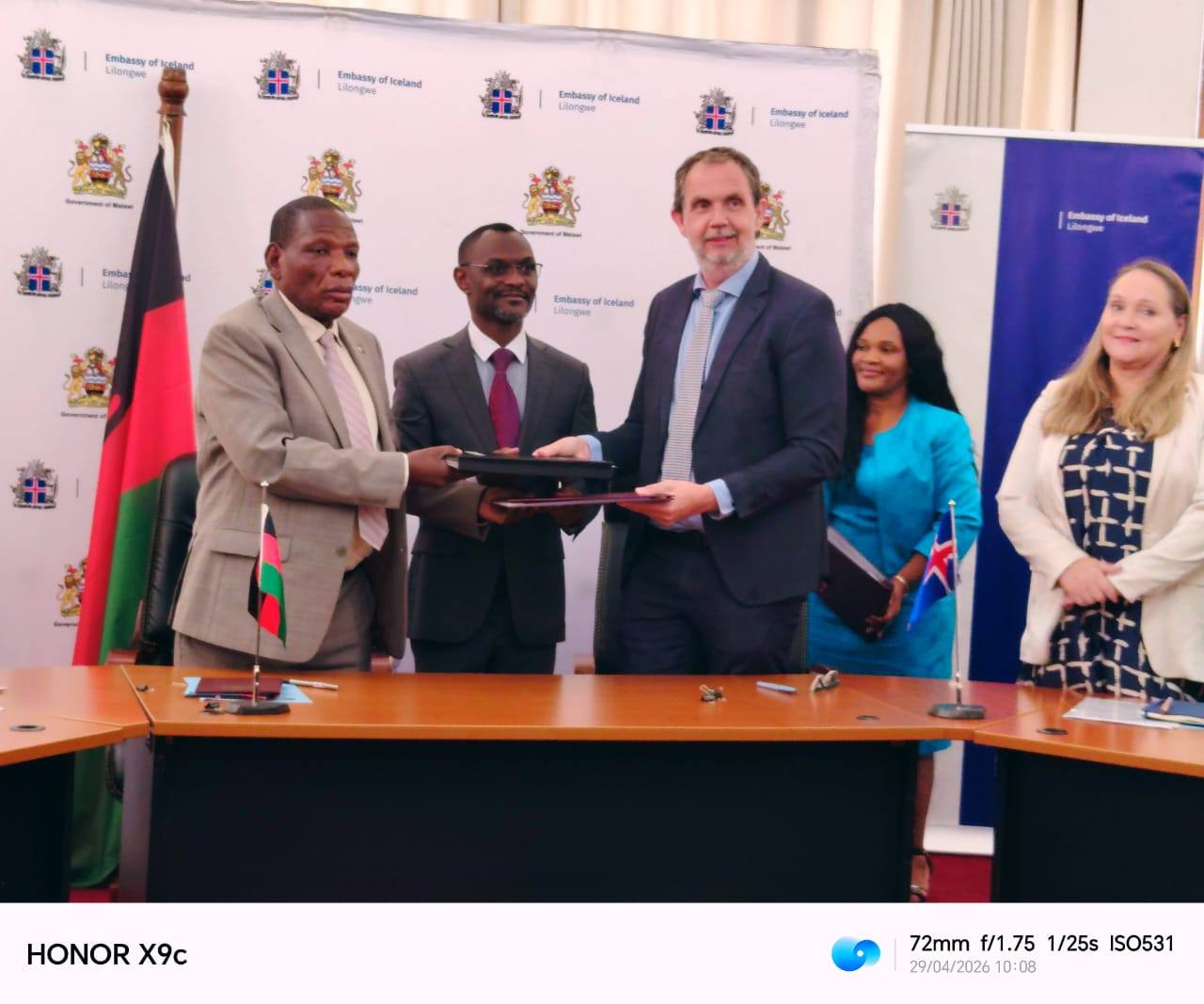
The funding, signed in Lilongwe by Finance Minister Joseph Mwanamvekha, is aimed squarely at strengthening essential services in Balaka, Machinga, and Salima—districts where communities continue to struggle with access to quality healthcare, education, clean water, and effective local governance.
At its core, the funding is about fixing what is not working.
For years, rural communities in Malawi have faced systemic challenges: under-resourced health facilities, overstretched schools, poor sanitation, and weak local administrative systems. Iceland’s intervention is designed to confront these realities head-on by channeling resources directly into the sectors that matter most for everyday survival and long-term development.
“This is not just money—it is a response to real needs on the ground,” Mwanamvekha emphasized during the signing. “It reflects a shared understanding that development must start where people live.”
Under the agreement, each district will receive up to $4.3 million between April 2026 and December 2028. The funds will be used to improve healthcare delivery, strengthen primary education, expand access to clean water and sanitation, promote climate resilience, and advance gender equality.
These are not random priorities. They are the pressure points holding back rural development.
Iceland’s decision to invest further in Malawi is also driven by confidence in a specific approach: decentralization. Instead of funds being controlled centrally, the programme empowers district councils to plan, prioritize, and implement development projects themselves.
According to Iceland’s Head of Mission, Dr. David Sigurdsson, this model is exactly why the partnership continues to grow.
“We believe development works best when decisions are made closer to the people affected,” he said. “This funding is about strengthening that system and scaling what has already shown results.”
The programme’s track record explains the expansion. It began in Mangochi in 2012, where it reached over 1.2 million people. Its success led to expansion into Nkhotakota in 2022. Now, with Balaka, Machinga, and Salima added, Iceland is deepening its investment where impact is visible and measurable.
Minister of Local Government Ben Phiri made it clear: the funding is not just about services—it is about power.
“This programme puts decision-making into the hands of local councils,” he said. “That is why it works. Communities are no longer passive recipients—they are active drivers of their own development.”
In simple terms, Iceland is funding Malawi because the needs are urgent, the gaps are clear, and the model being used has proven it can deliver results.
But the real test now lies ahead.
With $12.9 million on the table, expectations are high. The success of this funding will depend not on promises, but on how effectively Malawi’s local systems turn these resources into visible improvements in people’s daily lives.
Follow and Subscribe Nyasa TV :