A deepening sense of confusion is gripping Malawi’s fuel landscape, as sharply contrasting voices—from government optimism to industry pessimism—paint a picture of a crisis that is neither clearly worsening nor convincingly improving.
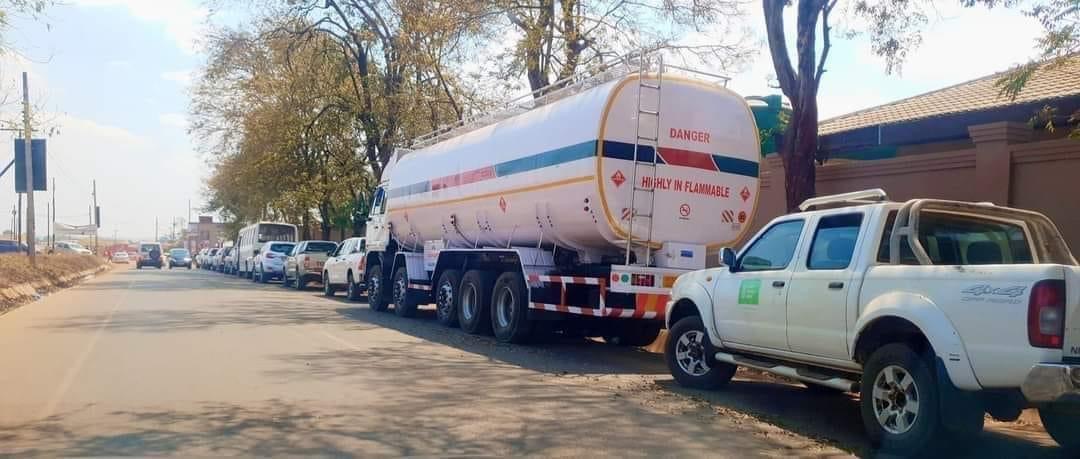
Even fuel tankers are queuing for fuel
At the centre of the storm is Energy Minister Jean Mathanga, who last week projected confidence and control. Standing before the nation, she announced that 143 fuel tankers were already in transit, with another 100 loaded and ready, bringing the total to 243 trucks expected to ease the country’s fuel shortages by Tuesday.
It was a bold, time-bound assurance—one meant to restore calm in a country where fuel is the lifeblood of daily economic activity.
But days later, the reality on the ground tells a far more complicated story.
Across Malawi, from Blantyre to Mzuzu, the expected wave of relief has been inconsistent at best—and invisible at worst. In many districts, fuel pumps remain dry. In others, supply appears briefly, only to vanish within hours, leaving behind frustration and uncertainty.
A nationwide spot check reveals a fragmented picture:
In the Southern Region, districts like Phalombe and Mulanje remain largely paralyzed, with Mangochi reporting only 3 out of 11 stations operational.
In the Centre, Lilongwe shows occasional supply, but areas such as Kasungu and Nkhotakota continue to struggle.
In the North, Mzuzu has seen some improvement, but Karonga reportedly depends on a single functioning station.
This uneven pattern has reinforced concerns raised by the Petroleum Retailers Association of Malawi (Pram), whose chairperson Happy Jere offers a far more pessimistic assessment.
According to Jere, the crisis is far from over—and may, in fact, be structurally mismanaged.
“There is a glaring imbalance,” he said. “Cities are being prioritised, while districts are left to wither. Some filling stations haven’t seen fuel for weeks.”
His remarks strike at the heart of the growing confusion: while government points to incoming supply, retailers on the ground are questioning where that supply is actually going.
For many operators, the numbers simply do not match reality.
“How do you explain 243 tankers on paper when stations have recorded zero deliveries since April 1?” Jere asked, highlighting districts such as Phalombe, Kasungu, Nkhotakota, and Mzimba as epicentres of the shortage.
Yet even amid the frustration, there are cautious signs of optimism.
The Malawi Energy Regulatory Authority (Mera), through spokesperson Fitina Khonje, acknowledges that supply has not yet met national demand—but insists that inflows are improving.
“Fuel is coming into the country, and distribution has registered noticeable improvement since the beginning of the week,” Khonje said, while urging patience as stakeholders work to stabilise supply.
Further reinforcing this guarded optimism is the Transporters Association of Malawi (TAM), which says at least 100 additional tankers are en route through regional ports such as Tanga, Beira, and Nacala—raising hopes that relief may still materialise in the coming days.
But on the streets, patience is wearing thin.
For ordinary Malawians, the crisis has evolved beyond inconvenience into economic strain. Transport costs are rising, businesses are stalling, and daily life is increasingly unpredictable.
Consumer rights advocate John Kapito warns that the bigger risk now is not just fuel scarcity—but a collapse of public trust.
“When authorities give a specific timeline and fail to deliver, people lose confidence completely,” he said. “Silence after missed deadlines only deepens the crisis.”
That silence has become a key part of the problem. Efforts to get updated clarification from Minister Mathanga have gone unanswered, leaving a vacuum filled by speculation, frustration, and conflicting narratives.
And so, Malawi finds itself in a strange and uneasy middle ground:
Government insists fuel is coming.
Regulators say supply is improving.
Transporters promise more deliveries.
But retailers report empty tanks.
And citizens see little change.
It is this gap—between promise and lived reality—that defines the current fuel crisis.
The 243 tankers, once a symbol of imminent relief, have instead become a symbol of uncertainty. Not necessarily proof of failure—but of a system struggling to communicate clearly, distribute fairly, and deliver consistently.
Until those three things align, the queues may shorten—but the confusion will remain.