

Ban First, Build Later: Malawi’s 89% lesson
Malawi banned raw mineral exports to capture more value. It lost almost all its mining revenue instead.
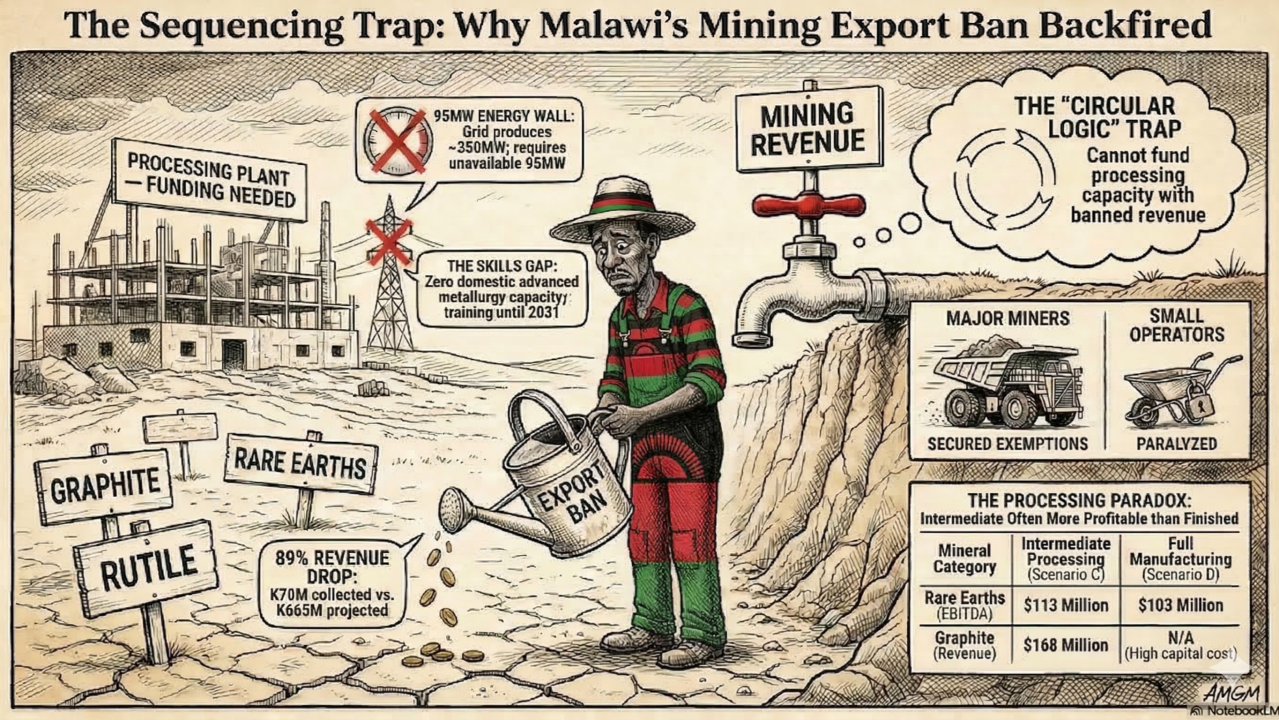
In October 2025 Malawi’s president signed Executive Order No. 2, banning the export of all raw, unprocessed minerals. The stated aim was to force domestic processing and capture more value. Within months mining revenue fell 89%. The government collected K70 million against a projected K665 million. The country that wanted to earn more from its minerals ended up earning almost nothing.
The collapse was not caused by a market downturn. It was caused by the ban itself. Malawi has no commercial-scale mineral processing facilities, no metallurgical training programmes, and a national grid that generates roughly 350 megawatts of reliable power for 20 million people. When the ban took effect, miners had nowhere to sell domestically and could not sell abroad. Revenue did not shift from one pocket to another. It vanished.
The geological case for the ban
The ambition behind the ban was not irrational. Malawi hosts the world’s largest natural rutile deposit and second-largest flake graphite deposit at Kasiya, where Rio Tinto holds a 19.9% stake. Lindian Resources is building the Kangankunde rare earth mine, one of the richest outside China, targeting first production in November 2026. Globe Metals’ Kanyika project would be the first major new niobium source outside Brazil in half a century.
The value multiplication from processing these minerals is real. Flake graphite concentrate sells for $600–900 per tonne. Coated spherical purified graphite, the material inside lithium-ion battery anodes, commands $7,000–10,000. That is a tenfold increase in value from a single processing step. Economic modelling of four processing scenarios per mineral shows selective beneficiation could push mining revenue past $1 billion annually by 2035. The geological case is strong.
Geopolitics sharpens the opportunity. China controls roughly 74% of the global graphite anode supply chain and over 90% of rare earth refining. The United States has imposed combined tariffs exceeding 200% on Chinese graphite. The EU’s Battery Regulation rewards low-carbon, non-Chinese supply. Malawi’s deposits, powered by hydroelectricity and solar, could qualify for premiums that Chinese competitors cannot access.
The sequencing trap
Yet the gap between geological promise and industrial reality is vast. Four constraints block the path. The first is power. Processing graphite to spherical form and separating rare earth oxides requires roughly 14 megawatts of continuous electricity. Feasible. Processing rutile into titanium sponge requires an additional 95 megawatts. Not feasible. Malawi’s grid cannot supply it before 2035.
The second is skills. The country has zero capacity in spherical graphite shaping, rare earth solvent extraction, or battery-grade chemistry. Its universities offer no such programmes. The proposed national training institute would take four years to build and produce its first graduates in 2031. Until then, any processing plant would depend entirely on expatriate engineers.
The third is capital. Building processing infrastructure requires $3.2–4.5 billion over a decade. The government’s current annual mining budget is $12 million. Development finance institutions hold framework agreements but have not committed funds.
The fourth is the ban’s own circular logic. You cannot fund processing capacity without mining revenue. You cannot earn mining revenue while banning exports.
Lessons from elsewhere
Malawian officials cite Indonesia’s nickel export ban as the model. The comparison is instructive, though not in the way they intend. Indonesia’s ban attracted roughly $14 billion in smelter investment. But Indonesia had cheap coal power, deep-water ports, and 275 million domestic consumers. Chinese firms built the smelters and now control approximately 75% of capacity. Environmental damage in Sulawesi has drawn international condemnation. And poverty in nickel-producing districts has risen even as output surged. Malawi has none of Indonesia’s preconditions.
The Zambia-DRC battery materials hub offers a blunter warning. The two countries signed a trilateral agreement with the United States in 2022 to build an EV battery value chain. Three years later, the feasibility study’s status is uncertain, the countries dispute the plant’s location, and no facility exists. Ambition without infrastructure produces announcements, not factories.
The buried finding
The most striking result in Malawi’s own economic modelling is one that policymakers have not yet absorbed. Maximum processing does not maximise revenue. For rare earths, intermediate processing (separated oxides) generates $113 million in annual operating profit. Full processing into finished magnets generates $103 million. The additional capital, technology licensing, and operating costs eat into the higher unit price. For rutile, any processing beyond concentration is infeasible until the power deficit resolves.
The optimal strategy is selective: process graphite and rare earths where the economics work, export rutile and niobium as concentrates where they do not, and use royalty income to fund the infrastructure that enables deeper processing in future decades.
The messy retreat
Malawi’s government has already begun adjusting. Lindian Resources and Sovereign Metals received formal exemptions from the ban. Major miners can ship concentrate. Smaller operators cannot. The result is a two-tier system that rewards political access over industrial logic.
A more honest approach would replace the blanket ban with a graduated export tax that rises over time, paired with processing incentives funded from the tax revenue. Botswana followed this path with diamonds, spending decades negotiating progressively better terms with De Beers before establishing a cutting industry in Gaborone. It was slow, patient, and ultimately effective. It also required something Malawi’s executive order did not: a willingness to earn revenue from raw exports while building the capacity to process them.
Malawi’s minerals are real. Its ambitions are rational. But ambition without capacity is not a strategy. It is a wish. And the 89% lesson is plain: you cannot water the field if you have turned off the tap.