

Exports in Free Fall: Malawi Squanders Up to 70% of Produce Potential as Trade Deficit Deepens
Malawi’s agricultural export sector is not just stagnating—it is bleeding.
Fresh figures from the Malawi Investment and Trade Centre (Mitc) expose a brutal reality: the country is failing to convert its most common crops into foreign exchange, leaving tens of billions of kwacha on the table while the trade deficit spirals out of control.
According to Mitc’s Export Map, Malawi is failing to exploit up to 70 percent of its export potential in key legumes and oilseeds—products that farmers grow every season and global markets actively demand.
Soya bean oilseed cake, one of Malawi’s flagship export products, has an estimated export potential of $103 million (K180 billion). Yet the country is only managing to export $33 million—just 28 percent of what is possible. A staggering 72 percent, equivalent to $74 million (K130 billion), is simply lost.
Legumes paint a similarly grim picture. Out of a potential $99 million (K173 billion), Malawi is exporting only $49 million, meaning half of the market—51 percent or $50 million (K88 billion)—remains untapped.
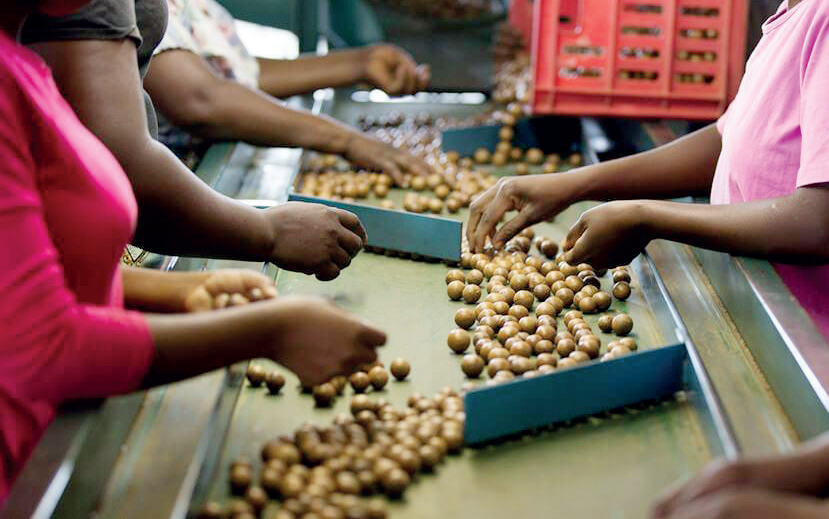
Even macadamia nuts, often showcased as a success story, reveal cracks beneath the surface. While utilisation is relatively higher at 72 percent, Malawi is still failing to realise 28 percent of its $22 million (K39 billion) potential. China alone could absorb an extra $1.6 million (K2.8 billion) worth of macadamia exports—if Malawi could supply consistently.
Industry players say the problem is not demand—it is policy incoherence.
Grain Traders Association of Malawi president Grace Mijiga Mhango points directly at government action as a key constraint.
“At times soya is highly demanded internationally, contracts are signed, then suddenly an export ban is imposed. That kills credibility and confidence,” she said.
The result is predictable: buyers look elsewhere, Malawi earns nothing, and farmers remain trapped in low-income cycles.
At a regional level, Comesa Business Council president James Chimwaza says Malawi is stuck exporting raw produce—if at all.
“Lack of first-level value addition is crippling us. Without processing, technology and aggregation, we cannot meet volume and quality standards,” he said.
Former Mitc chief executive officer and economist Paul Kwengwere agrees, pointing to chronic production and capacity constraints.
“Malawi receives orders but fails to meet demand. Production deficiencies and lack of value addition keep actual exports far below potential,” he said.
The failure to exploit export potential is now hitting the macroeconomic bottom line hard.
Reserve Bank of Malawi data show that in the 11 months to November, exports fell by 0.8 percent, dropping from $882.8 million in 2024 to $875.4 million this year.
Imports, meanwhile, surged by 12.4 percent, rising from $2.91 billion to $3.27 billion.
The result: Malawi’s trade deficit ballooned by 20 percent, jumping from $2 billion to $2.4 billion (K4.2 trillion) in just one year.
All this is happening despite the launch of the National Export Strategy II in 2021, which promised export competitiveness, regional market penetration and import substitution.
Four years on, the figures suggest the strategy is failing to bite.
With massive unrealised export potential, shrinking exports, rising imports and erratic policy signals, Malawi’s export sector is not facing a temporary slowdown—it is trapped in a structural crisis.
Until production capacity, value addition and policy discipline are fixed, Malawi will continue exporting poverty instead of products, and importing inflation instead of prosperity.
Follow and Subscribe Nyasa TV :