

Law experts censor Malawi’s Attorney General Kaphale on media quotes
Malawi’s former Attorney General (AG) Ralph Kasambara, SC, has censored incumbent government chieg legal advisor Kalekeni Kaphale for taking a political stand in his comment on the injunction Judge Kenyatta Nyirenda granted to the Human Rights Defenders Coalition (HRDC) stopping government from implementing a 21-day lockdown.
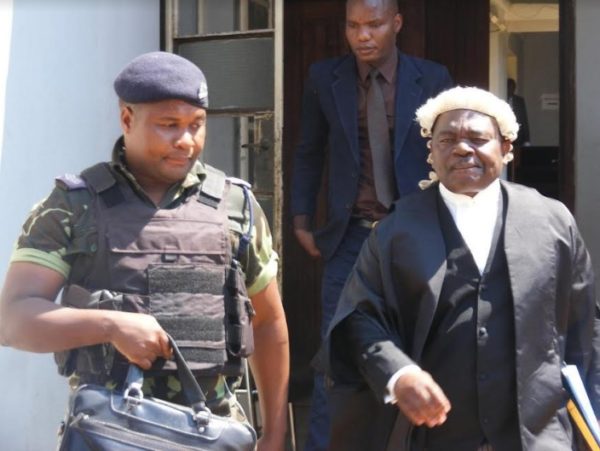
Kaphale is quoted that if coronavirus diseases (COVID-19) pandemic accelerated in the seven days given, the nation would know who to blame, which could be construed to refer to Judiciary and HRDC.
But Kasambara, who is also former Minister of Justice and Constitutional Affairs, said Kaphale’s statement demonstrates that constitutional litigation is not only about law, but also politics.
“It involves making political choices at both micro and macro level. And this is not surprising given the political contents of the Constitution itself. Second, human rights issues are not always easy to balance. The right to govern by the politician ends at the gate of individual liberties. In this case, public health measures by government must, in the first place, meet constitutional rule-making procedures and human rights standards,” argues the former AG.
Kasambara argues that if public officials or government agents rush to pass and or implement public measures without following the rule of law all in the name of containing the COVID-19 pandemic, they will have themselves to blame and not the judiciary.
He further schools Kaphale on the role of the judiciary in the administration of justice. Kasambara says the judiciary is merely a neutral referee whose noble duty is to see whether government and/or citizens are complying with or acting in accordance with the agreed upon rules of the game, i.e. the Constitution.
“Malawi is not an exceptional case. Elsewhere, COVID-19 measures are being challenged where there are too intrusive of citizens’ rights. For instance, in Croatia, the Constitutional Court there has held that recent public health measures by the officials were unconstitutional,” he says.
Kasambara warns that unchecked or unbridled exercise of powers by public officials masquerading as exercise of emergency powers to protect lives may actually lead to destruction of many more public lives.
He says this is the point demonstrators were making last Friday when the litigants in this case were in court applying for injunction.
“Indeed if unchecked, these public emergency powers may be the beginning of tyranny. Hence the need to wean any arbitrary wielding of state powers at the earliest opportunity. You recall the wise words of Lord Atkin in Liversidge v Anderson. They still hold truth about 100 years later,” stresses Kasambara.
He says the fight against COVID-19 requires a holistic approach by seeking consultation and participation in rule-making process as a prerequisite to the validity, legitimacy and acceptability of public health measures.
“Parliament need to be summoned as soon as possible. The court already advised on the need to amend or enact new public health legislation that will anchor the sought public health measures. By the way, where are we on this exercise?”
“By the way, the State President is at liberty to summon most former AGs to advise him on appropriate legal measures the State can take to combat Covid 19 as they are Senior Counsel and took an oath to be available for such noble task. So, to my good friend AG, here is the warrant for blame game: blame it on collective wisdom of former AGs and SCs on your next step, but not statements in the media. Wakusina khutu ndi nnasi…Kauzyanga ni fwiti yayi,” concludes Kasambara.
On the other hand, Dean of Law at the Chancellor College , Sunduzwayo Madise, also defends the Judiciary for granting HRDC an injunction, saying the Court was only playing its role as a neutral referee.
Madise says in the case at hand, the court gave the applicants leave to move for judicial review.
“Judicial review is a special type of legal proceeding in which the State calls on one or several of its organs to explain themselves following a complaint by an applicant or applicants in the manner that the organ has exercised its power. The review is therefore of the decision or exercise of power by the state or public organ,” he says.
Follow and Subscribe Nyasa TV :