

Malawi pioneers use of drones to save lives: HIV early infant Diagnosis
Malawi has become the first country on the continent to test flight the use of Unmanned Aerial Vehicles (UAVs or Drones) for improvement of HIV services having being used in the past for surveillance and assessments of disaster.

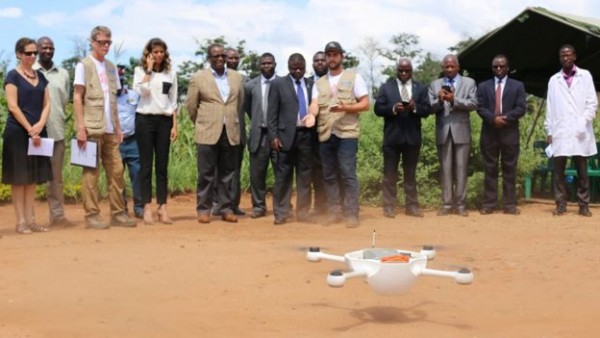
The government and UNICEF started testing the use of UAVs on Monday to explore cost effective ways of reducing waiting times for HIV testing infants.
The test, which is using simulated samples, will have the potential to cut waiting times drastically, and if successful will be integrated into the health system alongside other mechanisms such as road transport and SMS.
Minister of Health Peter Kumpalume said Malawi government is committed to the prevention of mother to child transmission of HIV.
He compares the launch to his days as a young boy flying toy planes fashioned from maize husks. He is not worried about safety, but does acknowledge that there are cost issues.
“Malawi has pioneered a number of innovations in the delivery of HIV services including Option B+ policy which puts mothers on a simple lifelong treatment regime. We have also pioneered the delivery of results from the central laboratory to health facilities through text messages.
We believe our partnering with UNICEF to test UAVs is another innovation and will help in our drive to achieve the country’s goals in HIV prevention,” the Minister stated.
“It’s specialist testing we do for youngsters. If you delay giving them treatment most of them don’t live beyond two years old,” said Kumpalume.
The first successful test flight completed the 10km route unhindered travelling from area 25 community health centre to Kamuzu Central Hospital laboratory and local residents gathered in amazement as the vehicle took off and flew away in the direction of the hospital.
Mahimbo Mdoe, UNICEF Representative to Malawi said HIV was still a barrier to development in Malawi, and every year around 10, 000 children die of HIV.
“This innovation could be a breakthrough in overcoming transport challenges and associated delays experienced by health workers in remote areas of Malawi.
“In 2014, nearly 40, 000 children in Malawi were born to HIV positive mothers. Quality care of these children depends on early diagnosis, which requires taking dried blood samples from health centre to central laboratory for testing.
“We hope that UAVs can be part of the solution to reduce transportation time as ensure that children who need it, start treatment early,” said Mdoe.
According to Mdoe, the test flights are assessing viability including cost and safety, will continue until Friday 18th March.
The UNICEF Representative further expressed gratefulness to Ministries of Health, Transport with civil aviation and defense for being supportive partners throughout the inception phase.
The UAVs are supported by US Company, Mannernet, who created the UAV being used in the test, designed exclusively for transportation. After the test flights, the cost comparison with road transport will be done, and if favorable, the second phase will carry out tests flights from remote areas in the country.
Samples are currently transported by road, either by motorbikes or local ambulances. Various factors including the high cost of diesel fuel, poor state of roads and limited distribution schedules have resulted in extreme delays in lab sample transport, constituting a significant impediment for scaling up paediatric ART’s effectiveness.
The experiment is still in its early phase.
The tests over the next week will measure the drone’s performance with differing winds speeds, humidity and distance, and if the results prove positive, the experiment will be expanded.
Follow and Subscribe Nyasa TV :