Malawi’s mining sector is facing a serious productivity crisis due to persistent electricity shortages, with government warning that continued power instability could stall industrial growth and undermine economic recovery.
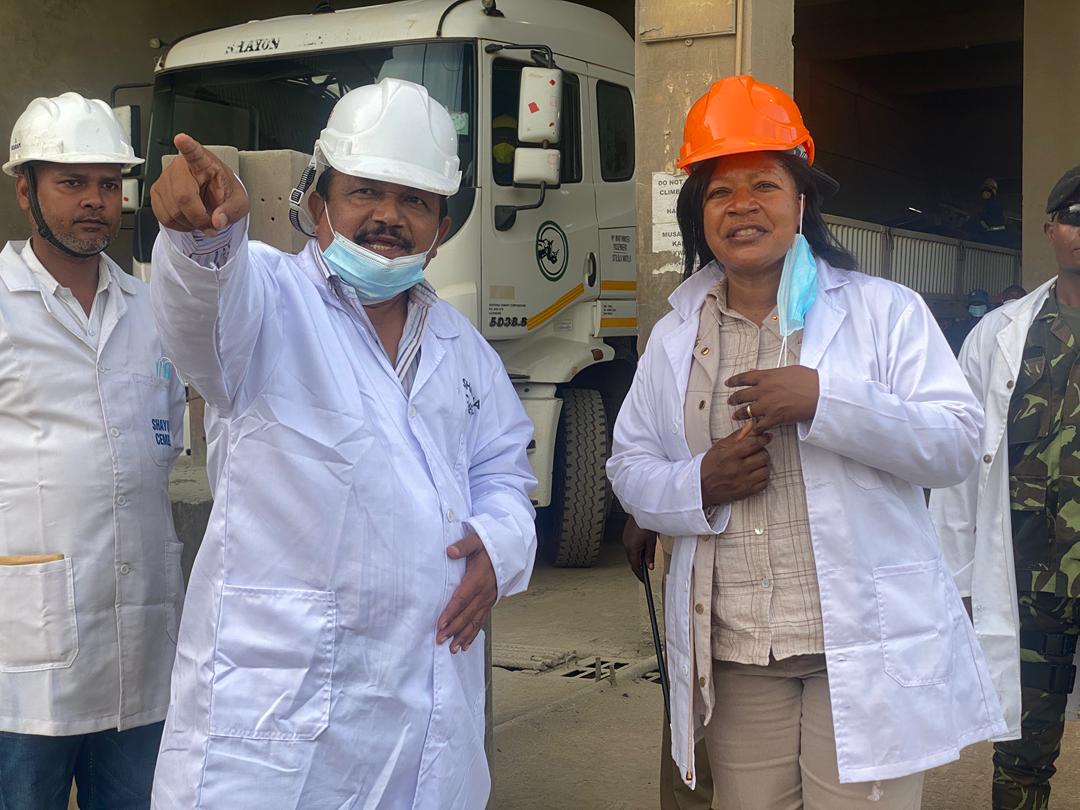
Minister Jean Mathanga and officials from Shayona Cement
Minister of Energy and Mining, Dr. Jean Mathanga, sounded the alarm on Thursday during a tour of Shayona Cement Company in Kasungu District, as part of a wider Ministry assessment of mining and heavy industry operations across the country.
Dr. Mathanga admitted that unreliable power supply from the Electricity Supply Corporation of Malawi (ESCOM) has become one of the biggest constraints facing the sector, forcing companies to operate below capacity, delay production and absorb rising operational costs.
“Unstable electricity is directly affecting output in mining and manufacturing. If this challenge is not urgently addressed, it will continue to slow down industrialisation and reduce Malawi’s competitiveness,” she said.
However, the Minister announced that the government has secured European Union funding for a major electricity transmission upgrade, which she described as a potential game-changer for industry.
She revealed that government will soon contract the construction of a new high-capacity transmission line known as the Eastern Backbone, designed to strengthen power distribution nationwide.
“The Eastern Backbone will transmit power from the southern grid through Golomoti and Salima to the northern region. Once completed, it will stabilise supply, reduce outages and ensure industries receive reliable electricity to operate at full capacity,” Dr. Mathanga said.
She stressed that the project is not only vital for mining but central to Malawi’s broader economic recovery, linking reliable power to increased production, exports, job creation and foreign investment.
At company level, Shayona Cement Human Resources and Administration Manager, Austin Mvula, confirmed that power disruptions remain a major operational threat.
“There are times when production has to completely stop because of inadequate electricity. Stable power is critical if companies like ours are to expand, create more jobs and contribute meaningfully to national development,” Mvula said.
Meanwhile, Kasungu District Council Chairperson, Nefutali Chikwanda, pointed out that poor road infrastructure is also holding back industrial growth in the district.
“If roads remain in bad condition, it affects business efficiency, safety and the local economy. Improving infrastructure is key to attracting investors and ensuring communities benefit from industrial development,” he said.
As government prepares to roll out the EU-backed transmission project, the mining and manufacturing sectors are watching closely, hoping the long-awaited power reforms will finally turn chronic electricity shortages from a national liability into a catalyst for sustainable economic growth.