

‘More needs to be done’: EU envoy to Malawi one-on-one with Tenthani
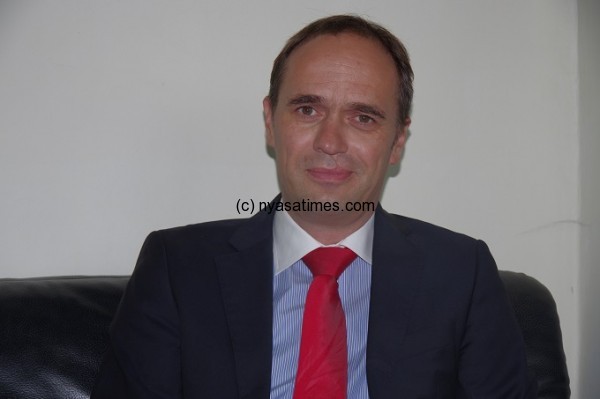
There is a new man at the helm of the European Union Delegation to Malawi. He is Marchel Gerrmann, a Dutch national. Gerrmann, who is also the Ambassador of the EU, comes at a time Western donor nations and agencies have suspended budgetary support to Malawi in reaction to ‘cashgate’, the systematic plunder of public resources where politicians and businessmen connived with civil servants to make payments for goods and services not rendered to government. At least K24 billion was skimmed from the government payment system. Journalist Raphael Tenthani engages the new EU man on ‘cashgate’ and related issues. Excerpts:
Your Excellency, first all can you give me a brief background of yourself?
On the personal front, I am married with three children — all boys. Two are studying at university in The Netherlands and the youngest is with me here in Malawi.
On the professional front, after completing my Masters in Economics, I joined the Dutch Foreign Service. I have had two postings, in Kenya and Zimbabwe. I was seconded to the EU as Ambassador and Head of Delegation in Eritrea in 2012. I arrived in Malawi at the beginning of September 2014 and I’m very happily settled here with my wife and son. I am impressed with the warm welcome and the beauty of the country. Malawi truly comes across as the ‘Warm Heart of Africa.
You’re coming in when Western donor nations and agencies, including the EU, have suspended budgetary support to Malawi pending improvements in government finance management system. What is your assessment of the measures government has already taken?
‘Cashgate’ unveiled significant structural weaknesses in the Public Financial Management (PFM) systems. The nature and the extent of the misappropriation of public funds called for a fundamental and genuine turn around in PFM to restore sound management of public finances.
It is important to acknowledge that measures have been taken to rectify some of the failures in the immediate aftermath of ‘cashgate’. It is also commendable that the new government has declared ‘zero-tolerance to corruption’ and expressed commitment to implementing the necessary reforms of public finance management as well as the modernisation of the public sector service. In this respect, I also acknowledge that the Minister of Finance is dedicated to enforcing better control over the execution of the budget. We also welcome progress in investigations and prosecution of cases.
At the same time, it is also important to acknowledge that more is needed to restore confidence in the PFM systems. We are collaborating closely with the Government of Malawi and, in particular, the Minister of Finance to address those issues.
What exactly are the expectations of the EU regarding the reform of national systems?
Let me start by saying that I agree with the Government of Malawi when it says that reforms of the national systems are needed, not because the donors want that, but because it will be beneficial to Malawi and its people. In this respect, the current lively debate and media focus on corruption are reflecting the concerns of many Malawians and is a positive side-effect of ‘cashgate’.
In terms of our expectations, we expect to work with the Government of Malawi to operate a system in a way that basic checks and balances can be ensured. Let me give you an example: one of the key requirements for a robust payment system is that funds cannot be committed outside the budget. Another example is that the money reaches the intended beneficiaries in a cost-efficient manner. In that vein, transparency on procurement processes, like major purchases of maize and procurements under the Farm Input Subsidy Programme (Fisp), is of course paramount.
How soon can we expect resumption of aid from the EU?
First of all, let me emphasise that budget support is just one of the modes of aid delivery and represents only a part of our total development assistance to Malawi.
While the budget support payments have been temporarily suspended, all other aid — mostly through projects and technical assistance — has been delivered as planned. In 2013, the EU Delegation disbursed €80 million in the frame-work of common EU Development Assistance Programmes. Furthermore, looking forward, the projected envelop for 2014-2020 is close to €800 million.
In terms of resumption of budget support, we will be able to resume the two on-going budget support programmes as soon as circumstances allow. This will be the case once there is sufficient progress in implementation of PFM reforms and of course a conducive macro-economic framework in place.
Recently there have been changes in leadership at the European Commission in Brussels. With such changes, should we also expect policy changes vis-à-vis the EU’s relationship with the developing world?
EU’s external policies, including development cooperation and assistance, are enshrined in a number of strategic documents. These set out the objectives, methods and means of implementation over a long term and commit the EU institutions, including the European Commission, over a longer term. The recently appointed leadership of the EU’s executive arm will be bound by the strategic guidelines and agreements, so the cornerstones of our partnership and cooperation with the developing countries will be respected.
However, the new leadership has vowed to give due respect to the expectations of its constituency, the EU tax-payers, to deliver aid according to the principles of good financial management and with assurances that resources are used for the intended purpose. In this respect, we may expect that the levels of scrutiny into the provision of development assistance in general and budget support in particular will remain high.
Lastly, back to the aid suspension; don’t you think such measures only succeed in hurting the poor who are already victims of the very resource plunder you’re punishing government for?
I am glad you are asking this important question. First and foremost, development partners are not responsible for ‘cashgate’ and its consequences. I also want to emphasise that the EU continues most of its programmes, only the budget support operations, which represents a relatively minor part of our overall effort, are suspended.
And in the few months that I have been here, I could already see first-hand the difference our programmes make to the lives of many people in particular in the rural areas. Let me give you a few examples: we help to rehabilitate 600 kilometres of rural roads a year and, by doing so, we are employing thousands of Malawians; by next year we will have provided safe-drinking water for more than 400,000 people and provided sanitation facilities to about 140,000 Malawians. We are the largest contributor to the purchase of seeds under of Fisp. I could go on.
Just as a final remark, ordinary Malawians are very likely to gain most from an improvement of the PFM systems and the rooting out of corruption as it will increase funds available for public services such as education and public health. In addition, it will increase investor confidence leading to more investment, jobs et cetera.
If the suspension of budget support can contribute to more reliable public finances, with no corruption and minimal leakages of taxpayers’ money, then this is clearly in the interest of the whole of Malawi, and especially the poor.
Follow and Subscribe Nyasa TV :