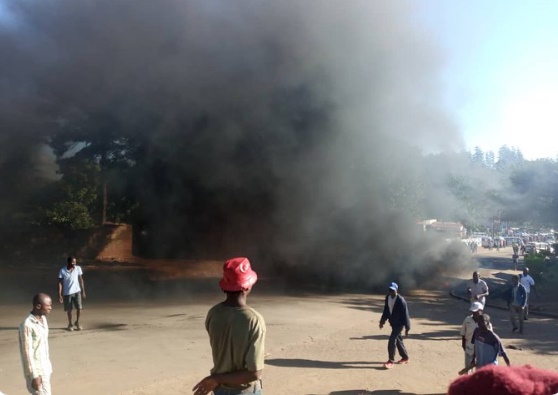
Just a day after police fired teargas to flush vendors from the streets of Lilongwe, traders were back in the same spots, laying out their goods as if nothing had happened.
Lilongwe vendor
The scenes on Wednesday morning were a repeat of what city authorities have been trying to stop for months: vendors occupying pavements, road reserves and busy junctions, particularly around Bwalo la Njobvu, one of the city’s main trading hotspots.
On Tuesday, the area had turned into a battlefield after police moved in to enforce a city council directive ordering all vendors to relocate to designated markets. Running battles followed, with police using teargas to disperse traders who resisted the operation.
But the crackdown proved short-lived.
By the next day, vendors had returned in large numbers, exposing the deep-rooted and seemingly unsolvable problem of informal street vending in Malawi’s capital.
For more than four months, the Lilongwe City Council, under Mayor Peter Alex Banda, has been holding meetings and engagements with vendors, urging them to move to officially recognised markets. The council argues that the vendors are operating illegally and creating serious problems for the city.
According to the authorities, the continued occupation of restricted areas has disrupted traffic flow, blocked pedestrians, worsened sanitation and increased safety risks in already congested parts of the city.
“These spaces are not meant for trading. They affect order, cleanliness and the free movement of people,” the council has repeatedly said.
However, for the vendors, the issue is not about defiance but survival.
Many argue that designated markets are either too far from customers, poorly located, or lack basic infrastructure. Others say the markets are already overcrowded and cannot absorb more traders. As a result, they return to the streets where business is guaranteed.
The standoff highlights a deeper structural problem: Lilongwe’s economy cannot absorb thousands of informal traders into formal systems, yet the city has no workable long-term plan for managing them.
Mayor Banda has made it clear that enforcement will continue, warning that police may keep using teargas if vendors refuse to relocate. But the rapid return of vendors after the operation raises serious questions about the effectiveness of force as a solution.
Critics argue that repeated crackdowns without addressing the economic realities only create a cycle of confrontation, where vendors are chased today and return tomorrow.
What is playing out in Lilongwe is not just a law enforcement issue, but a reflection of unemployment, urban poverty and the failure of the city’s planning systems to keep pace with population growth.
Until authorities address where people will actually earn a living — not just where they are allowed to sell — street vending in Lilongwe is likely to remain a permanent feature, no matter how much teargas is used.